Truecaller and Telna Push Embedded Travel eSIMs Forward
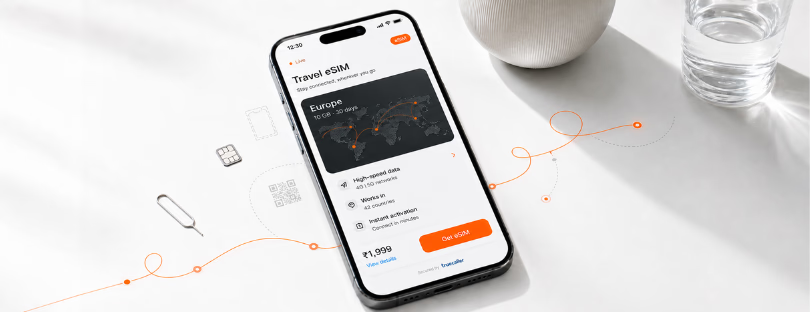
Last month, Alertify covered Truecaller’s move into travel eSIMs as a signal that mobile trust brands are starting to treat connectivity as an adjacent service, not a telecom side quest. The launch was notable because Truecaller is not a classic travel eSIM app. It is a caller ID, spam protection and communication platform with a huge existing user base.
Now we know more about the infrastructure behind that move: Telna has been selected as Truecaller’s exclusive global connectivity partner for the new in-app travel eSIM service. This is no longer only about Truecaller entering travel eSIMs. It is about how quickly large consumer apps can add connectivity when the telecom layer is already packaged as an API.
Through Telna’s platform, Truecaller can offer mobile data access in more than 190 countries, while the service itself is currently available in more than 30 purchase markets across Europe, North America, Africa and Asia-Pacific. Truecaller’s earlier launch announcement listed 29 initial markets, including the US, UK, Germany, France, Italy, Sweden, Australia, Canada, Malaysia, South Africa and Nigeria.
Telna underneath
Telna is not just selling Truecaller a data plan catalogue. It is giving the company access to a multi-network platform, carrier relationships, provisioning capability and the operational machinery needed to make travel eSIM work inside another brand’s app. According to Telna, the company distributes more than five million eSIMs every month and carries close to 5% of global roaming traffic.
For Truecaller, that means speed. It can test a new revenue layer without building telecom infrastructure, negotiating every carrier relationship itself, or hiring a full roaming operations team. For users, the pitch is simpler: buy and activate travel data inside an app they already know.
“Our users travel constantly, and staying connected abroad is a natural extension of the services they rely on. By working with Telna, we can offer international connectivity directly inside the app people already trust,” said Truecaller chief operating officer Fredrik Kjell. “Travel connectivity represents another valuable service.”
Gregory Gundelfinger, founder and CEO of Telna, framed the same point from the infrastructure side:
“Truecaller wanted to bring travel connectivity directly into its app, not embark on a multi-year telecom project. By combining its customer reach and trusted brand with Telna’s network infrastructure, carrier relationships and eSIM platform, we enabled the company to launch a seamless connectivity experience in weeks rather than years.”
That “weeks rather than years” line is the real signal. A few years ago, launching global connectivity looked like a telecom project. Today, for the right digital brand, it can look more like a product integration. Failed activations, refunds, network quality, device compatibility and support remain very real operational problems. But the commercial wrapper is becoming much easier to launch.
Your customers will buy connectivity. The question is: from you, or from someone else?
We help airlines, banks, and travel platforms turn that demand into a built-in product — not a missed opportunity.
The fund signal
This is also where Telna’s new investment push becomes relevant. Earlier this year, Telna announced a $100 million fund focused on digital-first travel eSIM brands, MVNOs, regional connectivity platforms and super app enablement partners. Telna’s Growth Venture says it is looking at minority strategic investments in travel eSIM MVNOs, regional platforms and super app partners, while allowing founders to remain operationally independent.
That tells us where Telna thinks the market is going. It is not only backing travel eSIM apps that sell directly to consumers. It is backing the companies that can turn connectivity into a feature inside bigger digital ecosystems.
READ MORE: Booking Platforms Monetized Flights and Stays. Connectivity Is Next
Kaleido Intelligence has been pointing in the same direction. Its research forecast the global travel eSIM market to be worth close to $10 billion in 2028 and to account for more than 80% of total travel SIM spend by then. Kaleido’s MWC 2026 analysis also described travel connectivity as a strategic battleground involving operators, aggregators, infrastructure vendors, super apps, travel platforms and device manufacturers.
Truecaller fits neatly into that map. So does Viber, which Kaleido highlighted as another communications platform moving closer to the connectivity layer. Banks, airlines, booking platforms, fintech apps, and security brands are watching the same opportunity: if you already have the user’s attention before or during a trip, why send the user elsewhere for mobile data?
Not for everyone
This does not mean every traveller should buy connectivity from a super app. Dedicated eSIM providers such as Airalo, Holafly, Ubigi, Yesim, Nomad eSIM, Saily and GigSky still have advantages in comparison shopping, plan depth, support focus or specialist positioning. Some users will still prefer a provider built entirely around travel connectivity, especially if they want unlimited data, regional bundles, transparent hotspot rules, or more control.
READ MORE: How Does Travel eSIM Work, Exactly?
The weak point for embedded eSIM offers is usually depth. If the experience is too simplified, travellers may not understand what they are buying: data-only service, validity windows, throttling, activation timing, supported devices and refund rules. Truecaller has a trust advantage, but trust can disappear quickly if a traveller lands abroad and the eSIM does not behave as expected.
That is why the Telna relationship matters. The more travel eSIMs move inside non-telecom apps, the more the invisible infrastructure becomes the product.
Final thoughts about Truecaller Telna travel eSIM
This partnership is not just about Truecaller adding one more feature. It shows how the next phase of travel eSIM may be won by companies that combine trusted consumer distribution, API-led connectivity infrastructure and enough operational discipline to handle the messy parts after purchase.
For travellers, that could mean fewer separate apps and more convenient connectivity when they need it. For the industry, it raises a sharper question: if caller ID apps, messaging platforms, banks and travel brands can all sell mobile data, where does the travel eSIM brand really live?
The answer may be less romantic than the market wants, but more useful. The winning brand may not always be the one with the cheapest gigabyte. It may be the one already in the traveller’s hand before roaming anxiety begins.