Booking Platforms Monetized Flights and Stays. Connectivity Is Next
For years, booking platforms mastered one thing better than almost anyone else on the internet: monetizing intent.
You book a flight to Tokyo, and suddenly you are offered airport transfers, hotel upgrades, lounge access, insurance, local experiences, rental cars, and even restaurant reservations before your boarding pass hits your inbox. Travel platforms became extraordinarily good at identifying the exact moment when travelers are already psychologically ready to spend.
Now another product is quietly sliding into that ecosystem: connectivity.
Not as an afterthought. Not as a “buy a SIM card later” banner buried in a confirmation email. But as a real revenue layer.
And honestly, it was inevitable.
Because the moment a traveler lands in another country, mobile data becomes infrastructure. Google Maps, WhatsApp, Uber, airline apps, digital tickets, QR menus, banking verification, translation tools, and hotel check-ins. Connectivity now sits much closer to necessity than convenience.
That changes the economics completely.
Travel Platforms Already Own Distribution
This is the part that many telecom companies still underestimate.
Most booking platforms do not need to build audiences anymore. They already have them. Massive ones.
The difficult part of telecom is no longer only the eSIM itself. Provisioning is becoming more standardized. APIs exist. Global connectivity access is easier than it was even three years ago.
Distribution is the real moat now.
Booking platforms, airlines, OTAs, fintech travel apps, loyalty ecosystems, hotel chains, and even airport apps already control the highest-intent moment in travel: the period between booking and departure.
READ MORE: How to Launch Your Own eSIM Product?
That is exactly why embedded connectivity has become so attractive.
A traveler booking a flight from Paris to Bangkok is infinitely more valuable than a random user searching “Thailand eSIM” on Google at midnight.
The intent already exists. The destination is known. Travel duration is often known. In some cases, spending profile, loyalty status, and travel frequency are known too.
That makes connectivity one of the easiest additional revenue layers travel companies can add.
And unlike insurance or generic upsells that travelers often ignore, mobile data solves an immediate pain point people genuinely care about.

Airlines Are Sitting on a Telecom Goldmine
The airline angle is especially interesting.
For years, airlines focused on ancillary revenue around seats, baggage, priority boarding, onboard purchases, and loyalty products. IATA expects ancillary services to generate $145 billion in 2025, equal to 14.4% of total airline revenue, which shows how important add-ons have become to aviation economics. embedded eSIM for travel platforms
But eSIM changes the equation because it extends monetization beyond the aircraft itself.
The boarding pass is quietly becoming a distribution channel.
READ MORE: Yesim Virtual Numbers for Business: Simple, Scalable Communication
A traveler checks into a flight. The airline already knows the route, timing, destination, and customer profile. Offering a local, regional, or global eSIM at that exact moment feels surprisingly natural.
The economics make sense.
Connectivity can be a high-intent digital product with low operational friction. There is no physical stock, no airport kiosk, no plastic SIM, no shipping issue. The customer buys, installs, and lands connected.
More importantly, connectivity improves customer experience in ways baggage upsells never could.
Nobody remembers paying extra for priority boarding with affection.
But people absolutely remember whether they could open Google Maps immediately after landing.
Why APIs Changed Everything
This shift would not be happening without API-based infrastructure.
A few years ago, integrating telecom products into a non-telecom platform was painful, slow, and operationally messy. Today, the model looks completely different.
Providers increasingly expose connectivity through APIs that allow travel brands, apps, fintechs, OTAs, and marketplaces to launch branded eSIM offerings without becoming telecom operators themselves.
That is where Yesim’s Partner API stands out.
What makes Yesim interesting is not simply that it offers eSIMs. Many companies do that now. The more important point is that its Partner API is built for embedded distribution: businesses can power their website, app, or eCommerce platform with globaI eSIM products and sell connectivity under their own commercial model.
READ MORE: Yesim’s FinTech Armenia Entry Signals Bigger Shift
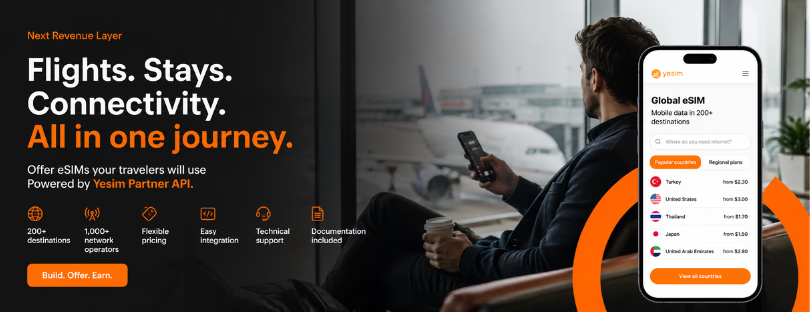
According to Yesim, the Partner API offers coverage in 200+ destinations, access to 1,000+ network operators, quick integration, flexible pricing configuration, technical support, and documentation for partners exploring API integration.
That combination matters.
A booking platform does not want a random affiliate link that sends the traveler somewhere else. It wants control: pricing, margin, user journey, branding, and customer relationship.
Flexible pricing is especially important because not every travel business will package connectivity the same way. An airline may sell it as an add-on. A hotel group may bundle it into a premium guest package. A fintech may offer it as a loyalty perk. A travel marketplace may use it as a margin-positive checkout product.
That is why Yesim’s model feels aligned with where the market is going. It is not only about selling data plans. It is about letting other businesses turn connectivity into part of their own product experience.
Connectivity Is Becoming a Platform Layer
This is bigger than travel eSIM hype.
Connectivity is gradually becoming a platform layer for digital services.
Fintech companies want users connected abroad because card usage, fraud alerts, and app-based support depend on mobile data. Airlines want smoother passenger experiences. Hotels want guests using mobile check-in and digital room access. Travel apps want uninterrupted engagement during the trip, not only before it.
In other words, connectivity improves retention, usage, and customer experience across entire ecosystems.
That changes how companies think about telecom.
Historically, connectivity was outsourced mentally to operators. Now it is becoming part of the product strategy itself.
READ MORE: Yesim B2B Strategy: API vs Enterprise Play
GSMA Intelligence has noted that travel eSIM is becoming an important growth route for consumer eSIM adoption, especially as device support improves and eSIM-only models accelerate awareness in markets like the US. Juniper Research also forecasts travel eSIM revenue to grow from $1.8 billion in 2025 to $8.7 billion by 2030, which explains why more platforms are starting to look at connectivity as a serious revenue category rather than a side widget.
The smartest players are not just selling gigabytes anymore.
They are helping other businesses monetize travel flows.
The Real Shift
The interesting thing is that this market still feels early despite all the noise around eSIM adoption.
Most travel platforms still treat connectivity as a secondary affiliate widget rather than a deeply integrated revenue stream. But that will likely change as margins tighten elsewhere.
Flights are competitive. Hotels are competitive. Advertising costs are brutal. Loyalty is fragile.
Connectivity offers something rare: a high-intent, low-friction digital product attached directly to international movement.
And unlike physical SIM logistics, eSIM scales globally almost instantly.
That is why the next wave will not be only about who has the best consumer eSIM app. It will be about who gets embedded into the places where travel decisions already happen.
Conclusion about embedded eSIM for travel platforms
The travel industry spent the last decade monetizing movement itself: flights, rooms, baggage, experiences, insurance, upgrades.
The next phase is monetizing digital mobility.
And the companies most likely to win are not necessarily the loudest consumer eSIM brands. They are the infrastructure-focused players helping travel platforms embed connectivity directly into existing ecosystems.
That is why the API layer matters now.
Compared with traditional travel eSIM providers still relying heavily on SEO and direct acquisition, infrastructure-oriented players are positioning themselves much closer to where long-term value is forming: inside airline checkouts, hotel ecosystems, fintech apps, and travel platforms.
Yesim is interesting because it already operates across both layers: consumer-facing eSIM products and scalable partner infrastructure.
That combination matters more than most people think.
Because eventually, travelers will stop “buying travel eSIMs.”
Connectivity will simply appear as part of the journey itself.