FairPlay eSIM Review: One Plan, No Bundle Math, No Surprises
There’s a moment every frequent traveler knows. You’re mid-trip, juggling a work call, and you watch your data bundle evaporate. Do you buy another 10GB now? Wait until you’re on Wi-Fi? The calculation is annoying, and it’s a distraction you shouldn’t have to deal with.
FairPlay was built around the premise that this shouldn’t be a problem in the first place. Not by offering more gigabytes — but by changing how the whole thing is structured.
The concept is simple enough: one eSIM, valid across 185+ destinations, with a subscription model that scales to what you actually use. No per-country plans. No bundle juggling. One line item at the end of the month.
This review examines FairPlay through the Alertify eSIM Power Index. This framework evaluates not only network quality but also the pricing logic, product design, distribution strength, and transparency behind the service.
Alertify eSIM Power Index Score: 90 / 100
Connectivity Quality: 18 / 20
Pricing Logic: 20 / 20
Product Architecture: 19 / 20
Distribution Strength: 15 / 20
Trust & Transparency: 18 / 20
The pricing logic score is a perfect 20 — because FairPlay actually solved the problem it set out to solve. The architecture is coherent. The distribution footprint is the weakest point, still developing compared to platforms that dominate affiliate networks and travel app integrations.
Connectivity quality
FairPlay offers global coverage across a wide range of destinations, using established roaming partnerships with major mobile operators. In practice, this means travelers can expect LTE or 5G connectivity in most major markets across Europe, North America, and many parts of Asia.
Like most travel eSIM providers, FairPlay does not operate its own mobile network. Instead, it relies on roaming agreements with existing telecom operators. This is the standard architecture for travel eSIM services.
What matters is how well those partnerships perform in real-world travel scenarios.
In everyday use, FairPlay delivers stable connectivity suitable for typical remote work activities such as video meetings, navigation, cloud access, messaging, and streaming. The service is particularly suited for people who remain connected throughout the day rather than occasional tourists who only need a few gigabytes.
For frequent travelers, digital nomads, and professionals working across borders, the network quality is strong and reliable.

How the Pricing Actually Works
FairPlay runs on a subscription model — and this part matters, because it’s not how most travel eSIMs operate.
You commit to a term: 6, 12, or 24 months. That sets your base monthly rate: €35, €30, or €25, respectively. At that base price, you get 5GB of data, usable across 185+ destinations. After that, usage is metered in additional tiers.
The structure looks like this:
5GB
+15GB
+15GB
Unlimited
The ceiling sits at €85 (24-month), €90 (12-month), or €95 (6-month) per month. Hit that cap, and you’re on real unlimited for the rest of the billing cycle.
There’s also a Stop button in the app. If you want to pause usage and avoid rolling into the next tier, you can. It’s a deliberate UX choice — and it puts control back in the user’s hands rather than letting the meter run silently in the background. The feature is called Stop, not “pause,” which is a small but honest distinction: you’re making an active decision, not putting something on hold.
No voice. No SMS bundles. Pure data.
€85
€90
€95
Who This Is Actually For
This is where honest assessment matters more than marketing copy.
FairPlay is not the cheapest eSIM on the market. For a weekend trip to Barcelona or a two-week vacation in Southeast Asia, you’re almost certainly better served by a prepaid plan from Airalo, Nomad, or Holafly — where you pay a flat fee for a fixed amount of data, use what you need, and move on.
But FairPlay isn’t competing for that customer.
The product makes economic sense for heavy users — people who travel continuously, work remotely across multiple countries, and historically spend €100 or more per month cobbling together various eSIM plans. If that’s you, the math flips. A capped monthly bill with real unlimited data at the top tier is genuinely more efficient than buying and stacking plans across providers.
The honest limitation: the subscription commitment. You’re locking in for at least 6 months. If your travel schedule changes — as it often does — you’re still tied to the plan. That’s a real consideration, and something occasional travelers will find difficult to justify.
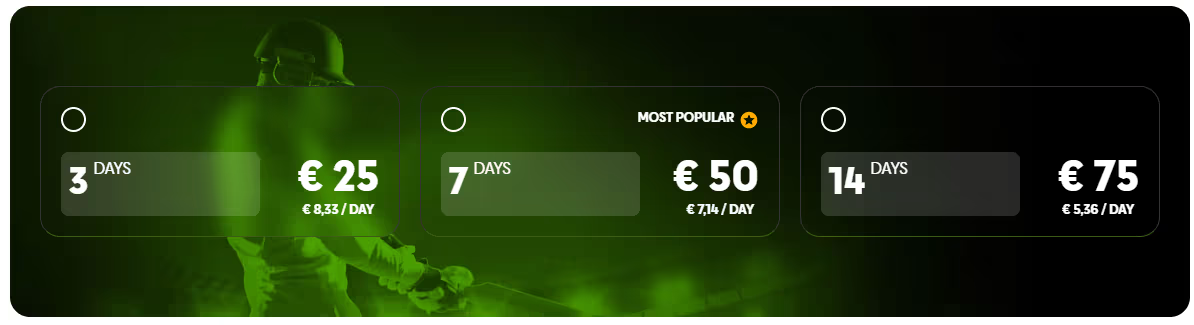
For shorter trips, FairPlay also offers Unlimited Day Passes, which follow a more traditional travel format.
Typical pricing looks like this:
3-day unlimited pass: about €25
7-day unlimited pass: about €50
14-day unlimited pass: about €75
These passes are useful for shorter travel periods when a fixed-duration plan makes more sense than a monthly subscription.
The combination of FLEX subscriptions and short-term unlimited passes gives the platform a flexible architecture that works across different types of travel.
Network and Setup
FairPlay doesn’t own infrastructure. Like every travel eSIM provider in this segment, it operates on roaming agreements with existing telecom operators. In practice, LTE and 5G coverage across major European, North American, and Asian markets is solid — reliable enough for video calls, cloud tools, tethering a laptop, and streaming without interruption.
Installation follows the standard eSIM process: activate via the app, confirm adding the profile, and done. The Help Center documents an in-app activation flow that reduces setup friction, which matters for less technically confident users who would otherwise call support before their flight.
Speaking of support, we ran a quick test. A technical question submitted to the FairPlay team came back in around 10 minutes, from a real person with a real answer. In an industry where chatbots and templated responses are the norm, that stood out.
Who FairPlay works best for
FairPlay is not designed primarily for the cheapest short-term data usage.
If you are taking a short weekend trip and need a small data bundle for navigation and messaging, many prepaid travel eSIM options will work well.
FairPlay becomes particularly valuable in longer travel scenarios.
It works best for:
- digital nomads
- remote workers
- frequent international travelers
- people who dislike managing data bundles
For these users, the ability to maintain a single connection with predictable costs across multiple countries can significantly simplify travel.
FairPlay eSIM Review – Alertify verdict
FairPlay lands in a genuinely interesting position in the 2026 travel eSIM landscape. The market is still largely dominated by bundle logic — Airalo, Holafly, and Nomad built their businesses on it, and it works well for the majority of travelers who use data intermittently. Ubigi pushed toward monthly subscriptions earlier than most and built a strong foothold with business and nomad segments. Yesim competes on app experience and breadth of plan options.
FairPlay’s differentiation is cleaner than most: it’s the only player with a transparent, tiered FLEX model that carries a hard cost ceiling and a genuine unlimited tier at the top — not a throttled version of it. The Stop feature is a smart trust-building tool. The app transparency around consumption reflects a product philosophy that’s less common in this space than it should be.
The broader trend it’s riding is real. According to GSMA Intelligence, the number of eSIM-capable devices will surpass 6 billion by 2030, and as that installed base grows, usage patterns are shifting. More travelers are using eSIMs as a primary connectivity layer, not a backup SIM — which means predictable billing matters more than it did three years ago. Juniper Research similarly points to subscription-based connectivity as the next structural shift in the travel data market.
Where FairPlay needs to grow is in distribution. Discovery is still a bottleneck. Travelers who would benefit most from this product often find it after they’ve already subscribed somewhere else.
For the right user — the perpetual traveler, the remote worker, the person who’s spent the last year buying data plans the way most people buy coffee — FairPlay isn’t just a viable option. It’s probably the most honest product in the segment.
Alertify Connectivity Score
| Category | Score | What We Evaluate |
|---|---|---|
| Network & Coverage | XX / 20 | Coverage footprint, local network partners, LTE/5G availability, travel reliability |
| Pricing Transparency | XX / 20 | Clear pricing, honest unlimited claims, predictable costs, no hidden throttling |
| Plan Architecture | XX / 20 | Bundles vs subscriptions, flexibility, regional/global plans, top-ups |
| User Experience | XX / 20 | Installation simplicity, app usability, activation speed, and dashboard clarity |
| Reliability & Trust | XX / 20 | Company credibility, support quality, transparency, and market reputation |
| Score Range | Meaning |
|---|---|
| 90–100 | Industry Leader |
| 80–89 | Strong Global Provider |
| 70–79 | Solid Option |
| 60–69 | Average |
| Below 60 | Limited Recommendation |
Alertify Insight
The Alertify Connectivity Score evaluates not only technical connectivity but also how well a provider’s pricing, product design, and user experience fit real travel behavior.
This framework helps readers compare eSIM providers more clearly and understand their strengths beyond simple star ratings.