Enterprise eSIM: Why Mobile Provisioning Still Lags
Most large companies can now ship a laptop to an employee, open it remotely, push security policies, install apps, configure access, and lock the device if something goes wrong.
Then the same employee lands in another country and asks: “Do I use roaming, buy a local SIM, scan this QR code, ask IT, expense it, or just hope hotel Wi-Fi works?”
That gap looks small until you see it from inside an IT, finance, or travel risk team. Device provisioning has become software. Mobile connectivity, in many companies, still behaves like office stationery: ordered, activated manually, chased by email, and reconciled after the bill arrives.
That made sense when mobile access meant a local operator contract and a plastic SIM in a drawer. It makes much less sense now. The hardware changed. The working model changed. The risk changed. But the process often did not.
Connectivity is now onboarding
This is the uncomfortable question behind enterprise eSIM: if a company can remotely provision a laptop, why is the connection that makes the device useful still treated as a separate manual task?
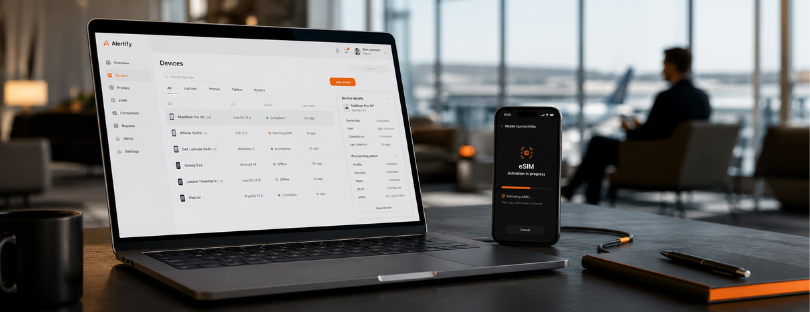
Microsoft Intune already supports eSIM cellular profile deployment for managed Windows devices. Apple’s deployment guidance also recognizes eSIM as part of managed device rollouts. Connectivity is becoming another managed layer, not a travel afterthought.
The modern employee is not “mobile” only when travelling. Sales teams work from trains. Engineers visit sites. Executives move between countries. Field teams often operate where fixed broadband is weak, restricted, or unavailable.
READ MORE: Why Enterprise eSIM Management Is Moving Beyond SIMs
In those moments, mobile data is not a perk. It is the thing between the employee and the work.
Yet many companies still treat it as an exception process. Someone raises a ticket. Someone approves roaming. Someone sends a QR code. Someone buys their own eSIM. Finance sees it later as a messy expense claim.
That is not mobility management. It is controlled improvisation.
The QR code problem
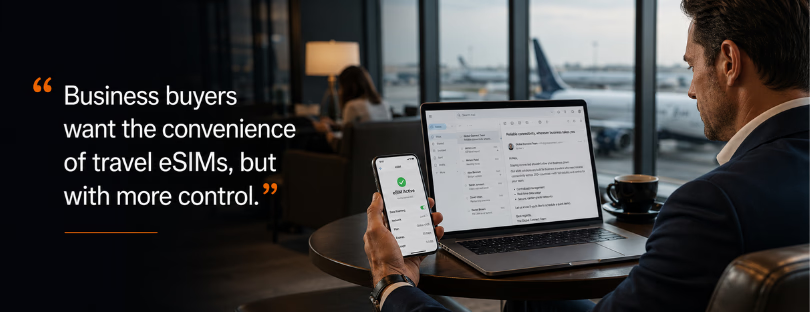
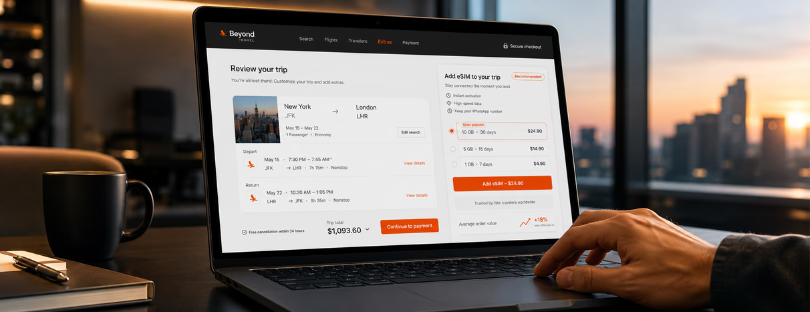
The travel eSIM boom trained people to expect instant connectivity. For consumers, scanning a QR code before a trip is usually fine. Inside a company, the same workflow becomes clumsy at scale.
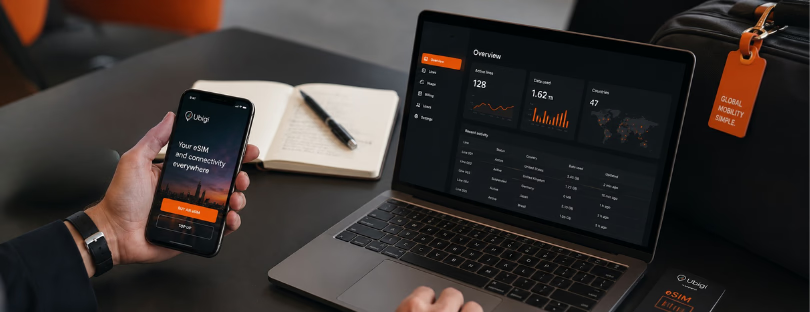
A QR code does not tell the CIO who is connected. It does not tell finance whether usage is business-related. It does not help a travel risk manager see whether a lone worker has arrived online. It does not solve policy control, cost caps, network visibility, or reporting. It only solves activation.
READ MORE: Enterprise eSIM Global Coverage That Actually Works
That is why enterprise eSIM is separating from consumer travel eSIM. The real question is not “can we give employees data abroad?” It is “can we deploy, monitor, govern, and pay for mobile connectivity with the same discipline we apply to devices and SaaS?”
Different players, different answers
Traditional telecom operators still have strengths that enterprises value: contracts, SLAs, account teams, private network options, security frameworks, and integration depth. Vodafone Business, Orange Business and similar groups remain important where connectivity is tied to network transformation, private 5G, IoT, or domestic fleet management.
But many enterprises are frustrated by the old procurement model: country-by-country deals, roaming complexity, unpredictable bills, and slow changes when teams expand internationally.
Travel-first platforms such as Airalo for Business and Holafly Connect make business travel connectivity easier to buy and manage. They speak the language of dashboards, budgets, central purchasing, and fast employee access. That is useful for teams that mostly need reliable data on short trips.
READ MORE: Enterprise eSIM 101: What IT Teams Really Need
Then there are deeper enterprise connectivity players. 1GLOBAL talks strongly about zero-touch eSIM provisioning, APIs, and multiple deployment methods for large fleets. SureSIM approaches the same problem from a managed enterprise angle: over-the-air deployment, live usage visibility, spend controls, and multi-network access across destinations. GigSky sits closer to business travel and partner distribution.
The direction is clear: less manual handling, more control, fewer surprises.
Why is manual risky?
Manual connectivity creates blind spots. IT does not know which line is active. Finance does not know whether spending is controlled until after usage happens. Employees do not know which option is approved. Security teams may not know whether staff are relying on public Wi-Fi because roaming is too expensive or too hard to activate.
That is the real failure. The deeper issue is that connectivity sits outside the operating model.
READ MORE: emnify Streamlines Enterprise eSIM Rollouts with Automated MDM Integration
Enterprises have spent years centralizing identity, endpoint security, device compliance, access management, and SaaS spend. Mobile connectivity is one of the last messy layers. It touches those systems but is often managed through telecom contracts, travel policies, spreadsheets, and employee behavior.
Conclusion about enterprise eSIM provisioning
The manual SIM process is starting to look like a leftover from another era.
Remote laptop provisioning taught enterprises an important lesson: employees should not need to understand the plumbing before they can work. Connectivity should follow the same logic. It should be ready when the person is ready, governed when the company needs control, and visible before the bill becomes a problem.
Telecom operators will keep winning complex network-heavy accounts. Travel eSIM platforms will keep simplifying business travel. Enterprise-first players such as 1GLOBAL and SureSIM will push harder into automation, visibility, and policy control. The smart companies will not ask which category sounds trendier. They will ask which model removes the most friction.
The real question is no longer whether eSIM works. It does. The question is why so many companies still manage mobile connectivity like it is 2012, while everything around it has already moved to the cloud. enterprise eSIM provisioning