Travelex Nomad Brings Mobile FX to UK Airports
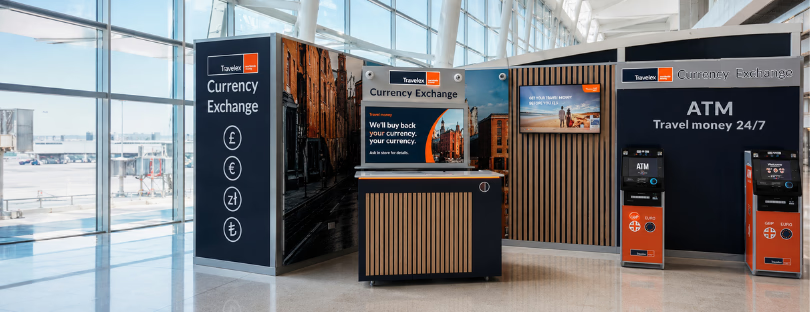
Travelex has brought its Nomad mobile store concept to Manchester Airport and Liverpool John Lennon Airport, expanding a flexible foreign exchange format first piloted at Zurich Airport earlier this year.
It sounds like a small retail update, but it points to something bigger. Airport services are being redesigned around passenger flow, not fixed counters. Currency exchange is still useful, especially for travelers heading to cash-heavy destinations, but the way it is delivered has to feel faster, lighter, and closer to the journey.
Nomad is a mobile foreign exchange unit that can be moved around the terminal according to demand. It can open and close within minutes, then be securely stored outside trading hours. Through the units, travelers can buy more than 50 currencies, collect travel money ordered online, or pick up a prepaid Travelex Travel Money Card. Retractable digital screens show exchange rates and promotions, giving the format a cleaner pop-up feel.
Why Manchester and Liverpool matter
At Manchester Airport, the Nomad unit is located in the newly renovated Terminal 2 East, the centrepiece of the airport’s £1.3 billion transformation programme. At Liverpool John Lennon Airport, it sits in the landside departures hall, catching passengers before security and before the usual rush begins.
“Travelex’s Nomad marks an evolution in the retail travel money experience, helping us to serve a greater number of customers more conveniently than ever before,” said Jacqueline Kelleher, Managing Director – UK at Travelex. “Following a successful pilot at Zurich Airport, we’re proud to bring the success of Nomad to both Manchester and Liverpool airports and continue to ensure the nearly 40 million annual passengers have convenient access to travel money.”
Stephen Turner, Chief Commercial Officer of Manchester Airport, said:
“At Manchester Airport we’re proud to offer a world-class passenger experience, making innovative use of technology and providing seamless connections between the North and the world. This innovation from Travelex really fits the profile of what we’re trying to achieve – it provides operational flexibility but also convenience for customers, allowing Travelex to take their currency exchange services to passengers at key touchpoints.”


From cash to connectivity
The more interesting part is that Travelex is not limiting its travel retail role to currency. In the Netherlands, GWK Travelex has partnered with Golden eSIM to offer travelers roaming data at physical locations. Customers can buy Golden eSIM at more than 40 GWK Travelex locations, including Amsterdam Schiphol, Eindhoven Airport, Rotterdam The Hague Airport, and major railway stations. The process is simple: visit a bureau de change, scan a QR code at the counter, choose a data bundle starting from €2.50, and activate mobile data on the phone. Golden eSIM says its roaming plans cover more than 200 countries, which makes the service a natural add-on for travelers already sorting out cash, cards, and last-minute travel basics.
Travelex also promotes an international eSIM offer through Simify, formerly SimsDirect, on its own site. The proposition is straightforward: prepaid international eSIMs with no lock-in contract, no ID verification, fast setup, generous data inclusions, and access to local networks. Travelex describes the partnership as a way to provide international phone calls and data for travelers who want an easy connected travel experience. That matters because airport connectivity is still messy. Some travelers buy data in advance. Some rely on airport Wi-Fi. Some only think about roaming when the first expensive message arrives from their operator.
Useful, but not universal
This is where Travelex’s move becomes more strategic than it first appears. Travel money and mobile data are both “pre-trip panic” products. People do not always plan them carefully, but they notice immediately when they do not have them.
For less confident travelers, a physical counter can remove friction. They can ask a real person, scan a QR code, and avoid searching for the right eSIM provider while standing beside a baggage carousel. For fully digital travelers, direct eSIM apps from providers such as Airalo, Ubigi, Yesim, GigSky, or Nomad eSIM may still be faster and easier to compare. Physical retail adds trust and visibility. Digital-first apps usually win on range, transparency, and price comparison.
What could be improved is consistency. Travelex now has different eSIM partnerships in different markets, including Golden eSIM in the Netherlands and simify in Australia. That can work locally, but global travelers may eventually expect one clear connectivity proposition from a brand they already know.
The real story
The Nomad rollout is not just about moving a currency counter on wheels. It is part of a larger shift in airport retail: services are becoming modular, mobile, and tied to the passenger journey.
GSMA Intelligence has noted that mobile operators are increasingly launching travel eSIM offers, while Juniper Research expects travel eSIM revenue to rise sharply between 2025 and 2030. Airlines, airports, travel money brands, OTAs, fintechs, and eSIM specialists are all looking at the same moment: the traveler is about to leave, needs practical services, and is willing to solve problems quickly.
Travelex has an advantage many digital-only players do not have: physical presence at the point of travel. If it connects Nomad, travel money, prepaid cards, ATMs, and eSIM offers into one clearer customer journey, it could become more than a foreign exchange provider. It could become one of the most visible last-mile travel utility brands in the airport.