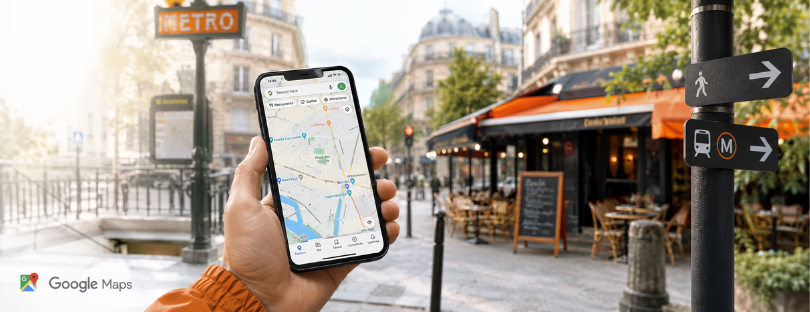
Google Maps Becomes a Smarter Travel Planning Tool
Google Maps has quietly become one of the most important travel apps on a phone. Not because it looks exciting, but because it sits exactly where travel stress happens: outside the airport, in a taxi queue, on a rainy afternoon, or near a hotel entrance that somehow does not look like the photos.
Google is now pushing Maps further into trip planning, with offline maps, public transport routes, live location sharing, parking reminders, “busy times” data and AI-powered discovery working together inside one app. The direction is clear. Maps is no longer just about getting from A to B. It is becoming a lightweight travel companion.
That matters because travellers do not usually want another app. They want fewer decisions, fewer tabs and fewer small problems when they are tired, roaming, late or somewhere unfamiliar.
Offline is still the safety net
The most practical feature for international travellers remains offline maps. Before departure, users can download a selected destination area by opening their profile menu, choosing “Offline maps” and saving the area they need.
It sounds basic, but it solves a real problem. Mobile signal can be weak in rural areas, roaming can be expensive outside Europe, and airport Wi-Fi is not always useful when you are already moving. With an offline map, travellers can still find streets, landmarks and driving directions without depending fully on mobile data.
But offline maps are not a magic fix. Live traffic, updated public transport data, ride-hailing, messaging, restaurant availability and many AI suggestions still work better with a connection. For Alertify readers, this is the important nuance: offline maps reduce risk, but they do not replace reliable travel connectivity.
AI changes the search habit
The bigger shift is AI discovery. Google has been adding Gemini-powered features to Maps, including more natural searches and recommendations based on everyday questions. Instead of typing “restaurants near me”, a traveller can ask for something closer to real intent, such as a quiet café for working, a family-friendly dinner spot or indoor attractions on a rainy day.
That is a small UX change with a large commercial meaning. Travel search is moving away from keyword hunting and towards intent. The user does not want a list of 40 places. They want one or two options that fit the moment.
READ MORE: The Most Traveler-Friendly eSIM Yet? Jetpac Adds WhatsApp, Google Maps, Uber & VPN Free
This is where Google has an advantage. Maps already have location data, reviews, photos, opening hours, public transport context and route information. Trip-planning startups may have smarter interfaces, but Google has the daily habit.

Group trips need live coordination
Live location sharing sounds simple until you actually need it. In crowded city centres, festivals, ski resorts or large airports, it can remove the endless “Where are you?” messages from a group trip.
Public transport planning also remains one of Maps’ strongest travel uses. Travellers can compare buses, trains and metro routes without downloading a local transit app for every city. The quality depends on local data, so it is not perfect everywhere, but for many major destinations, it is good enough to make the first day easier.
Drivers get practical tools too: saved parking, fuel station searches during navigation, rest stops and route-based suggestions. None of this feels futuristic. That is the point. The best travel tech often disappears into the trip instead of shouting for attention.
Where Maps still falls short
Google Maps is excellent for orientation and discovery, but it is not a full travel planner. It does not replace a booking platform, a proper itinerary tool, a hotel app, airline updates or a dedicated road-trip planner for complex journeys. Travellers who want budgets, reservations, confirmations and shared itineraries in one place may still prefer tools such as Tripadvisor, Expedia, Wanderlog or airline and OTA apps.
READ MORE: How to Plan Places to Visit on Vacation (With a Group!) Using Google Maps
Privacy will also remain part of the conversation. Location sharing, personal recommendations and AI-based discovery are useful precisely because they know context. Some travellers will love that. Others will prefer less personalisation and more manual control.
The real story
The travel app market is moving towards assistants, not directories. Expedia has pushed AI trip support, Tripadvisor has built AI planning into Trips, and Apple Maps continues improving core navigation and offline use. But Google Maps has the strongest position because it owns the moment when travel becomes physical.
You can plan a beautiful itinerary in another app. You can book the hotel elsewhere. But when you step onto the street, look for the entrance, avoid the crowd, find the train or search for a place that is open right now, Maps is often where the decision happens.
That is why this update matters. Google is not just improving navigation. It is defending one of the most valuable layers in travel: the real-world decision layer.