Why Specialist eSIM Providers Are Not Replacing Operators Yet
For the past few years, the travel connectivity industry has been flooded with a familiar narrative: eSIM providers are disrupting roaming, operators are losing control, and traditional telecom models are slowly becoming irrelevant.
It makes for a good headline.
The reality is considerably more complicated.
A growing body of industry research, including recent travel eSIM market reports from Telna and Kaleido Intelligence, suggests that the future of travel connectivity is not a winner-takes-all battle between operators and specialist eSIM brands. Instead, it is becoming a hybrid ecosystem where travelers combine multiple connectivity options depending on where they are going, how long they are staying, and how much they care about saving money.
In other words, travelers are becoming connectivity shoppers.
And that changes the entire conversation.
The myth of total replacement
There is no question that specialist eSIM providers have changed traveler expectations.
A few years ago, many international travelers accepted roaming charges as an unavoidable travel expense. Today, they can open an app, buy a data package for dozens of countries, install it within minutes, and avoid searching for a local SIM card after landing.
That convenience is real.
Companies such as Airalo, Yesim, Nomad eSIM, GigSky, Ubigi and others have built businesses around solving a very specific pain point: expensive and inconvenient international connectivity.
But solving one pain point does not automatically eliminate all alternatives.
READ MORE: World’s Best Travel eSIM 2026: Can Anyone Beat BNESIM?
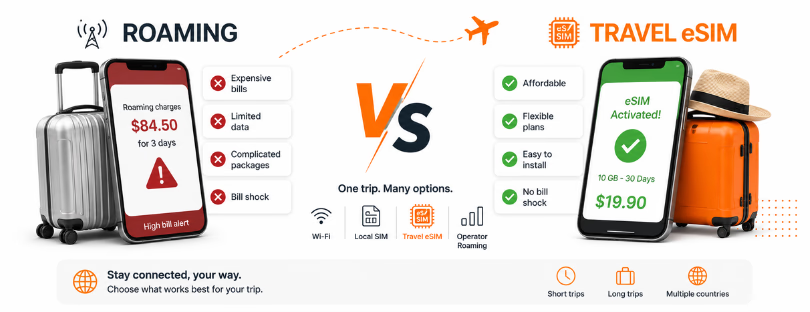
Many travelers still use operator roaming packages because they value simplicity. Others buy local SIM cards because they need local phone numbers or lower long-term costs. Some rely heavily on hotel Wi-Fi and public networks. Most combine several of these options during the same trip.
The market is not replacing one model with another.
It is layering new options on top of existing ones.
Different travelers, different decisions
One reason the replacement narrative falls apart is that travelers do not behave the same way.
A business traveler flying from London to New York for three days has completely different priorities from a backpacker spending two months across Southeast Asia.
The first traveler may activate their operator’s roaming package because reliability matters more than saving a few euros.
The second traveler may compare five different eSIM providers before departure and still purchase a local SIM card after arrival if the economics make sense.
A family taking a two-week summer holiday may simply choose whichever option requires the fewest setup steps.
That diversity matters.
Travel connectivity decisions are often driven by convenience, habit, employer policies, device compatibility, and trust rather than pure pricing.
The assumption that everyone will automatically choose the cheapest eSIM ignores how people actually travel.
Operators are adapting faster than expected
Another reason specialist providers are not replacing operators is that operators are not standing still.
Many mobile operators now offer their own eSlM products, flexible roaming bundles, regional passes, and digital activation processes that look surprisingly similar to what travel eSIM providers pioneered.
In Europe, Asia, the Middle East, and North America, operators increasingly recognize that travel connectivity is becoming an important customer retention tool.
Instead of fighting eSIM adoption, many are embracing it.
READ MORE: eSIM Customer Recovery Is the Next Competitive Battlefield
Some carriers now allow customers to activate travel plans directly through mobile apps. Others have introduced competitive regional data packages that narrow the pricing gap with specialist providers.
The result is a market where operators and eSIM brands often compete, but increasingly overlap.
That overlap is likely to grow.
The trust factor
One interesting pattern emerging across the industry is the role of trust.
Many travelers still feel more comfortable buying connectivity from brands they already know.
Their mobile operator.
Their airline.
Their bank.
Their travel platform.
This is one reason embedded connectivity partnerships are becoming so important.
When an airline offers an eSIM during check-in, or a banking app includes travel connectivity as a customer benefit, the traveler may never actively search for a dedicated eSIM provider at all.
The connectivity still exists.
The distribution channel changes.
Several industry observers believe the next phase of market growth will be driven less by direct consumer acquisition and more by embedded distribution through travel, fintech, telecom, and loyalty ecosystems.
That trend could benefit specialist eSIM providers and operators simultaneously.

Geography still matters
Another overlooked reality is that travel connectivity behaves differently depending on the destination.
In some countries, local SIM cards remain extremely affordable and widely available.
In others, roaming packages are surprisingly competitive.
Certain regions have regulatory restrictions, identification requirements, or network arrangements that influence traveler behavior.
A traveler moving between France, Germany, and Spain faces a completely different connectivity landscape than someone traveling through Indonesia, Morocco, or Brazil.
This fragmentation creates room for multiple models to coexist.
No single solution consistently wins across every destination.
That is precisely why hybrid behavior continues to grow.
Convenience versus optimization
Many connectivity decisions ultimately come down to a simple trade-off.
Convenience versus optimization.
The traveler who wants the easiest possible experience may activate roaming and never think about connectivity again.
The traveler who enjoys researching travel hacks may compare multiple eSIM plans, download several apps, and switch between providers depending on the destination.
Neither approach is objectively right.
Most travelers sit somewhere in the middle.
They may use a travel eSIM for one trip, roaming for another, and a local SIM card when staying abroad for several months.
The industry often talks about connectivity products as if consumers are choosing permanent sides.
In reality, travelers switch constantly.
Distribution is becoming the real battleground
One lesson from the travel eSIM sector is becoming increasingly clear.
The biggest challenge is no longer technology.
It is a distribution. travel eSIM vs roaming
Most eSIM platforms offer relatively similar user experiences. Coverage differences continue to narrow. Installation has become easier. Pricing gaps are shrinking.
The real question is who reaches the traveler first.
Airlines, online travel agencies, hotel groups, fintech apps, loyalty programs, operators, and specialist eSIM brands are all competing for the same moment in the customer journey.
The winner may not be the company with the best network.
It may be the company already sitting inside the app the traveler uses before departure.
Conclusion about travel eSIM vs roaming
The travel connectivity market is evolving in a way that is both less dramatic and more interesting than many headlines suggest.
Specialist eSIM providers are not replacing operators. At least not yet.
Instead, the market is moving toward coexistence. Operators continue to innovate, travel eSIM brands continue to grow, and travelers increasingly mix roaming, local SIMs, eSIMs, and Wi-Fi depending on context.
That aligns with findings from industry analysts such as Kaleido Intelligence, GSMA Intelligence, and Telna, all of whom point toward a fragmented and expanding ecosystem rather than a single dominant model.
The most successful companies may not be those trying to eliminate competitors. They may be the ones who understand how travelers actually behave and position themselves as part of a broader connectivity journey.
The future of travel connectivity looks less like a replacement story and more like a portfolio strategy. And for an industry that spent years searching for one perfect solution, that may be the most important shift of all.