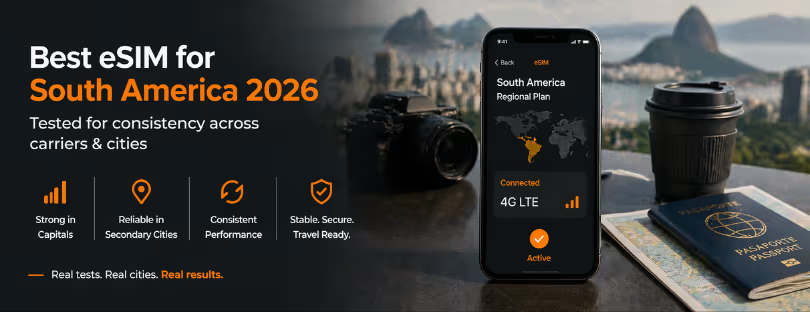
Best eSIM for South America 2026 — Tested for Consistency Across Carriers & Cities
If you check coverage maps, South America in 2026 looks impressive.
4G is widely deployed.
5G expanding in major capitals.
Urban penetration high.
But the lived traveler experience tells a more nuanced story.
You land in São Paulo, and everything feels fast.
You take a domestic flight to a secondary city and suddenly your “LTE” feels like it’s buffering.
You move from Buenos Aires to Mendoza and notice the difference immediately.
You drive outside Lima or Bogotá, and apps start hesitating.
So the real question isn’t “Does eSIM work in South America?”
It does.
The real question is:
Which partner network are you actually landing on — and how does it behave outside the capital?
That’s why our angle for 2026 is different:
Best eSIM for South America 2026 — Tested for Consistency Across Carriers & Cities
Because South America is not about coverage on paper.
It’s about consistency in real life.
The capital illusion
South America’s largest cities are powerful connectivity hubs.
São Paulo, Santiago, Buenos Aires, Lima, Bogotá — these cities benefit from strong investment, dense infrastructure, and competition among carriers.
Measurement firms consistently show strong urban mobile experience in major Latin American capitals, with 4G widely available and 5G expanding steadily in countries like Brazil and Chile.
But the continent is vast.
And once you move outside these core metros, the experience shifts.
The problem is not total absence of coverage.
It’s variability.
The secondary city drop
Here’s where travel eSIMs get tested.
In secondary cities or peri-urban zones:
- Backhaul capacity may be thinner
- Congestion hits faster during peak hours
- Partner network choice becomes critical
- Latency spikes are more noticeable
You might still see LTE.
But Slack loads slowly.
Banking apps time out.
Video calls feel fragile.
This “LTE but slow” phenomenon is usually not about signal strength.
It’s about network load and routing.
And this is where roaming partner selection matters more than most travelers realize.
Roaming partner choice: the hidden variable
When you buy a regional South America eSIM, you are not buying “South America performance.”
You are buying a roaming agreement with a specific partner network in each country.
That means:
In Brazil, you may attach to one of several major operators.
In Argentina, Chile, Peru, or Colombia, different partner choices can produce very different results.
Two travelers in the same city can have wildly different experiences simply because their eSIM provider chose a different wholesale partner.
This is rarely visible on marketing pages.
But it is visible in performance.
What we tested
For South America 2026, we evaluated eSIMs across five practical stress points.
Capital city stability
In São Paulo, Buenos Aires, Santiago, Lima, and Bogotá, we looked for:
- Latency consistency
- Stable video calls
- Reliable hotspot sessions
- Performance during peak hours
If a plan cannot behave well in the capital, it is not serious.
Secondary city reliability
This is where many plans degrade.
We tested:
- Attach stability outside core metros
- Recovery when signal weakens
- Performance under moderate congestion
This is the real differentiation layer.
Latency consistency
Not just average speed, but sudden spikes.
Latency spikes break calls, remote desktop sessions, and financial logins.
Consistency matters more than peak download numbers.
Network switching behavior
Some plans allow automatic partner switching. Others stick to one network.
When the network is congested, does the eSIM recover?
Manual selection can dramatically improve performance in South America.
Hotspot usability
South America is popular with digital nomads.
Tethering makes performance more sensitive to congestion and shaping.
Hotspot sessions expose weaknesses faster than casual browsing.

Best eSIMs for South America 2026
There is no universal winner across all countries.
But certain providers consistently perform well within the South America variability framework.
Airalo
Airalo remains one of the most practical regional options due to broad coverage and reliable provisioning.
Strengths:
- Easy activation
- Strong presence across multiple South American countries
- Solid capital city performance
Where caution is needed: secondary cities.
If performance feels inconsistent, manual network selection can improve results in some markets.
Airalo is a strong baseline for most travelers.
Ubigi
Ubigi tends to appeal to travelers who want predictability and clear usage policies.
In South America, predictability under load matters.
Strengths:
- Stable performance in capitals
- Clear fair-use policies
- Better behavior during sustained usage
For business travelers or remote workers, Ubigi’s structured approach often feels more “product-like.”
Yesim
Yesim’s advantage is continuity.
If you are moving between Brazil, Argentina, Chile, Peru, and Colombia in one trip, operational simplicity becomes valuable.
Strengths:
- Multi-country management
- Good attachment consistency
- Fewer profile juggling issues
Yesim is not necessarily about the fastest network in each country.
It’s about a smoother travel flow.
Saily
Saily’s positioning around cleaner browsing and security is useful in environments where congestion creates unpredictability.
Reducing background noise can improve perceived stability during work sessions.
Saily works well for:
- Security-conscious travelers
- Frequent app logins
- People working in cafés and coworking spaces
Holafly
Holafly’s convenience model works for short-term tourism in capitals.
But South America’s variability means unlimited plans should be evaluated carefully outside urban cores.
Holafly is best for:
- City-based tourism
- Simplicity over optimization
The deeper infrastructure story
Latin America continues investing in mobile and digital infrastructure, with 5G expansion underway in major markets like Brazil and Chile.
But research across the region still highlights uneven quality outside large metros and varying operator performance country to country.
This structural unevenness explains why roaming partner selection matters so much in South America.
Unlike Europe, where infrastructure maturity is relatively uniform across many countries, South America still presents a patchwork of performance realities.
Conclusion
South America in 2026 is not a coverage problem.
It is a consistency problem.
The difference between “great” and “frustrating” often comes down to:
- Which partner network does your eSIM use
- How it behaves outside the capital
- Whether it handles congestion gracefully
- Whether it allows recovery when the first network is weak
In Europe, the stress test is border switching.
In the US, it is congestion.
In Asia, it is routing.
In the Middle East, it is policy.
In Africa, it is resilience under a weak signal.
In South America, there is consistency across carriers and cities.
Airalo is often the safest general-purpose choice.
Ubigi appeals to structured, predictable usage.
Yesim reduces friction across multi-country trips.
Saily supports cleaner, more controlled sessions.
Holafly prioritizes simplicity.
But the real conclusion is this:
Stop assuming that a good experience in São Paulo guarantees a good experience in Salvador, Mendoza, or Cusco.
South America rewards travelers who understand that performance is local.
The best eSIM for South America in 2026 is not the one with the most countries on the list.
It is the one that behaves consistently when you leave the capital.
And that difference — between marketing coverage and lived reliability — is exactly what serious travelers should be paying attention to.