Orange Tunisia Expands with Airport Store in Tunis
There’s a small but telling shift happening at airports, and Orange Tunisia just made its move.
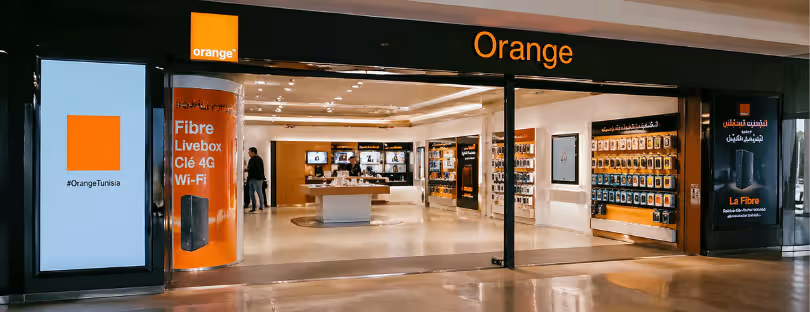
The operator has opened a retail store inside Tunis-Carthage International Airport, placing connectivity exactly where travelers need it most. Not downtown. Not after a taxi ride. Right at the point of arrival.
On the surface, this looks like a standard retail expansion. In reality, it’s a direct response to how people now travel and connect.
Why airports still matter for connectivity
For years, airport SIM kiosks were the default solution for staying connected abroad. You land, you queue, you buy a prepaid SIM, and you’re online. Simple, but often slow, confusing, and sometimes overpriced.
Now, with eSIM adoption rising globally, you might expect these physical touchpoints to fade away. But that hasn’t happened. Instead, they’re evolving.
Orange Tunisia’s new store sits inside the terminal, offering SIM cards, mobile plans, and internet solutions immediately upon arrival. For many travelers, especially those less familiar with eSIMs or arriving from regions where adoption is still limited, this is still the easiest and most trusted option.
And importantly, it’s not operating in isolation. The airport already hosts competitors like Tunisie Telecom and Ooredoo Tunisia, making Tunis-Carthage a compact battleground for first-touch customer acquisition.
That competition matters more than it seems.
The real game: first connection wins
In telecom, the first connection often decides everything.
The provider you choose at the airport is likely the one you’ll stick with for your entire stay. That means whoever captures that moment owns the relationship, the data usage, and the revenue.
Orange Tunisia knows this. The company framed the store as part of a broader effort to “enhance customer experience and expand service accessibility,” with CEO Stéphane Varret emphasizing the role of local teams and service delivery.
But behind the corporate language is a clearer strategy: win the traveler at the moment of arrival.
This is something we’ve seen globally. Operators are moving closer to high-intent environments where connectivity is not optional. Airports are one of the last places where demand is guaranteed.

Physical retail in a digital-first world
It might seem counterintuitive to invest in physical stores in 2026, especially in telecom. But airports are different.
They compress urgency, confusion, and demand into a single moment. Travelers need data immediately. They may not trust unfamiliar apps. They may not have prepared in advance.
That’s where physical retail still wins.
At the same time, this move highlights a gap. While global eSIM providers like Airalo or Holafly focus on pre-trip digital acquisition, local operators still dominate the arrival moment.
This creates a split market:
- Digital-first players win before the trip
- Local operators win at the airport
- Very few players bridge both seamlessly
And that’s where things get interesting.
A signal for broader market trends
Orange Tunisia’s airport expansion is not just about Tunisia. It reflects a wider shift in how telecom operators think about distribution.
Across Europe, the Middle East, and Africa, operators are doubling down on high-traffic entry points. According to industry data from GSMA, international travel continues to rebound strongly, with roaming and visitor connectivity becoming a key revenue driver again.

At the same time, research from firms like Juniper Research shows that global eSIM adoption is accelerating, but unevenly. Many travelers still rely on physical SIMs, especially in emerging markets.
That combination creates a hybrid reality. Digital is growing, but physical access points still matter.
Airports sit right at that intersection.
What Orange is really building
From the outside, this is a retail store. But strategically, it’s a control point.
By placing itself inside the airport, Orange Tunisia is not just selling SIM cards. It’s embedding itself into the traveler journey from the first minute in the country.
That opens the door to more than just connectivity:
- Upselling data plans
- Offering tourist bundles
- Building long-term customer relationships
- Potentially integrating digital onboarding or eSIM activation
It’s a small footprint with a big strategic role.
And importantly, it reinforces Orange’s position against local competitors in a space where visibility equals trust.
Conclusion
This move by Orange Tunisia might look incremental, but it highlights a deeper tension in the connectivity market.
On one side, global eSIM players are trying to own the pre-travel moment, capturing users before they even board the plane. On the other hand, local operators are defending the arrival experience, where urgency and trust still give them an edge.
Right now, both models coexist. But they rarely connect.
The players that win long-term will not be the ones with the most stores or the cheapest data. They will be the ones who control the entire journey, from booking to arrival to daily usage, without friction.
We’re already seeing early versions of this with airlines experimenting with connectivity bundles, fintechs embedding roaming solutions, and platforms starting to treat connectivity as part of the travel product itself.
Orange Tunisia’s airport store fits into that puzzle. It secures the first touchpoint. But the bigger question is what comes next.
Because in a market moving toward embedded, always-on connectivity, the real competition is no longer about selling SIM cards.
It’s about owning the moment when the traveler first connects, and everything that follows after.