AT&T Tops U.S. Upload Speeds as Connectivity Shifts
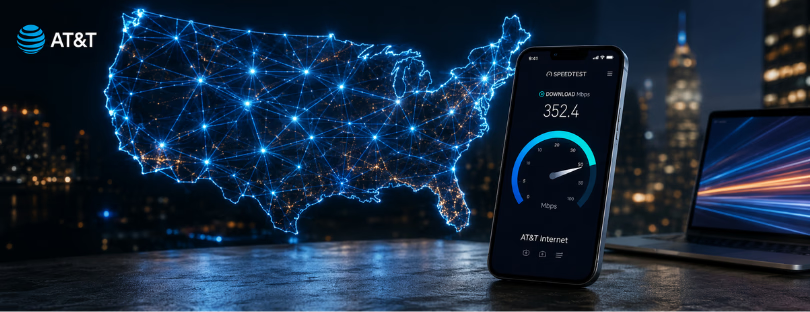
AT&T has picked up a useful headline at a very useful moment: according to Opensignal’s first Converged Experience report for the US, the operator leads the country for converged upload speeds, delivering more than twice the upload performance of its closest competitor. Opensignal measured AT&T at 109.0 Mbps for Upload Speed Experience, ahead of Verizon at 48.0 Mbps.
That matters because the old network conversation was mostly about download speed. How fast can you stream? How quickly can you load a webpage? Can you watch a match without buffering?
Useful, yes. But slightly dated.
The internet people actually use today is much more two-way. Video calls, cloud backups, livestreams, gaming, short-form video, remote work, AI tools, smart home cameras and real-time collaboration all depend heavily on uploads. The network is no longer just pushing content toward users. Users are constantly sending data back.
That is why AT&T’s result is more than a marketing win. It reflects a broader shift in how connectivity performance is being judged.
Fiber and mobile are starting to merge
The Opensignal report is especially interesting because it does not look at mobile or fixed broadband in isolation. It looks at the converged experience, meaning customers who use the same provider for both home broadband and mobile connectivity.
In that context, AT&T’s combination of fiber and wireless ranked first for upload speeds. AT&T also says its Fiber and wireless combination ranked first in both upload and download speeds in a breakdown of the report, outperforming other fiber, cable and fixed wireless competitors by double digits.
This is where the US connectivity market is quietly becoming more strategic. AT&T, Verizon, T-Mobile, Comcast/Xfinity and others are no longer competing only as “mobile operators” or “broadband providers.” They are competing for the whole household, the whole device stack and increasingly the whole customer relationship.
READ MORE: Are You Getting the Internet Speed You’re Paying For?
For AT&T, fiber is the anchor. Wireless adds mobility. Together, the company can tell a story that is not just about coverage, but about continuity: fast uploads at home, reliable performance outside, and a single provider relationship across both.
That is not a small thing in a market where customers are tired of juggling separate subscriptions, separate apps and separate support channels.
 Why do uploads suddenly matter more?
 Why do uploads suddenly matter more?
AT&T’s own framing is clear: upload speed is becoming more important as AI becomes part of everyday digital life.
“Fast upload speeds are indispensable as customers game, stream, share, and rely more on AI-enabled experiences,” said Jenifer Robertson, executive vice president & GM, AT&T Mass Markets. “This win further demonstrates how AT&T is delivering the performance our customers need at home and on the go.”
That quote lands because it is not just about speed tests. AI-enabled services often depend on real-time input: voice, images, video, files, prompts, sensor data and app activity moving from the user to the cloud. Add remote work, creator tools and live collaboration, and upload capacity starts to look like infrastructure, not a bonus feature.
This is also where fiber has an advantage over many cable-based broadband setups. Fiber networks are typically stronger on symmetrical or near-symmetrical performance, while cable networks have historically been more download-heavy. Cable companies are improving, of course, and fixed wireless has become far more competitive in some markets. But when the conversation shifts from “Can I stream Netflix?” to “Can I upload, sync, call, create and use AI without friction?”, fiber-led operators get a cleaner story.
World Cup pressure is coming
There is another reason this matters now: North America is about to become the center of global travel.
The FIFA World Cup 2026 will take place across the United States, Canada and Mexico from June 11 to July 19, with 48 teams, 104 matches and 16 host cities.
That means millions of fans, journalists, creators, teams, sponsors and business travelers will be moving between cities, stadiums, hotels, airports and fan zones. Many of them will be uploading constantly: match clips, social posts, work files, livestreams, photos, navigation data, translation requests and video calls back home.
READ MORE: Mobile Networks Face Their Biggest Test at World Cup 2026
For domestic US customers, AT&T’s converged performance gives it a strong message before the tournament. For international visitors, however, the story is slightly different. They will not all buy a local AT&T plan. Many will arrive with roaming packages, travel SIMs or eSIM offers covering the US, Canada and Mexico.
That is where travel eSIM providers have a real opening. A good North American eSIM offer for World Cup visitors should not only shout about cheap gigabytes. It should explain network access, hotspot support, activation before departure, coverage across host countries, and whether the plan works smoothly when crossing borders.
The smartest eSIM offers around the World Cup will sell peace of mind, not just data.
Final take
AT&T’s Opensignal result is a reminder that the next connectivity battle will not be won only by download speed, coverage maps or low-price data bundles. The more interesting fight is about performance in real life.
For AT&T, the advantage is the combined strength of fiber and wireless. Verizon will keep leaning on premium mobile and fixed wireless. T-Mobile will keep pushing value, 5G coverage and home internet growth. Cable players such as Xfinity will defend the household relationship with broadband scale and bundled pricing.
But the market is moving toward something more demanding: upload-heavy, AI-assisted, video-first, travel-driven connectivity.
That is good news for operators with deep infrastructure. It is also good news for eSIM brands that understand the moment. The World Cup will expose weak connectivity promises very quickly. Fans will not care who has the nicest landing page if their upload fails outside a stadium.
The winners will be the companies that make connectivity feel invisible when the pressure is highest.