The Entitlement Server Power Shift Behind Travel eSIM
For years, the travel eSIM market has focused on the visible parts of the market: prices, country coverage, unlimited plans, QR codes, app UX, affiliate rankings. Fair enough. That is what travellers see.
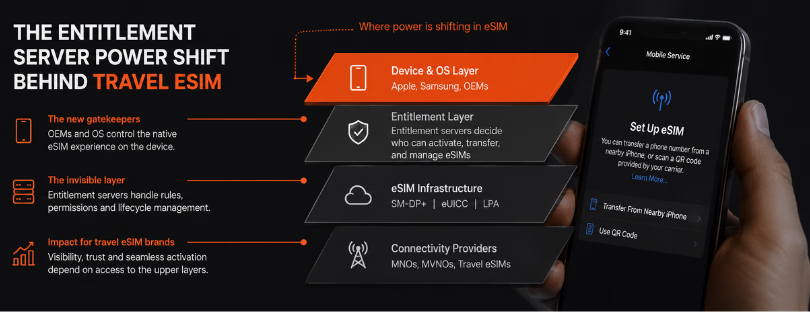
But underneath that retail layer, something more important is happening. The power in eSIM is slowly moving closer to the device.
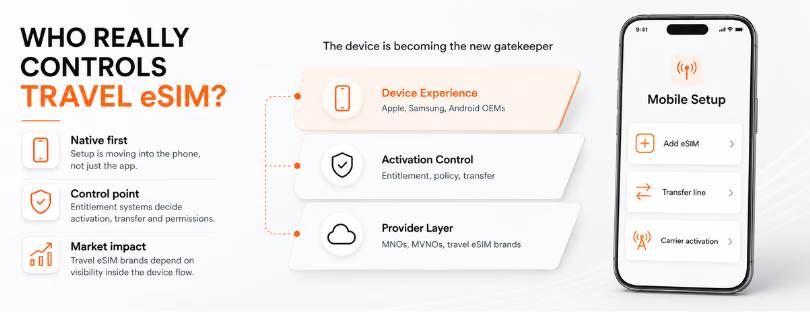
Not just the phone. The operating system. The setup flow. The carrier activation screen. The entitlement server. The invisible machinery that decides whether an eSIM appears naturally inside the user’s device experience, or whether it remains a third-party product living outside the main flow.
That distinction sounds technical, but commercially it is huge.
Apple already lets supported carriers assign an eSIM digitally through eSIM Carrier Activation, and Apple’s support pages list carriers by activation method, including Carrier Activation, Quick Transfer, QR code, carrier app, and prepaid plans for international travellers. In plain English: the iPhone experience is no longer just “scan this QR code.” It is becoming a managed device-native connectivity experience.
Samsung and Google are moving in the same direction. Samsung’s Galaxy eSIM support guides walk users through SIM manager, QR code activation, manual activation codes and transfer flows, while Google’s Pixel help explains that users can transfer a physical SIM or eSIM to an eSIM on a new phone during setup or later in settings, depending on carrier support.
That is the shift. eSIM is not only a downloadable product anymore. It is becoming part of the device lifecycle.
What the entitlement layer does
The entitlement server is one of those telecom terms that sounds painfully boring until you understand what it controls.
In simplified terms, entitlement systems help confirm whether a user, carrier, device and service are allowed to do something. Activate an eSIM. Transfer a profile. Enable certain carrier features. Support a device-native onboarding flow. It sits between the carrier’s backend and the device experience.
In the GSMA consumer eSIM architecture, the more familiar components are the SM-DP+, which prepares and delivers eSIM profiles, the eUICC, which stores profiles on the device, and the LPA, the Local Profile Assistant inside the device that manages downloading and local profile operations. GSMA’s SGP.22 specification covers consumer remote SIM provisioning, while Android’s carrier documentation explicitly refers to entitlement server providers as part of eSIM transfer support.
That last point matters. When eSIM transfer becomes something users expect inside the phone setup process, the companies integrated into that entitlement and OEM layer gain leverage. Those outside it may still sell eSIMs, but they risk sitting one step away from the native experience.
For travel eSIM brands, this is uncomfortable.

Airalo, Holafly, Nomad, Ubigi, Yesim and others built much of the consumer category around apps, QR codes, checkout flows and destination packages. That model still works. It is familiar, scalable and affiliate-friendly. But the user journey is changing. A traveller with a new iPhone or Galaxy device may increasingly expect connectivity to be suggested, transferred, activated or managed from inside the phone itself.
The question then becomes: who gets invited into that native layer?
The app store problem, but for eSIM
There is a useful comparison here. Travel eSIM brands today are not unlike app developers in the early smartphone era. At first, the opportunity looked open. Build a great app. Acquire users. Own the experience.
Then the platform owners refined the rules.
Apple and Google did not need to compete with every app directly to shape the economics of the app economy. They controlled discovery, permissions, payments, notifications, privacy rules, and default behaviours. Developers could still win, but they were building inside someone else’s operating system logic.
READ MORE: Who Controls eSIM? The Entitlement Battle Begins
Something similar may happen in eSIM.
“The next eSIM battle will not only be fought on price, coverage or app design. It will be fought inside the device experience itself. Once Apple, Samsung and other OEMs decide how eSIM activation is presented to the user, travel eSIM providers are no longer competing only with each other. They are also competing with the operating system layer that controls the first customer touchpoint.”
Sandra Dragosavac, Alertify.
The OS does not need to become an eSIM provider to influence the market. It only needs to control where the user sees connectivity options, which activation methods are prioritised, which carriers support smooth transfer, and which experiences feel “official” versus external.
For a consumer, this may feel wonderful. Less friction. Fewer QR codes. Fewer support tickets. Easier device upgrades. Better continuity.
For eSIM providers, it introduces a harder reality: being good at retail UX may not be enough.
Why MNOs may benefit first
The first obvious winners are mobile network operators and large MVNOs with deep carrier integrations.
They already have billing systems, identity checks, entitlement infrastructure, device certification relationships and support processes. When Apple says a carrier supports eSIM Carrier Activation or Quick Transfer, that carrier is being pulled closer to the native phone experience. Apple explains that Carrier Activation allows a carrier to assign an eSIM digitally at purchase or after setup, while Quick Transfer lets users move a number from an old iPhone without contacting the carrier, where supported.
This is where travel eSIM players face a structural disadvantage. Many do not own the full telco stack. Some rely on upstream wholesale partners, roaming sponsors, aggregators or platform enablers. That is not a weakness by itself. It is how the market scaled so quickly.

But native device integration tends to reward operators with cleaner identity, numbering, entitlement and provisioning relationships. A tourist eSIM app selling short-term data is not always set up for that world.
This does not mean Airalo or Holafly will disappear. Not even close. Their strengths are distribution, brand recognition, country-level SEO, app conversion and travel-focused packaging. They can still win where the user is actively searching before a trip.
But the battleground splits. Search-led eSIM buying remains one lane. Device-native connectivity becomes another.
The pressure on pure-play travel brands
Pure-play travel eSIM brands now need to think beyond “more destinations” and “better app design.”
The deeper question is whether they can move closer to the infrastructure layer without losing their consumer simplicity. That may mean stronger carrier partnerships, better SM-DP+ relationships, more sophisticated lifecycle management, device-aware onboarding, or partnerships with companies already sitting inside the entitlement stack.
This is where players such as 1GLOBAL, Gigs, eSIM Go, Transatel/Ubigi and other platform-oriented companies become interesting comparisons. Some are less visible to casual travellers than Airalo or Holafly, but they may be better positioned for embedded, white-label or device-integrated models because they operate closer to the enablement layer.
Ubigi, for example, benefits from Transatel’s MVNO and network infrastructure background. Gigs has leaned into telecom APIs for digital products. 1GLOBAL often positions around a broader telco stack and managed connectivity capabilities. These models are not always as shiny on TikTok, but they may age well if the market shifts from “download a travel eSIM app” to “connectivity is embedded into the product or device journey.”
That is the real tension.
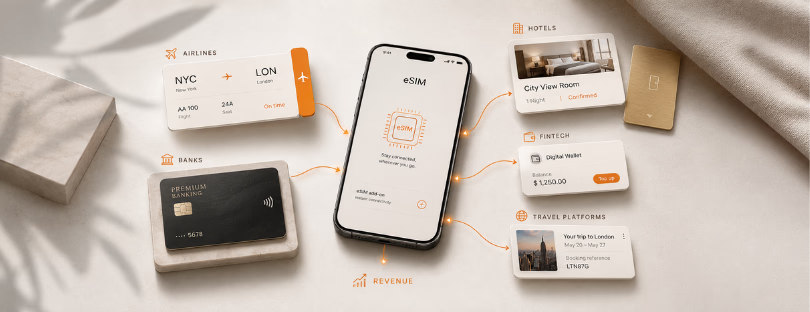
Retail eSIM brands are excellent at packaging connectivity for travellers. Infrastructure-led players are better placed when connectivity becomes a hidden layer inside devices, banks, airlines, booking platforms, or enterprise tools.
The user will not care who won
Travellers will not talk about entitlement servers. They will not ask whether an LPA handled the profile download elegantly. They will not praise an SM-DP+ implementation over coffee at the airport.
They will simply notice whether the eSIM works.
If a phone offers a cleaner native activation flow than a travel eSIM app, many users will choose the cleaner flow. If an airline, bank or booking app can offer connectivity at the right moment, the standalone eSIM app may lose some intent before it even sees the customer. If device transfer becomes seamless for some carriers and clumsy for others, support perception will change quickly.
That is why this layer matters. It changes who owns the trust.
READ MORE: Why eSIM Adoption Is Stuck: Distribution Over Tech
Until now, travel eSIM brands have fought for trust through reviews, price tables, app ratings and coverage claims. In the next phase, trust may increasingly come from being present inside the device’s own connectivity experience.
That is a much harder game.
Conclusion
The entitlement server power shift will not kill consumer eSIM brands, but it will separate retailers from real connectivity platforms.
Airalo and Holafly still have a powerful advantage in consumer awareness. They made travel eSIMs understandable for millions of people. That deserves credit. But the next phase of the market will reward companies that can do more than sell plans beautifully. It will reward those who understand provisioning, device flows, carrier relationships, transfer logic, support escalation and embedded distribution.
The market is moving in two directions at once. At the front end, eSIM is becoming simpler for users. At the back end, it is becoming more controlled by OEMs, OS-level flows and infrastructure partners. That is not a contradiction. That is usually how technology matures.
For Alertify readers, the signal is clear: do not judge the next eSIM winner only by app downloads, affiliate visibility or who has the loudest unlimited-data campaign. Watch who gets closer to the device. Watch who becomes part of the setup, transfer and activation. Watch who can work with Apple, Samsung, Google, carriers, and enterprise platforms without becoming invisible.
Because in eSIM, the next power layer may not be the app.
It may be the screen before the app ever opens.