SAS Launches EuroBonus Business Credit Card
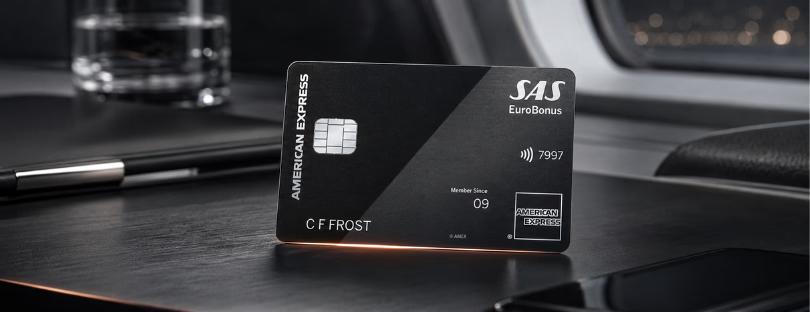
SAS is moving EuroBonus deeper into business payments with the launch of the SAS EuroBonus Executive Business Card, a new credit card program for small and medium-sized companies across Scandinavia.
At first glance, it has all the expected premium signals: a metal card, Mastercard World Elite positioning, lounge access, travel insurance and points. But the more interesting story is the infrastructure behind it. SAS is trying to connect business travel, loyalty and company spending in one product, instead of leaving firms to juggle corporate cards, expense apps and travel benefits separately.
Loyalty goes corporate
The card is aimed at executives, business owners and finance managers who travel frequently. SAS says the rollout will happen in phases across Scandinavia. Cardholders receive 20,000 yearly Level Points and earn 25 EuroBonus points per 100 SEK, DKK or NOK spent, described as the highest EuroBonus earning rate on the market.
Paul Verhagen, Chief Commercial Officer at SAS, framed the launch around a familiar business-travel problem: too much admin.
“This program is built with a simple purpose: to make everyday business life easier for our customers. Companies tell us they want less administration, clearer travel benefits and a card that genuinely supports how Scandinavian businesses operate,” said Verhagen.
“With this program, they get smoother expense handling, EuroBonus points, better travel experiences for their teams and a single product that replaces what previously required several cards and platforms,” he added.
That last line is the core pitch. SAS is not only selling points. It is a selling consolidation.
The embedded finance play
The card is issued on Mastercard’s network as a World Elite product. The platform is powered by Nordiska’s embedded finance and Cards-as-a-Service infrastructure, while Danish fintech Cardlay delivers the app experience and expense management tools.
That matters because airline loyalty is changing. In the older model, airlines mostly partnered with banks and put their brand on a card. In this model, SAS keeps more control over the customer experience, while regulated financial partners handle the banking layer.
READ MORE: SAS Brings Free Starlink WiFi to European Flights
The app includes receipt and expense management, digital cards, flexible credit limits and ERP integration. For SMEs, that is not cosmetic. Many smaller companies still manage travel costs through personal cards, delayed receipts and manual reconciliation. SAS is betting finance teams want real-time visibility without adding another standalone platform.
Why now?
The timing makes sense. Business travel has returned, but companies are watching costs more closely. Finance teams want tighter controls. Employees want the same smooth digital experience at work that they get as consumers.
SAS also has a loyalty reason to move quickly. EuroBonus is one of its most valuable customer assets. By extending it into daily business spending, SAS gives companies a reason to keep the airline visible between flights. A hotel bill or client dinner can become part of the loyalty loop.
This is where the card starts to look less like an airline perk and more like a retention product.

A wider market shift
SAS is not operating in a vacuum. Lufthansa Group, Air France-KLM, British Airways and other airline groups have long used co-branded payment cards to keep frequent flyers close. The difference here is the business payments angle and the embedded finance setup.
At the same time, European fintechs such as Pleo, Spendesk, Revolut Business and Wallester have trained SMEs to expect spending controls, virtual cards and faster expense workflows. SAS enters that conversation with something most fintechs do not have: an airline loyalty ecosystem, lounge access and travel-status benefits.
READ MORE: SAS Expands hoppaGo Partnership to Add Global Rail Bookings Across 70+ Countries
Mastercard has also been pushing SME payment solutions and embedded finance, in which financial tools are integrated into platforms that companies already use. Nordiska’s own embedded finance positioning follows the same logic: non-bank brands can offer financial products without becoming banks themselves.
For Alertify readers, this is the travel-tech angle. Airlines are no longer competing only on routes, fares and lounges. They are moving into the financial layer around travel.
The real test
The SAS EuroBonus Executive Business Card is interesting because it understands how modern business travel actually works. Travel is not just the flight. It is the booking, payment, receipt, reimbursement, insurance question, lounge wait, points strategy and finance-team headache afterwards.
Compared with traditional airline co-brand cards, SAS appears to be taking a more owned and integrated approach. Compared with pure fintech corporate cards, it brings a travel loyalty advantage that is hard to copy. The risk is execution: pricing, credit terms and rollout quality will decide whether SMEs see this as a serious business tool or just another executive perk.
Still, the direction is clear. Airlines want to own more of the journey, and payments are becoming part of that journey. For SAS, this card is not only about earning EuroBonus points faster. It is about keeping the business traveller inside the SAS ecosystem before, during and after the trip.