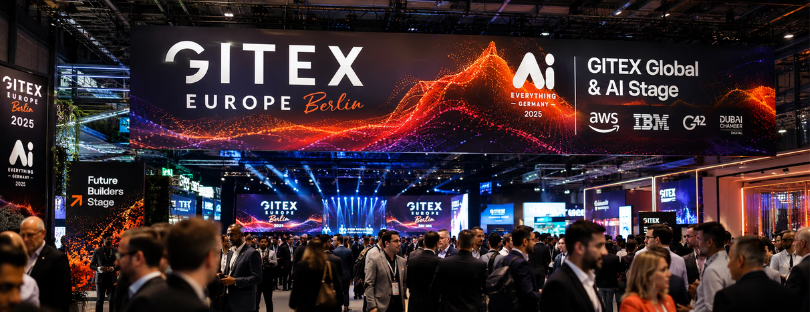
That’s exactly what GITEX Europe is positioning itself to be when it lands in Berlin at Messe Berlin Exhibition Grounds on 30 June – 1 July 2026.
And no, this isn’t a side spin-off. It’s the European expansion of the GITEX ecosystem that has been shaping tech deal-making for decades through GITEX Global.
The difference? Berlin brings a different tone. Less spectacle. More strategy.
For Alertify readers, that matters.
Because when AI, infrastructure, cybersecurity and intelligent connectivity converge in one place, that’s where real ecosystem shifts happen.
And yes — this is exactly where eSIM players should be looking.
Not Just Keynotes, But Capital
If you scroll through the official positioning, you’ll see familiar words: AI, quantum, cybersecurity, green tech, deep tech.
But here’s what actually stands out.
GITEX AI Europe is engineered around deal flow.
Investor matchmaking. Curated B2B meetings. Startup pitching with capital attached.
It is structured less like a hype festival and more like a controlled marketplace.
The startup platform, North Star Europe, mirrors the proven format that made GITEX’s Dubai edition a magnet for early-stage funding rounds. Meanwhile, AI Everything Germany focuses on enterprise-grade adoption, not theoretical research panels.
This is important. Europe’s AI ecosystem is not short on research. It is short on scaled commercialization.
Berlin is a smart choice because it sits at the intersection of:
EU digital policy
Startup density
Venture capital inflows
Industrial AI deployment
That combination creates a serious buyer audience.
Why This Matters for Connectivity
Now let’s talk about what most tech media will miss.
AI does not scale without infrastructure. Infrastructure does not scale without connectivity.
And connectivity is no longer a background utility.
It’s programmable.
It’s API-driven.
It’s embedded.
For eSIM companies, this is not a telecom event. It’s something more interesting.
AI companies building global SaaS platforms need cross-border device connectivity. IoT deployments need scalable provisioning. Remote teams need borderless data. Enterprise travel programs need centralized funding models.
That is exactly where modern eSIM providers operate.
Traditional telecom trade shows often preach to the converted. GITEX AI Europe puts connectivity in front of buyers who may not even think of themselves as telecom buyers — but absolutely are.
And that shift is powerful.
A Different Energy Than Web Summit
Let’s compare.
Web Summit is enormous. Great for media exposure. Great for brand visibility.
But it can feel like controlled chaos.
Slush is founder-driven and investor-heavy, but still very startup-centric.
Mobile World Congress is infrastructure-dominant and telecom-deep, but sometimes overly operator-focused.
GITEX AI Europe sits somewhere in between.
It borrows the scale DNA from its Dubai parent. It borrows the European policy seriousness from Berlin. And it layers AI as the central narrative.
For connectivity brands trying to position themselves as infrastructure — not travel gadgets — this is the right room.
Intelligent Connectivity Is Not a Buzzword
The official language includes “intelligent connectivity.”
That phrase is doing heavy lifting.
Because AI workloads, distributed teams, edge computing, and quantum experimentation — none of this works without resilient network layers.
And Europe is currently doubling down on:
Digital sovereignty
Secure infrastructure
Data localization
Cross-border digital services
That means the conversation isn’t just about AI models.
It’s about who controls the pipes.
And who can provision them globally?
This is precisely where advanced eSIM orchestration players can elevate their positioning.
Not as roaming alternatives. Not as travel accessories.
But as programmable infrastructure.
That distinction is crucial.
The Investment Angle
Another reason this event deserves attention: capital.
GITEX’s global editions have consistently attracted sovereign funds, venture investors and corporate venture arms.
Europe’s AI funding ecosystem is heating up again after a cautious 2024 cycle. According to recent reports from organizations like PitchBook and CB Insights, AI infrastructure startups are regaining strong investor momentum.
Connectivity infrastructure is often grouped into this AI-adjacent stack.
Meaning eSIM platforms positioned as orchestration layers rather than travel utilities suddenly look far more investable.
And GITEX AI Europe is structured to connect those dots.
Why Berlin, Why Now
Europe is navigating a delicate balance:
Encouraging innovation Protecting data Competing with the US and Chinese AI ecosystems
It says Europe wants a flagship tech marketplace that is not purely American-style hype nor purely regulatory debate.
It wants capital plus compliance. Scale plus sovereignty.
That framing could make the event more serious than people expect.
Should eSIM Companies Exhibit?
Short answer: If you want to be seen as infrastructure, yes.
If you only sell travel data plans, maybe not.
This is where positioning becomes everything.
Connectivity brands that can articulate:
Enterprise orchestration
API integration
Multi-country provisioning
Secure device management
Scalable funding models
Will resonate strongly in this environment.
Those who focus purely on retail tourist plans will likely struggle.
GITEX AI Europe is not about prepaid convenience.
It is about digital architecture.
And that’s a different conversation.
What Could Make It Succeed
For this event to truly matter in Europe, it must avoid two traps:
Becoming just another expo floor with buzzword booths
Over-indexing on policy panels without commercial traction
If it maintains its investor matchmaking rigor and real buyer access — the same strengths seen in its global editions — it could become a serious annual anchor in the European tech calendar.
And frankly, Europe needs one.
Conclusion
GITEX AI Europe is not trying to replace Web Summit. It is not trying to out-telecom Mobile World Congress.
It is carving out a more strategic space.
A cross-industry AI marketplace with capital access and infrastructure conversion baked in.
In a world where AI headlines dominate but infrastructure quietly determines who scales and who stalls, this matters.
For eSIM and intelligent connectivity companies, the opportunity here is not visibility. It is narrative repositioning.
Move from travel convenience to programmable global infrastructure.
Move from roaming replacement to enterprise enabler.
If GITEX AI Europe successfully blends its global brand strength with Europe’s regulatory and industrial ecosystem, it could become the place where connectivity companies redefine how they are perceived.
Not as SIM sellers. But as digital backbone providers.
And that shift is bigger than any single event.
It’s a market evolution in progress.
The question is simple.
Will connectivity players show up where the future buyers are — or stay in their comfort zone?
For 2026, Berlin looks like the more interesting bet.
Driven by wanderlust and a passion for tech, Sandra is the creative force behind Alertify. Love for exploration and discovery is what sparked the idea for Alertify, a product that likely combines Sandra’s technological expertise with the desire to simplify or enhance travel experiences in some way.