Google Wallet Adds Digital ID Pass in Spain, Italy, France, Ireland and Estonia
Google is preparing to bring its digital ID Pass feature to selected European Union countries by the end of summer 2026, adding another private-sector layer to Europe’s fast-moving identity wallet race. Google Wallet ID Pass Europe
The first EU markets named are Spain, Italy, France, Ireland and Estonia. The announcement was made on June 4, 2026, at Money 20/20 Europe in Amsterdam by P.J. Linarducci, Google’s Vice President of Product Management for Consumer Payments.
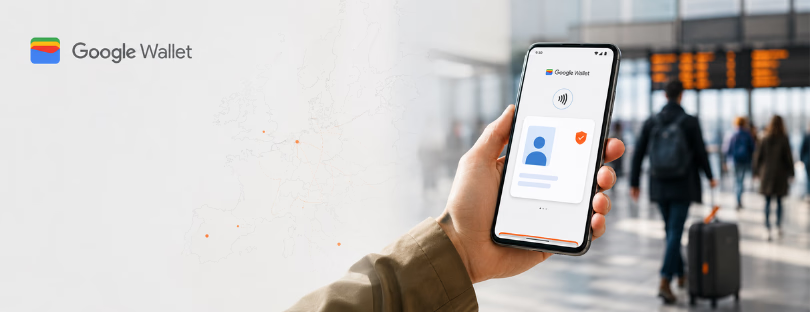
On paper, the feature is simple: users will be able to create a digital version of their passport inside Google Wallet and use it for selected online identity and age verification checks. In practice, it says something bigger about where digital identity is going. Payments, travel, age checks, banking, public services and telecom onboarding are all slowly moving toward the same question: can your phone prove who you are without forcing you to overshare?
Google thinks the answer is yes.
How ID Pass works
Creating an ID Pass in Google Wallet follows a fairly familiar flow. Users open the Google Wallet app, tap “Add to Google Wallet,” select “ID,” then choose “ID Pass.” From there, they select their issuing region or country, scan the information page of their passport, scan the document’s NFC security chip, and complete a short video selfie check.
Once verified, the pass is encrypted and stored locally on the device. Google says the information is not stored in the cloud or transferred to its company servers. That distinction matters, because digital identity is not just a convenience story. It is also a trust story.
The more interesting part is selective disclosure. If a merchant, platform or service only needs to know whether someone is over 18, the system can share that yes-or-no confirmation instead of handing over the person’s full name, date of birth, address or passport details. That is a much better model than sending scans of documents into random online forms, which is still far too common.
Why Europe matters
Google has already rolled out ID Pass in markets including Brazil, India, Singapore, Taiwan and the United Kingdom. It has also been building digital credential support in the United States, where some state-issued IDs and driver’s licences can be stored in Google Wallet.
Europe, however, is different. The EU is already building its own digital identity infrastructure under eIDAS 2.0. Every member state is expected to offer at least one European Digital Identity Wallet, giving citizens and residents a way to identify themselves, store credentials and share verified information across borders.
That means Google is not entering an empty market. It is entering a market that is being shaped by regulators, banks, national ID systems, public-sector wallets and private technology platforms at the same time.
For users, this could be useful. For policymakers, it will raise questions. Who controls the wallet experience? Which credentials become widely accepted? And how do private wallets sit alongside official national and EU identity tools?
Banking joins the first use case
The first concrete European banking example involves Sparkasse Bank in Germany. Sparkasse has been named as Google’s first national credential partner for EU age assurance. With more than 340 regional savings banks and over 50 million customers, it gives Google a serious financial-sector entry point.
The use case is practical: Sparkasse customers should be able to prove they meet an age requirement to a merchant or online service through Google Wallet without disclosing unnecessary personal information.
READ MORE: Google Pay App Explained: Setup, Use & Travel Tips
This is where digital identity becomes less abstract. Age verification is a growing issue for online platforms, financial services, gaming, alcohol-related purchases, adult content access, mobility services and regulated digital commerce. A privacy-preserving age check could be much cleaner than today’s patchwork of uploads, manual reviews and intrusive verification flows.
At the same Money 20/20 event, Google also announced that Google Pay direct checkout is available for selected merchants using Airwallex. It also highlighted an updated Secure Payment Authentication feature, which Google says reduced authentication time by 50% and increased conversions by 3% in its own testing, with rollout involving Visa, Checkout.com, Autopay and Adyen in the UK and Poland.
So this is not only about identity. It is about reducing friction at checkout, in onboarding and in regulated digital journeys.

What it does not replace
Travellers should be careful here. Google Wallet ID Pass does not replace a physical passport for border crossing, immigration or air travel boarding where a legal travel document is required.
That point is important because the phrase “digital passport” can easily create the wrong impression. For now, this is best understood as a digital verification tool, not a travel document. It may help with pre-trip checks, account verification, age confirmation or selected identity flows. It does not mean you can leave your passport at home before flying to another country.
READ MORE: Trainline Partners with Google Wallet for Seamless Ticketing
It is also not for everyone yet. Availability is limited by country, device support, document compatibility and acceptance by services. Users who do not trust private wallets with identity credentials, or who prefer national identity apps such as Italy’s IT-Wallet on the IO app, may choose to wait until EU-backed wallets mature further.
Italy is a good example of how crowded this space is becoming. The country already has national digital identity tools, participates in European digital identity projects, and has been expanding its own wallet infrastructure. Google Wallet adds convenience, but not necessarily the final answer.
The real signal Google Wallet ID Pass Europe
The bigger story is not that Google is putting passport-based ID Passes into Wallet. The bigger story is that identity is becoming a platform layer.
Apple Wallet, Google Wallet, national wallets, banking apps and future EUDI Wallets are all moving toward the same destination: fewer plastic cards, fewer document scans, more verified attributes, and more control over what data gets shared.
For travel, this could eventually make check-in, car rental, hotel registration, age-restricted bookings and mobility services smoother. But the winning model will not be the one that simply digitises a passport. It will be the one users trust, regulators accept and businesses actually integrate.
Google has scale and a polished wallet experience. Europe has regulation, public infrastructure and strong privacy expectations. The next phase will be about interoperability. Until then, Google ID Pass looks useful, but limited. It is a smart step toward digital identity, not the moment physical passports disappear.