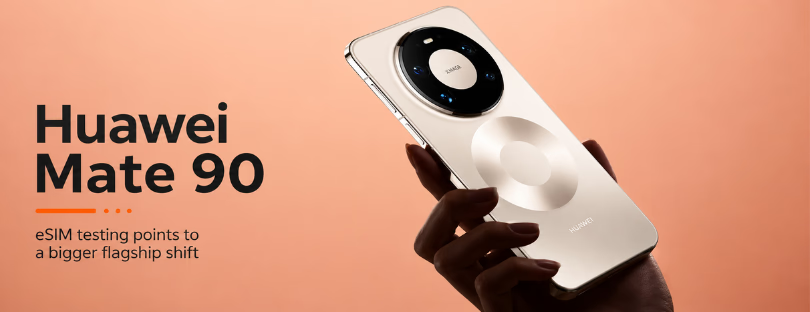
Huawei Mate 90 Could Push eSIM Further in China
Huawei appears to be preparing a bigger eSIM push for its next Mate flagship family, and that matters more than it may first sound.
According to Huawei Central, citing Weibo tipster SmartPikachu, Huawei has started testing eSIM capability for the upcoming Mate 90 series. The report does not confirm which models will get the feature, so the safest reading is simple: Huawei is evaluating eSIM for its 2026 Mate lineup, with the premium versions looking like the obvious candidates.
That would fit Huawei’s recent pattern. Last year, the Mate 80 RS Ultimate Design became the first Huawei smartphone to introduce a dual-eSIM setup, combining physical SIM slots with eSIM profiles.
Why this is not just another spec
On paper, “two physical SIMs plus two eSIMs” sounds like a neat technical detail. In real life, it changes how a phone behaves for people who live between networks.
The Mate 80 RS approach supports up to four numbers on one device, with two numbers usable at the same time. That is useful for people juggling private and business lines, but also for frequent travellers, cross-border workers and executives who want to keep a domestic number active while adding a data plan abroad.
READ MORE: Best Budget eSIM Phones for Smarter Travel
Huawei has described eSIM as the “advanced avatar of the physical SIM card,” enabling users to activate mobile service for voice, SMS and data without relying only on the removable card. That wording matters because Huawei is not presenting eSIM as a travel hack. It is positioning it as the next form of mobile identity.
China’s eSIM moment is different
In the West, eSIM often gets discussed through the iPhone lens. Apple says eSIM is a digital SIM built into the iPhone that can store eight or more eSIMs and simplify switching, travel and activation. In markets where iPhones are eSIM-only, that shift has pushed the market forward by removing the SIM tray from premium devices altogether.
Android is moving in the same direction, although less uniformly. Samsung lists eSIM support across recent Galaxy S, Z Fold, Z Flip and selected A-series models, while Google says US Pixel 10 models are eSIM-only. In other words, eSIM is no longer a niche checkbox. It is becoming part of the default flagship experience.
Huawei’s situation is more nuanced. In China, eSIM phone services have moved more carefully, with operator support, identity checks and service procedures still playing a bigger role than in some Western markets. That means Huawei cannot simply copy Apple’s eSIM-only path. A hybrid design — physical SIM plus eSIM — is the more practical bridge.
Why Mate 90 could matter
If Huawei expands eSIM beyond one ultra-premium model, the Mate 90 series could become a signal to Chinese operators and device makers: eSIM is ready to move from showcase feature to product strategy.
That does not mean every Mate 90 model will get it. The base and Pro versions may still rely on physical SIMs, while Huawei keeps the enhanced setup for top-tier models. This would be a very Huawei-style rollout: introduce a capability on the highest-end devices, test demand, then gradually bring it down the portfolio.
READ MORE: eSIM-Only Phones Put Operators Under Pressure
The timing also makes sense. Huawei’s next Mate series is expected in the fall, with recent reports pointing to a possible September window. Camera, chipset and HarmonyOS upgrades may dominate the launch. For the connectivity market, though, eSIM may be one of the more meaningful upgrades.
The bigger trend
The eSIM market is no longer waiting for awareness. It is waiting for habit.
GSMA Intelligence puts global eSIM smartphone penetration at 5% at the end of 2025, rising to 10% by the end of 2026. Trusted Connectivity Alliance also reported accelerating eSIM growth in 2025, with eSIM shipments up 18% and consumer adoption up 43%. The direction is clear: device roadmaps, operator systems and user behaviour are starting to line up.
Still, eSIM is not perfect for everyone. People who swap SIM cards between older phones, rely on smaller local operators, or travel to markets with limited eSIM support may still prefer a physical slot. What could improve is the transfer experience. Moving an eSIM between devices is better than it was, but still depends on the carrier, region and operating system.
That is why Huawei’s likely hybrid approach is smart. It does not punish users who still need plastic SIMs, but it gives power users the digital flexibility they increasingly expect.
Conclusion
Huawei’s Mate 90 eSIM testing should not be treated as a confirmed product feature yet. It is still a leak, and the model split remains unclear. But strategically, it fits the direction of the premium smartphone market.
Apple is pushing eSIM as a cleaner, more secure default. Google is already eSIM-only on some US Pixel models. Samsung has made eSIM a normal part of its premium Galaxy portfolio. Huawei, meanwhile, appears to be taking a more China-sensitive route: keep the physical SIM, add more digital identity, and let power users manage several numbers from one device.
The future of smartphone connectivity will not arrive in one clean global switch. It will arrive through hybrid designs, operator readiness, better onboarding and devices that make multi-line life feel normal. If Mate 90 brings eSIM to more than one Huawei flagship, it will be another sign that eSIM is moving from “nice extra” to expected infrastructure.