Inside China’s Fully Robotic Hotel Opening in 2027
A hotel where robots handle reception, luggage, cleaning, food delivery and guest support sounds like something built for a trade-show booth. This time, it has an address and an opening window.
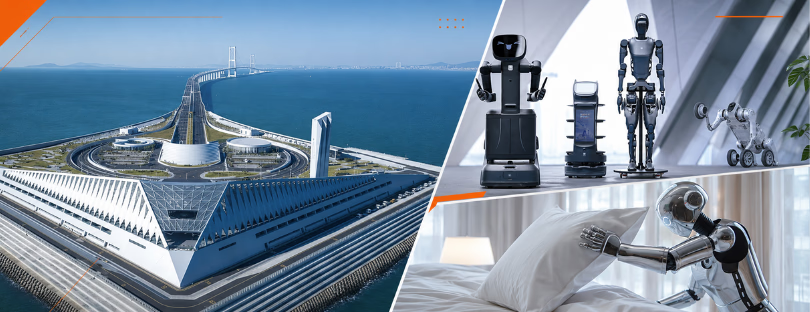
Pudu Robotics and Shenzhen Culture & Tourism Industry Development are preparing what they describe as the world’s first “full-scenario robot-serviced hotel” on West Artificial Island, part of the Shenzhen-Zhongshan Link in China’s Greater Bay Area. A trial phase is planned for late 2026, with the full opening expected in 2027.
This is not a roadside hotel chasing viral TikToks. West Artificial Island is part of a major cross-sea infrastructure project, and the ambition is larger than accommodation.
What guests can expect
The hotel is expected to have 44 premium rooms, a restaurant, a gym and common areas connected through a single smart service system. The idea is simple on the surface: arrive, check in, receive luggage, order drinks, request room service and move through the stay with robots handling the visible service layer.
Pudu’s confirmed fleet includes FlashBot for mobile ordering and drink delivery, the PUDU T300 for luggage transport, and cleaning robots including the PUDU CC1 Pro and PUDU MT1. At the launch event, BellaBot Pro and KettyBot Pro also demonstrated coffee, snack and refreshment service.
READ MORE: Hotel Tech Trends: Personalization & AI Power Hospitality Growth
The more interesting part is orchestration. Pudu says its PuduFM 1.0 model and PuduAgent platform will allow robots with different roles to work from a “shared intelligence framework”. Reception, delivery and cleaning robots are not supposed to behave like isolated gadgets. They are meant to operate like one coordinated hotel team.
That is the real test. A hotel where the robot, elevator, payment system, room status and guest request history all work together is much harder.
Why China is the obvious stage
China has the manufacturing base, robotics suppliers, smart-city appetite and tourism infrastructure to turn this kind of idea into a physical destination. Shenzhen already has a strong hardware ecosystem and has become shorthand for fast-moving commercial technology.
There is also a market logic behind the spectacle. The International Federation of Robotics reported nearly 200,000 professional service robots sold globally in 2024, while hospitality remained one of the largest service-robot categories by volume. Mordor Intelligence also expects strong growth in hospitality robotics through 2031, driven by labour shortages, contactless habits and hotel operators looking for predictable operations.
READ MORE: Hospitality Tech Is Changing Faster Than Hotels Realize
For hotels, robots are rarely about replacing charm. They are about removing friction from repetitive tasks. Late-night deliveries, corridor cleaning, luggage movement, wayfinding and multilingual check-in are not always where human service creates the most value.
The catch is that Pudu’s project goes further. It is selling the absence of human intervention as part of the product.
The Henn-na lesson
The obvious comparison is Japan’s Henn-na Hotel, famous for dinosaur receptionists and humanoid staff after opening in 2015. It was charming, strange and genuinely important as an early experiment. It was also a warning. Reports in 2019 said the hotel reduced a large share of its robot workforce after some machines annoyed guests, misunderstood requests or needed too much human support.
That history makes Pudu’s project more serious, not less. The industry has learned that a robot hotel cannot survive on novelty alone. It has to be operationally boring in the best possible way: reliable elevators, accurate room delivery, clean floors, simple support and clear escalation when something breaks.
This is where the China project could become a milestone or another showroom. It needs human-grade service recovery, transparent data and privacy rules, multilingual support that actually works, and maintenance teams behind the curtain. A hotel with no visible staff still needs accountability.
Not for every traveller
Some guests will love this: tech tourists, business travellers, families with curious kids and people who prefer low-contact stays. For them, the hotel is not just a room; it is a live demonstration of where service automation is heading.
But it will not be for everyone. If you choose hotels because of the concierge who remembers your name, the bartender who reads the room, or the small human improvisations that make travel feel warmer, a fully robotic property may feel efficient but emotionally thin.
READ MORE: 10 Coolest Hotel Robots Around the World
That is why the better future for most hotels is probably hybrid. Companies such as Keenon Robotics, Bear Robotics, Relay Robotics and LG-backed hospitality automation players are pushing practical models: delivery bots, restaurant runners, cleaning units and lobby assistants that support staff rather than replacing the whole guest-facing experience.
What this really means
Pudu’s robot-operated hotel is not just a story about a futuristic check-in desk. It is a signal that hospitality is becoming part of the wider automation economy, where hotels behave more like connected service platforms.
The smartest operators will not copy this model blindly. They will watch what works, steal the useful pieces and ignore the theatre. A robot should not be in a hotel because it makes a good photo. It should solve a real operational problem better, faster or more consistently than the old process.
If Pudu proves that full-scenario robotics can feel smooth rather than strange, the hotel industry will pay attention. If it feels cold, buggy or over-engineered, it will still teach the market something valuable: in hospitality, technology only wins when the guest stops noticing it.