
7 Travel Connectivity Market Trends to Watch
A traveler lands in Tokyo, opens a rideshare app, checks a hotel message, approves a bank alert, and joins a work call before reaching baggage claim. That sequence now feels ordinary, which is exactly why travel connectivity market trends deserve closer attention. Connectivity is no longer a travel add-on. It sits at the center of customer experience, ancillary revenue, operational resilience, and brand trust.
For travelers, the expectation is simple: service should work immediately and predictably. For airlines, hotels, telecom operators, and travel platforms, the challenge is harder. They need to deliver fast, affordable, high-visibility connectivity across fragmented networks, changing regulations, and rising customer expectations. The result is a market that is growing, but not in a straight line. Some segments are maturing. Others are being rebuilt from the ground up.
Travel connectivity market trends are shifting from access to experience
A few years ago, the selling point was basic access. Could the traveler get online at all? That question still matters in some corridors, but in most developed travel markets, the conversation has moved on. Reliability, onboarding speed, pricing transparency, and cross-border continuity now matter more than raw availability.
This shift changes how companies compete. A mobile operator with broad coverage but confusing roaming terms may lose to a more transparent offer. An airline with onboard internet that technically works but requires awkward sign-in steps may still disappoint customers. A hotel with strong lobby coverage but weak room performance risks poor reviews even if it advertises free Wi-Fi.
In other words, connectivity is being judged as a full-service layer, not a technical utility. That pushes providers to think beyond network reach and toward user journey design.
Roaming economics are under pressure
One of the clearest travel connectivity market trends is the steady pressure on traditional roaming revenue. International travelers have become more price-aware, and they are better at comparing options before departure. That has weakened the old model where operators could rely on customer inertia and opaque pricing.
This does not mean roaming is disappearing. Far from it. Roaming still matters because it offers continuity, convenience, and native-number access. Business travelers in particular often prefer not to switch behaviors when crossing borders. But roaming economics are changing. Operators increasingly need to justify the premium through quality, bundled benefits, enterprise features, or partnership-led distribution.
There is also a regional story here. In some markets, regulatory intervention has already squeezed margins. In others, competitive pressure is doing the same job. Providers that once treated roaming as a high-margin legacy product are being forced to rethink packaging, wholesale agreements, and customer retention strategy.

Airlines are treating connectivity as a product, not a perk
In-flight connectivity is moving into a new phase. For years, many airlines positioned onboard internet as a nice extra – useful for some passengers, irrelevant to others. That view is fading. Travelers increasingly expect meaningful onboard access, especially on long-haul routes and for premium or business travel.
What is changing is not just availability, but the business model around it. Some carriers now use connectivity to support loyalty, sponsorship, premium cabin differentiation, or broader digital retail strategy. Free messaging, ad-supported access, and tier-based internet are all part of the mix. The smart move is not always full free Wi-Fi for everyone. It depends on route economics, aircraft type, passenger mix, and the airline’s wider digital strategy.
READ MORE: Booking Platforms Monetized Flights and Stays. Connectivity Is Next
There is a technical trade-off too. Better onboard performance can improve customer perception, but installation costs, satellite partnerships, retrofit complexity, and service consistency remain real constraints. Airlines that market connectivity aggressively and then underdeliver create a trust problem. In this segment, expectation management is as important as bandwidth.
Hospitality is underestimating how visible bad connectivity has become
Hotels used to treat internet access as an amenity. Guests now treat it as infrastructure. That sounds like a small language shift, but commercially it is significant. A poor breakfast might annoy a guest. Poor connectivity can disrupt work, payments, bookings, messaging, entertainment, and smart-room functions all at once.
This is why hotels are becoming a more important part of the connectivity value chain. The stronger operators are looking at network quality not only as an IT issue, but as a contributor to revenue, ratings, and guest retention. Business hotels, resorts, serviced apartments, and long-stay properties all face slightly different usage patterns, so the winning model is not identical everywhere.
The market is also seeing more overlap between hospitality tech and telecom strategy. Property-level connectivity decisions now influence app adoption, digital check-in performance, upsell effectiveness, and staff productivity. For hotel groups, this means connectivity investment is easier to justify when it is tied to broader operating metrics, not just guest complaints.
Enterprise travel is pushing demand for managed global connectivity
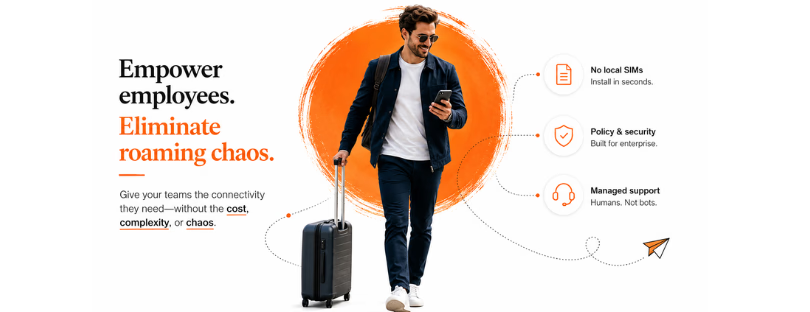
Consumer travel gets most of the attention, but enterprise mobility is one of the most commercially significant travel connectivity market trends. Companies with traveling employees want predictable service, centralized visibility, policy control, and lower support friction. They are less interested in one-off fixes and more interested in managed, scalable frameworks.
That demand is pushing telecom providers and travel-tech firms toward tighter integration. Expense management, device policy, traveler safety, and international mobile access are becoming linked decisions. A disconnected experience is costly for enterprises because it affects productivity and support overhead, not just user satisfaction.
READ MORE: The 6 Moments Where You Could Sell eSIM (But Don’t)
This creates opportunity, but also complexity. Enterprise buyers expect reporting, billing clarity, compliance controls, and service reliability across multiple countries. Providers that can simplify those layers have an advantage. Providers that only compete on raw data pricing may struggle to win larger accounts.
Regulation and security are becoming product issues
Travel connectivity is often discussed as a commercial or consumer convenience story, but regulation and security are now shaping product design more directly. Data privacy rules, lawful intercept requirements, digital identity frameworks, and cross-border telecom restrictions all affect how services are deployed and monetized.
For travelers, the visible effect may be small. A sign-in flow changes, a verification step appears, or a service works differently in one country than another. For operators and platforms, the impact is much bigger. Compliance can influence partner selection, provisioning methods, customer onboarding, and time to market.
Security expectations are also rising because travelers increasingly handle sensitive tasks while in transit. Banking, corporate communication, identity verification, and travel booking all happen on the move. That makes trust a competitive factor. A provider that is cheap but unclear on privacy, traffic handling, or account protection may lose to one that communicates those points well.
 Connectivity monetization is getting more creative
The next stage of growth is not only about selling access. It is about using connectivity to enable adjacent revenue. Airlines can tie onboard access to loyalty and retail. Hotels can use stronger digital infrastructure to support app engagement and premium services. Telecom operators can bundle travel-oriented plans with financial services, insurance, or loyalty perks.
This matters because pure connectivity is getting harder to differentiate in isolation. Margins tighten as access becomes more expected and easier to compare. Companies that treat connectivity as a platform for broader traveler engagement are in a stronger position than those that treat it as a standalone SKU.
READ MORE: Your Customers Travel. Why Aren’t You Monetizing It?
That said, not every monetization idea works. Customers are quick to spot artificial bundles or weak value. If the offer feels padded, adoption drops. The commercial upside comes when connectivity improves a service the traveler already cares about, such as convenience, speed, or certainty.
Infrastructure investment is still uneven by geography
One reason the market remains so dynamic is that performance is highly regional. Urban hubs, major airports, and premium travel corridors often improve quickly. Secondary cities, remote destinations, maritime routes, and certain cross-border areas do not always keep pace. This creates a two-speed market.
For businesses, that means strategy cannot rely on global averages. A travel brand may perform well in North America and still disappoint customers in parts of Latin America, Africa, or island destinations if network partnerships are weak. A telecom player may have strong domestic quality and poor travel relevance outside its core region.
The practical lesson is simple: travel connectivity is still local in execution even when it looks global in branding. Companies that understand corridor-specific demand, infrastructure limits, and partner quality tend to make better commercial decisions.
What matters next in travel connectivity market trends
The market is heading toward a more integrated model where connectivity, identity, payments, loyalty, and customer service increasingly overlap. Travelers do not think in industry silos. They only notice whether the experience works. That is why the winners in this space will not be the loudest marketers. They will be the companies that reduce friction at the moments when travel is most time-sensitive and least forgiving.
For readers tracking the sector through Alertify, that means looking past headline claims and asking harder questions. Does the product reduce uncertainty? Does it scale across real travel patterns? Does the revenue model hold up as customer expectations rise? Those are the questions shaping the next wave of growth.
The smartest players in this market are not chasing connectivity for its own sake. They are treating it as the operating layer that makes modern travel feel dependable.