Hospitality Tech Is Changing Faster Than Hotels Realize
For years, hospitality treated technology as something that sits in the background. Necessary, but invisible. Booking engines, PMS systems, revenue tools… all quietly powering the business while the real value happened at the front desk, in the room, or through service.
That model is gone.
Today, technology is no longer supporting hospitality. It is shaping it. And if you talk to anyone building or running large hotel ecosystems, the shift is obvious. The conversation is no longer about systems. It is about experiences, consistency, and how to scale something that still feels personal.
That’s where things get interesting.
Because hospitality has a problem most tech-driven industries don’t have: you can’t automate the human part. But you still need to scale it globally.
The Real Challenge: Scale Without Losing the Soul
The biggest tension in hospitality right now is simple to describe and incredibly hard to solve.
You want every guest to have a consistent experience. But you also want every location to feel local, unique, and human.
Technology is what sits in the middle of that contradiction.
Without it, you get inconsistency. With too much of it, you risk becoming sterile.
That balance is exactly what leaders are trying to figure out. And increasingly, the answer is not “more systems” but better orchestration. Systems that talk to each other. Data that flows. Experiences that feel continuous rather than fragmented.
Because from the guest’s perspective, nothing should feel like a system at all.
Guests Don’t See Systems. They Feel Moments
This is where hospitality is quietly ahead of many other industries.
E-commerce still exposes friction. Fintech still has moments where things break. Telecom… well, that’s a different conversation entirely.
But in hospitality, the expectation is higher.
You search, book, check in, enter your room, order service, check out. That entire journey needs to feel like one continuous experience.
Not five platforms stitched together.
Not a mobile app fighting with a front desk system.
Just one flow.
And this is exactly the direction the industry is moving toward. Less focus on individual tools, more focus on end-to-end experience design.

A Quick Look Inside Marriott International’s Thinking
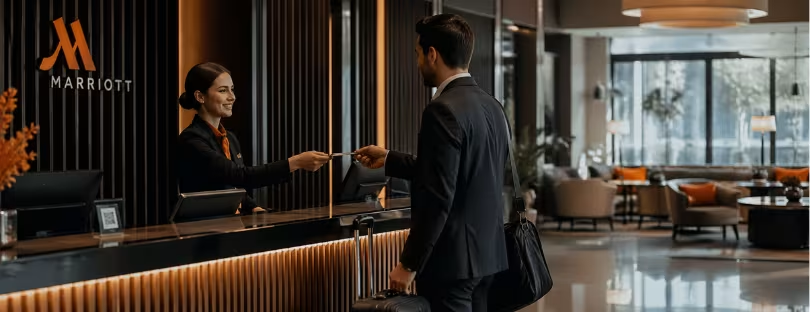
If you want a concrete example of how this shift looks at scale, it’s worth looking at how Naveen Manga, global CIO of Marriott, frames it.
He puts it very directly:
“For many decades, the mindset was to create technology that was built to last. Today, the goal is to build technology that is designed to change. So, as the business evolves, technology adapts.”
That one sentence captures the entire transformation.
Hospitality tech used to be static. Now it has to be flexible by design.
Manga also reframes what technology leadership actually means inside a global hotel group. It’s no longer about systems on a dashboard.
It’s about outcomes.
Guest experience. Staff productivity. Owner economics.
If those three work, everything else follows.
And from the guest perspective, the ambition is even clearer:
“Guests do not experience systems. They experience moments.”
That’s the bar now.
AI Is Everywhere. But It’s Not the Point
Like every other industry, hospitality is deep into AI experimentation.
Revenue management, pricing, personalization, marketing content… AI has already been embedded for years in some of these areas. Generative AI is now extending that into guest communication and internal productivity.
But there’s a nuance here that often gets lost in the hype.
AI doesn’t create value on its own.
It only matters if it improves outcomes.
That’s why the more serious players are moving away from scattered AI pilots and toward structured deployment. Layered architectures. Governance frameworks. Reusable capabilities.
Manga describes it as moving toward a scalable AI “chassis” with orchestration across use cases.
In simpler terms: stop experimenting in silos. Start building infrastructure.
And maybe more importantly, rethink the role of humans in that system.
It’s no longer “human in the loop.”
It’s “human in the lead.”


The Shift to Composable Everything
If there’s one concept quietly reshaping hospitality tech, it’s composability.
Instead of building massive, monolithic systems that do everything, companies are moving toward modular capabilities. Small pieces that can be assembled, reassembled, and scaled depending on the need.
Think of it like this:
You don’t rebuild your entire tech stack to launch a new guest experience. You plug together components that already exist.
That’s how you move fast without breaking consistency.
That’s how global brands operate at scale without becoming rigid.
And it’s not just a Marriott idea. You see the same shift across major hospitality groups, and even beyond the industry.
Cloud-native architectures, API-first platforms, modular services… it’s all pointing in the same direction.
Where This Is Going Next
The direction is pretty clear now.
Hospitality is becoming an orchestration layer.
Not just for rooms and services, but for data, experiences, and increasingly, adjacent verticals like travel connectivity, payments, and mobility.
Airlines are already doing it. Fintech is embedding into travel. Telecom is trying to move closer to the user journey.
The hotel is no longer just a place you stay.
It’s becoming a node in a much bigger digital ecosystem.
And that’s where things start to overlap with what we’re seeing in travel tech more broadly.
Conclusion: The Winners Will Be Invisible
If you step back and look at the bigger picture, the shift in hospitality mirrors what’s happening in other industries, but with one key difference.
In hospitality, the best technology is the one you don’t notice.
That’s the real benchmark.
Compare this to airlines like Delta Air Lines investing heavily in biometric journeys, or platforms like Airbnb building end-to-end digital experiences. Even telecom players are trying to embed connectivity directly into travel flows instead of selling it separately.
Everyone is moving toward the same idea: seamless, continuous experience.
What Marriott and others are doing is pushing that idea further inside a physical environment where human interaction still matters.
That’s much harder to get right.
Reports from Deloitte and McKinsey & Company consistently point to the same trend: hospitality leaders who invest in integrated digital ecosystems outperform those who treat tech as infrastructure.
But the nuance is this.
The winners won’t be the ones with the most technology.
They’ll be the ones where technology disappears completely.
Where the guest just feels understood, everything works, and nothing gets in the way.
That’s not a tech problem anymore.
That’s a design problem.