The hidden cost of global workforce connectivity
For years, the business case for travel eSIMs has been easy to explain: roaming is expensive, eSIMs are cheaper, problem solved.
Except for companies, it has not been solved.
Roaming charges are only the cost everyone can see. They appear on an invoice. They trigger a complaint. Someone in finance asks why one trip produced a mobile bill that looks like a flight upgrade. It is visible, and because it is visible, it gets attention.
The hidden cost sits around it.
It is the sales director who lands in Singapore and spends 40 minutes trying to get connected before a client meeting. It is the consultant who buys a consumer eSIM on a personal card, then submits a receipt in another currency. It is the project manager who uses airport Wi-Fi because the data plan failed. It is IT having no live view of what is happening, finance having no clean reporting, and procurement discovering that “cheap travel data” has quietly become another unmanaged supplier category.
Global workforce connectivity is no longer just a roaming problem. It is an operational cost problem. And corporate mobile cost control has become a big problem.
The bill is not the whole bill
Companies usually start with the obvious question: how do we reduce roaming?
That is understandable. Traditional roaming has been unpredictable, especially for international teams moving across regions, client sites, events and remote work locations. Travel eSIMs changed the conversation by making short-term international data easier to buy and activate.
But once workforce connectivity moves beyond a few individual travellers, the economics become more complicated.
A €20 or €30 travel eSIM may look cheap at the point of purchase. But what happens when 200 employees buy different plans from different providers, in different currencies, with different expiry dates and support processes? What happens when some overbuy because they are afraid of running out, while others underbuy and then purchase mid-trip again? What happens when finance has to reconcile dozens of small claims that were never part of a central policy?
This is where “savings” become difficult to prove.
READ MORE: Enterprise eSIM 101: What IT Teams Really Need
The direct mobile data charge might fall, but the business absorbs cost elsewhere: expense processing, admin time, user downtime, support tickets, duplicated purchases, fragmented contracts and weak visibility.
IDC’s enterprise mobility research frames mobile deployment as part of the wider corporate workspace strategy, not merely a device or telecom issue. Its Enterprise Mobility: Workspace and Deployment Strategies research examines how mobile device deployments are evolving in the corporate market, which is the right lens for this topic: connectivity is now part of how employees work, not just how they roam.
Fragmentation is expensive
The consumer travel eSIM market has done something genuinely useful. Providers like Airalo, Holafly and GigSky have made international data feel normal, digital and accessible. For individual travellers, that is a win.
The problem starts when the same buying behaviour enters the company through the side door.
One employee uses Airalo. Another uses Holafly. A third uses GigSky. Someone else buys a local SIM because they prefer it. A team leader tells people to “just expense it.” Suddenly, the company has connectivity, but no real management layer.
This is shadow IT in mobile data form.
READ MORE: Why Travel eSIMs Break at Enterprise Scale?
The company may not see it that way at first because the tools are legitimate. These are not suspicious apps or unsafe downloads. They are mainstream travel connectivity products. But from a governance perspective, the result can still be messy.
Who approved the supplier?
Who owns support?
Can usage be audited?
Can spending be capped before it happens?
Can IT see whether a user is actually connected?
Can procurement negotiate around total usage rather than scattered receipts?
This is why business products have emerged from travel-first players. Airalo for Business promotes eSIMs for business travel, 200+ destinations, automated package renewals and a dashboard with visibility into expenses and data usage. Holafly’s business content also positions its offer around keeping companies connected, invoicing and employee eSIM management.
That is a real improvement over unmanaged employee purchases. But it is still important to ask whether the product is solving business travel administration, or deeper enterprise mobility control. Those are related, but not the same.
Visibility changes the economics
The most expensive connectivity issue is often the one nobody can see in real time.
A user says the connection is slow. IT does not know which network they are on. Finance says spending is rising. Nobody can see usage by employee, department, destination or project until after the fact. A field team loses connectivity in a remote location. Operations cannot tell whether the issue is coverage, device setup, policy, plan exhaustion or network performance.
That uncertainty has a cost.
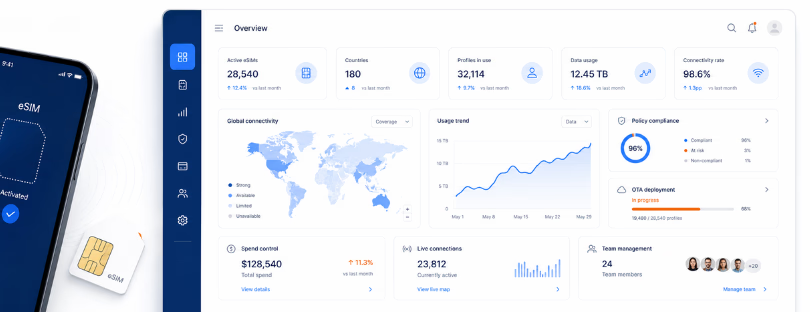
At enterprise scale, visibility is not a dashboard decoration. It is what turns connectivity from a reactive expense into a managed service. Companies need to know who is connected, where they are connected, what they are using, what it is costing, and where exceptions are appearing.
This is where the market starts to split into layers.
Travel-first eSIM brands are strong at quick access and user convenience. Business travel eSIM platforms add central purchasing, team management and easier reporting. Traditional enterprise telecom providers such as Vodafone Business and Orange Business bring account management, contract depth and managed mobility experience. Infrastructure-led players like 1GLOBAL sit closer to the full-stack telecom and eSIM enablement layer, particularly where provisioning, network control or embedded connectivity matter.
SureSIM’s role sits in a narrower but important part of this landscape: enterprise eSIM management for global workforce and device connectivity. Its platform positioning is built around visibility, cost control and centralised management rather than selling one-off travel data bundles. SureSIM Global includes access to over 450 local carrier networks across 200+ destinations on one plan and one agreement, with a single global tariff rather than daily passes, boIt-ons or local carrier portals.
The key point is not that every company needs the same model. They do not. The point is that hidden costs become easier to manage when the business can actually see what is happening.
Downtime rarely appears on the invoice
Employee downtime is a strange cost because everyone recognises it, but few companies measure it properly.
If an employee cannot connect after landing, the cost is not only the wasted data plan. It is the lost time. It is the missed call. It is the delayed upload. It is the stress before a meeting. It is the person who stops using corporate tools and starts improvising with public Wi-Fi, personal hotspots or messaging apps because they need to get work done.
That matters for frequent travellers. It matters even more for field teams, offshore workers, construction teams, healthcare staff, logistics crews and anyone whose work depends on being connected outside the office.
READ MORE: The Biggest Security Risk Enterprises Ignore: Connectivity
This is why coverage claims need more scrutiny. “Available in 200 countries” is useful, but it is not enough. Enterprise buyers should ask what happens when coverage is poor, which networks are available, whether multi-network access exists, whether usage is visible, whether support can intervene, and whether policies can be changed without waiting for the next billing cycle.
The NIST guidance on enterprise mobile device security is useful here because it treats mobile deployment as a lifecycle that must be managed, secured and monitored, not as a one-time setup. NIST’s five-step strategy for enterprise mobile deployment is focused on helping organisations build and manage the security of mobile deployments. That logic applies neatly to connectivity too. If mobile devices are part of the enterprise environment, the connectivity behind them cannot remain unmanaged.

Procurement needs a cleaner model
Procurement teams are usually not against travel eSIMs. They are against fragmentation.
They want fewer suppliers, clearer commercial terms, consolidated invoices, reporting they can use, and policies that reduce surprise spend. Finance wants to know where money is going before it becomes a problem. IT wants fewer tools to support. Employees want something that works without becoming another travel admin task.
The market is responding in different ways.
Airalo for Business and Holafly Business are making travel connectivity easier to organise for teams. GigSky has long served international travellers and businesses needing mobile data coverage. Vodafone Business and Orange Business remain relevant where companies want enterprise telecom relationships and broader managed mobility services. 1GLOBAL is important for buyers looking at eSIM infrastructure, provisioning and more advanced telecom control. SureSIM is closer to the enterprise workforce management layer, where the buyer wants global eSIM connectivity with usage visibility, corporate mobile cost control and policy awareness.
SureSIM’s Live View capability, for example, is designed to show current network, live data usage, cost-to-date and SIM status, with usage data typically refreshed within 10 minutes. That kind of capability belongs in the procurement conversation because it changes the question from “What is the data price?” to “How much corporate mobile cost control do we actually have?”
And that is the better question.
The real cost is unmanaged connectivity
The hidden cost of global workforce connectivity is not simply that companies pay too much for roaming. It is that many still manage mobile data as if it were an individual travel purchase while expecting enterprise-level outcomes.
That mismatch is where the money leaks out.
It leaks through employee downtime, manual expense claims, duplicated purchases, poor support routes, fragmented contracts, unclear usage, weak policy enforcement and procurement models that were never designed for global teams.
Travel eSIMs solved an important first problem. They made international data easier for individuals. The next phase is harder. Companies now need to make connectivity visible, governable and financially accountable.
That is why the strongest enterprise eSIM conversations are no longer about who has the longest destination list. Serious providers can all talk about reach. The more useful comparison is how they handle control.
For some businesses, a travel-first team product will be enough. For others, a traditional enterprise telco relationship will make more sense. For companies that need centralised visibility and a more operational view of workforce connectivity, platforms like SureSIM deserve attention, not as a magic answer to every use case, but as part of a market shift toward managed mobile data.
The most expensive connection is not always the one with the highest roaming rate.
It is the one nobody manages until it breaks.