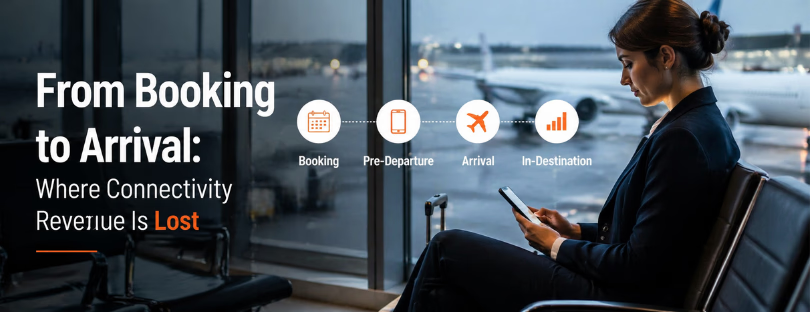
From the second a traveler books a flight to the moment they land and unlock their phone, there are multiple opportunities to sell connectivity. Most companies miss almost all of them.
And that’s not a small problem. The travel eSIM market alone is already worth over $1.4 billion and is projected to double in the coming years. At the same time, ancillary revenue has become critical, with airlines generating tens of billions from add-ons annually.
So the demand is there. The revenue is there. The infrastructure is easier than ever.
Yet the execution is still… surprisingly poor.
Let’s walk through where that revenue actually gets lost.
The booking moment everyone ignores
This is the most obvious one. And somehow still the most underused.
When someone books a flight, hotel, or trip, they are in “purchase mode.” They are already thinking about logistics. Bags, seats, insurance, transfers. Connectivity fits naturally here.
But in most booking flows, it’s missing entirely.
That’s strange when you consider how effective ancillary upsells have become. Airlines have trained users to accept add-ons during booking. In some cases, over 50% of passengers buy at least one extra service .
Connectivity should be one of the easiest to attach. It’s universal. It’s immediate. And unlike luggage, it’s not optional anymore.
Instead, what happens? The traveler books everything… except the thing they will need within 30 seconds of landing.
Pre-departure: high intent, zero guidance
A few days before travel is where behavior gets interesting.
People start checking things. Boarding passes. Weather. Local transport. And yes, data.
This is where they Google things like “internet in Italy” or “best SIM for Japan.”
Which means the intent is already there. The problem is that most travel brands are completely absent from this phase.
Instead, the user ends up on comparison blogs, affiliate sites, or directly inside eSIM apps.
This is where third-party providers win.
And this is not just anecdotal. Consumer awareness of eSIM is still relatively low, with only about one-third of users fully understanding it. That means whoever educates first often captures the sale.
If you’re not present in that moment, you’re not even in the consideration set.
More on Alertify
Follow the latest eSIM news
Market moves, provider updates, roaming trends, travel connectivity insights and the technology shaping how travellers stay connected worldwide.
The traveler lands. Turns off airplane mode. And nothing works.
This is where traditional telecom players used to dominate with roaming. Now, that model is being disrupted fast. Travel eSIMs are often cheaper and easier to activate, making them a preferred alternative.
But here’s the key detail.
If the traveler didn’t prepare in advance, they are now in a high-stress situation. And stressed users don’t explore options. They pick whatever is fastest.
That could be:
Expensive roaming
Random airport Wi-Fi
The first app they see
This is the least controlled, least profitable point in the journey. And yet for many brands, it’s the only moment where connectivity even becomes visible.
That’s backwards.
In-destination: someone else owns your user
Once the traveler is connected, the opportunity doesn’t disappear. It just shifts.
Now they are using maps, booking restaurants, ordering rides, and checking emails. Connectivity becomes the backbone of their entire trip.
And this is where another layer of value is lost.
Because whoever provided that connectivity now owns a small but critical part of the user relationship.
They can:
Upsell more data
Push notifications
Cross-sell travel services
Collect behavioral insights
In other words, connectivity is not just a one-time sale. It’s an entry point into the travel experience itself.
And most airlines, banks, and travel platforms give that away completely.
The structural reason this keeps happening
It’s easy to say “companies should just add eSIM.”
But the real issue is structural.
Travel companies are still organized around products:
Flights. Rooms. Payments. Insurance.
Connectivity doesn’t fit neatly into any of these categories. So it gets ignored.
Meanwhile, the market has moved on.
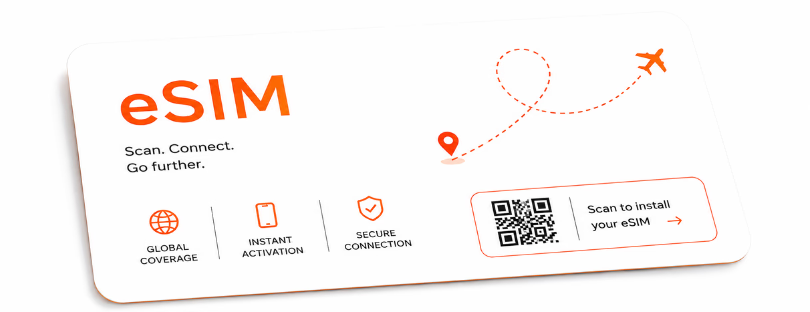
Connectivity is becoming a layer. Something that sits across the entire journey, not just one touchpoint. And thanks to Connectivity-as-a-Service platforms, launching it is no longer technically complex .
The barrier isn’t infrastructure anymore.
It’s mindset.
Your customers will buy connectivity. The question is: from you, or from someone else?
We help airlines, banks, and travel platforms turn that demand into a built-in product — not a missed opportunity.
Instead of treating connectivity as an add-on, they embed it across the journey:
At booking, as a simple upsell
Pre-trip, as a reminder or recommendation
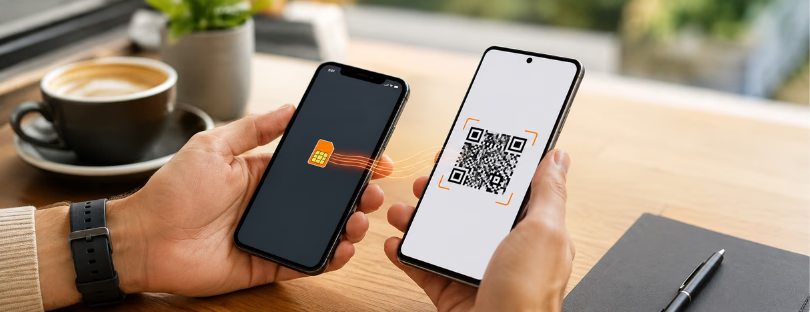
During travel, as a seamless activation
Post-arrival, as a managed service
This mirrors what happened with other ancillaries.
Seat selection used to be optional. Now it’s expected.
Baggage used to be included. Now it’s monetized.
Connectivity is following the same path.
The difference is that it’s more universal than any of those.
Everyone needs it.
Why this gap won’t last long
Here’s the reality.
eSIM adoption is accelerating quickly, with expectations that usage will double in the near term . At the same time, more than a third of international trips are expected to include eSIM usage by the end of the decade .
This is not a niche anymore. It’s becoming default behavior.
Which means the current gap between demand and integration won’t last.
Either travel brands capture this layer, or specialized connectivity players will continue to dominate it.
And right now, it’s mostly the latter.
Where the real opportunity sits eSIM monetization travel industry
The biggest misconception is that this is about selling data.
It’s not.
It’s about owning a moment in the travel journey that is currently fragmented, stressful, and highly valuable.
Connectivity sits exactly at the intersection of:
Revenue
Experience
Retention
Few products do all three.
That’s why the opportunity is so large. And why is the leakage so expensive?
Conclusion: This is not a telecom play anymore
If you compare what’s happening across the market, a pattern emerges.
Traditional telecom operators are losing control of roaming revenue. Agile eSIM providers are capturing demand. And travel platforms are stuck somewhere in between, watching value move past them.
The numbers support it. Travel eSIM revenue is growing fast, competition is increasing, and barriers to entry are dropping .
But here’s the more important shift.
Connectivity is no longer a telecom product. It’s becoming a distribution layer.
The companies that understand this are not just selling data. They are embedding connectivity into their ecosystem, turning it into part of their core offer.
The ones that don’t will keep leaking revenue at every stage of the journey.
From booking to arrival, the opportunity is there. The behavior is already there.
Driven by wanderlust and a passion for tech, Sandra is the creative force behind Alertify. Love for exploration and discovery is what sparked the idea for Alertify, a product that likely combines Sandra’s technological expertise with the desire to simplify or enhance travel experiences in some way.