How Does Travel eSIM Work, Exactly?
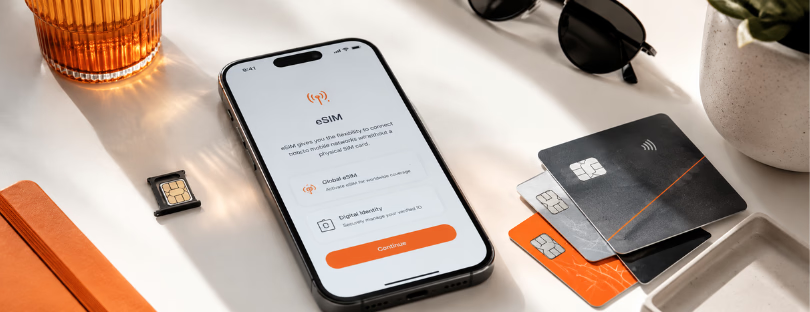
You land, switch off airplane mode, and your phone connects within seconds – no airport SIM kiosk, no plastic card, no guessing which local carrier to trust. That convenience is why so many travelers now ask, how does travel eSIM work, and is it actually better than roaming or buying a physical SIM? The short answer is that a travel eSIM lets you download a mobile plan digitally to your phone, then connect to partner networks abroad without swapping hardware.
The longer answer is more interesting, because travel eSIM sits at the intersection of consumer convenience and telecom infrastructure. It feels simple on the surface, but several moving parts decide whether your experience is smooth, cheap, fast, or frustrating.
How does travel eSIM work on a phone?
An eSIM is an embedded SIM built into the device itself. Instead of inserting a plastic SIM card, you install a carrier profile digitally. That profile contains the credentials your phone needs to authenticate on a mobile network.
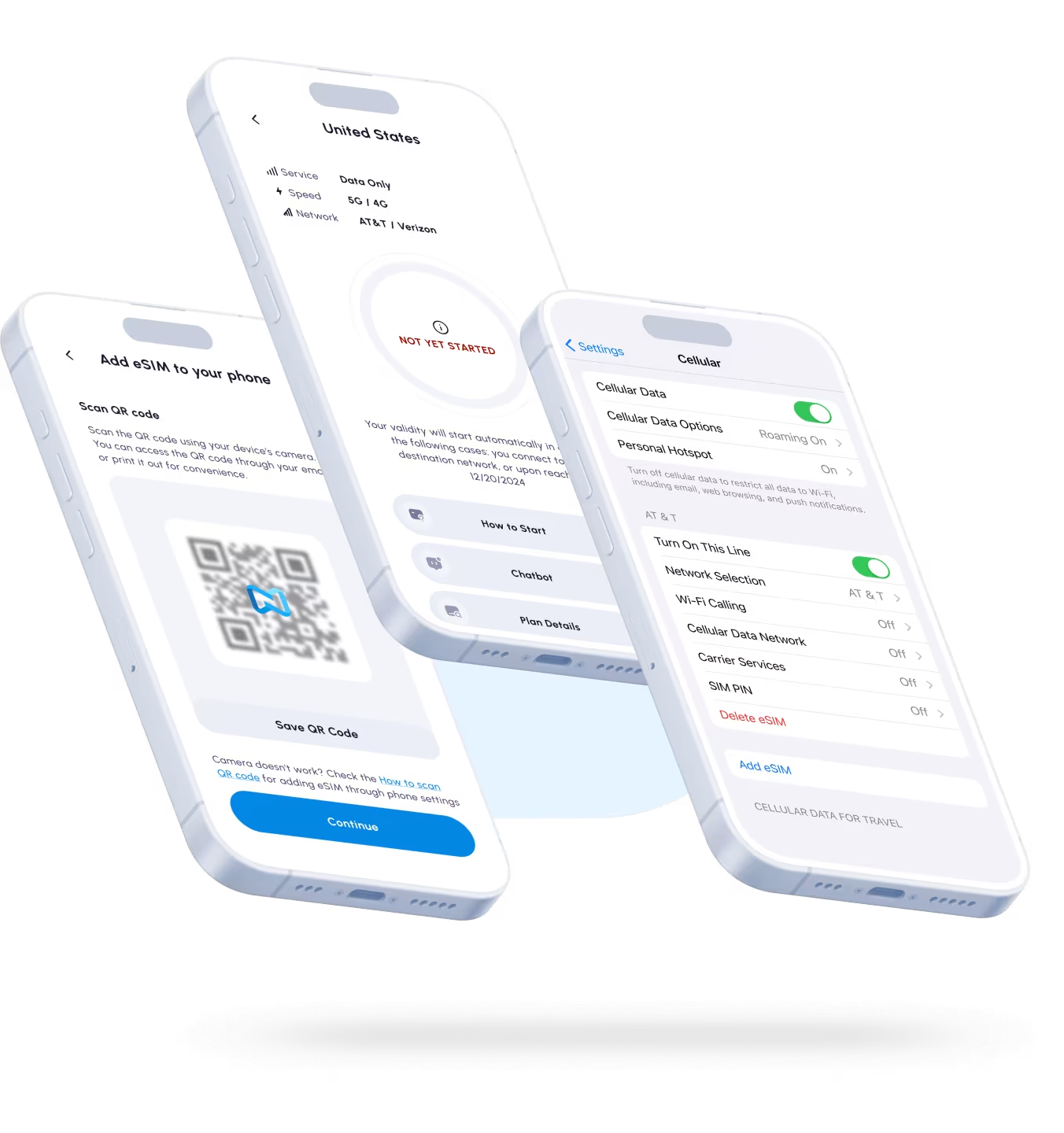
With a travel eSIM, the process usually works like this: you buy a plan from an eSIM provider, receive a QR code or app-based installation option, add the plan to your phone, and activate it either immediately or when you arrive at your destination. Once active, your phone connects to one of the provider’s partner networks in that country or region.
From the user side, it feels like adding another mobile line. From the network side, it is remote SIM provisioning. The carrier profile is delivered over the air, and your device stores it alongside or instead of your primary line, depending on the phone model.
That distinction matters because a travel eSIM is not magic global coverage. It is a commercial arrangement between the eSIM brand and local mobile operators. Your provider is essentially reselling access to partner networks, often with data-first packages designed for short-term travelers.
What happens after you buy a travel eSIM?
After purchase, most providers give you one of two setup paths. The first is a QR code you scan in your phone’s cellular settings. The second is in-app installation, where the provider handles provisioning more directly.
Once installed, your phone may show the new line right away, but that does not always mean the plan is active. Some plans start the moment you install them. Others start only when the eSIM first connects to a supported network in the destination country. That difference affects value. If you install too early and the validity starts immediately, you can burn a day or two before your trip even begins.
You will also usually need to decide how the phone should use each line. Many travelers keep their primary SIM active for calls or banking texts and assign the travel eSIM to mobile data. On dual SIM devices, that is often the smartest setup, but it comes with one warning: if your home line has data roaming enabled, your carrier may still generate charges.
Why travel eSIMs are usually data-only
Most travel eSIM products are built for data, not traditional voice and SMS. That is not a technical weakness so much as a product decision. Data is easier to package across multiple countries, and most travelers now communicate through apps anyway.
For consumers, that means WhatsApp, FaceTime, Telegram, Google Maps, ride-hailing, email, and browser access will work normally. What may not work is placing standard cellular calls from the eSIM number, because many travel eSIMs do not include one.
For business travelers, this changes the risk profile. If your workflows still depend on SMS-based two-factor authentication or direct calls to local numbers, check the plan details carefully. A cheap regional eSIM can be excellent for data and still be the wrong tool for voice-heavy usage.
 How does travel eSIM work across different countries?
A single travel eSIM plan may cover one country, a region, or dozens of markets globally. The reason that works is that the provider has roaming or wholesale agreements with operators in each supported destination.
When you cross a border, your phone does not keep using one universal network. It registers on a different local partner network based on the plan rules, signal availability, and preferred carrier settings. In practice, that means coverage can vary by country even under the same eSIM brand.
This is one of the biggest gaps between marketing and reality. A provider may advertise Europe coverage, for example, but your speeds in France, Italy, and Greece can be very different because the underlying network partnerships are different. In some markets, you may get premium network access. In others, traffic may be deprioritized versus local subscribers.
That does not make travel eSIM unreliable. It just means the service quality is only as strong as the provider’s wholesale relationships and network routing.
What you need for a travel eSIM to work
First, your phone has to support eSIM. Most newer flagship iPhones, Google Pixel devices, and many Samsung Galaxy models do, but not every version sold in every market includes the same capability.
Second, the device usually needs to be carrier-unlocked. If your phone is tied to one mobile operator, it may block the installation or activation of another carrier profile.
Third, you need a stable internet connection during setup, because the eSIM profile must be downloaded. It is easiest to install before departure while connected to Wi-Fi.
Finally, settings matter. Travelers often assume installation is enough, then discover the line was never turned on for data, data roaming was disabled on the travel line, or the wrong SIM remained the default for mobile data.
Where travel eSIM beats roaming
For most leisure and business travelers, the strongest advantage is cost control. Traditional roaming from your home carrier is convenient, but it can still be expensive or limited, especially outside bundled regions. A travel eSIM lets you see the allowance, validity period, and destination coverage upfront.
The second advantage is speed of setup. You can buy and install a plan before takeoff, then land connected. That has real operational value. For consumers, it means no scramble for Wi-Fi. For enterprise travelers, it reduces downtime and keeps staff reachable the moment they arrive.
There is also flexibility. If one provider’s pricing is poor for your route, you can switch plans without replacing hardware. That is a subtle but important shift from the old SIM-card model.
Where travel eSIM does not always win
The catch is that cheaper is not always better. Some low-cost eSIM plans route traffic in ways that increase latency, cap speeds after a threshold, or exclude hotspot use. Others offer fixed validity windows that do not match real travel patterns.
There is also a support issue. If something goes wrong with a local physical SIM, you can often walk into a store. With travel eSIM, support is usually digital. That is efficient when it works and maddening when it does not.
Another trade-off is phone compatibility. If you carry an older device, a physical SIM may still be the more practical option. And if you rely heavily on receiving calls to your home number, dual SIM behavior can get messy depending on the device and carrier.
The business angle behind travel eSIM
Travel eSIM is not just a consumer convenience product. It is part of a broader telecom shift toward digital provisioning, lower distribution costs, and more flexible mobile packaging. For airlines, online travel agencies, fintech apps, and hospitality brands, eSIM is increasingly a monetizable travel add-on rather than a niche telecom feature.
That matters because the buying journey is changing. Connectivity is moving closer to the point of trip booking, not just the point of arrival. The company that controls the traveler relationship can now bundle mobile data alongside flights, accommodations, insurance, or airport services.
For readers who follow Alertify for market context, this is where travel eSIM gets strategically interesting. It reduces friction for users, but it also changes who gets to own the connectivity layer and the margin attached to it.
So, should you use one?
If your priorities are fast setup, predictable pricing, and avoiding airport SIM queues, a travel eSIM is usually the smartest default. It is especially strong for short trips, multi-country itineraries, and travelers who mainly need mobile data for apps, maps, and messaging.
If you need a local phone number, expect heavy voice use, or carry a locked or older device, the answer is less automatic. In those cases, a local SIM or even a home carrier roaming pass may still make more sense.
The practical move is to treat travel eSIM like any other travel tool: useful, efficient, and worth checking before you rely on it. Look at coverage country by country, confirm when activation starts, and make sure your phone settings match the way you actually travel. The best connectivity setup is not the one with the boldest marketing claim. It is the one that keeps working when your trip starts moving.