Expedia Full-Trip Planning: Why Travel APIs Matter
Expedia Group is putting fresh numbers behind something many travel companies have been circling for years: travellers do not want another booking screen. They want the trip to make sense. Expedia travel booking API ecosystem
It’s new global research, commissioned from The Harris Poll in February 2026, surveyed 2,500 decision-making travellers across 10 markets, including the US, UK, France, Germany, India, China, Japan, Australia, Mexico and Brazil. The headline finding is clear: 77% of travellers are at least somewhat likely to book more than one part of their next trip on the same platform, while 76% would return to the same website or app to add more trip elements later.
That matters because travel planning has become strangely fragmented. A traveller may book a hotel on one app, flights somewhere else, car hire through a separate link, activities from social media inspiration, and insurance only when panic hits. It looks digital, but underneath it often feels stitched together.
Rapid API expands
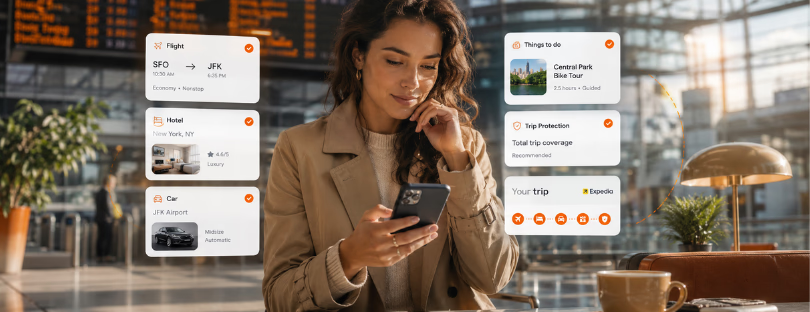
To support that shift, Expedia Group is expanding its Rapid API ecosystem, a B2B platform that lets partners plug more travel products into their own customer journeys. Rapid Car API gives access to more than 110 rental brands across 190 countries and 45,000 pickup locations. Rapid Flight API connects partners to more than 400 airlines through one interface. Rapid Activities API adds bookable experiences, while trip protection products, including Cancel For Any Reason options for hotels and car-rental cover, bring flexibility into the booking flow.
This is not just a technology update. It is a distribution play.
For banks, airlines, loyalty platforms, travel agencies, fintech apps and even telecom or eSIM brands, the opportunity is obvious. If you already have the traveller’s attention before, during or after a trip, why send them elsewhere?
Why travellers want bundles
Price is still the sharpest hook. Expedia’s research found that 81% of travellers would be likely to book trip elements together if they received additional savings, while 95% said any extra discount would meaningfully influence their decision.
But the bundle story is also about control. Trips are more expensive, complex and layered than they used to be. People want to add pieces gradually: flight first, hotel next, then a rental car, food tour, airport transfer, travel protection or local connectivity. The winning platform is not necessarily the one that sells everything at once. It is the one that remembers the traveller and makes the next decision feel easy.
This is especially relevant for younger travellers. Expedia says 83% of Gen Z travellers are likely to book multiple trip elements on the same platform. That generation is not loyal to old booking categories. They are loyal to convenience, relevance and a feeling that the app “gets” the trip.

Experiences change the trip
The research also shows why activities matter. Expedia reports that 55% of travellers say having an authentic, immersive trip is more important than it was five years ago. Local activities contribute to that for 92% of travellers, rising to 95% among Gen Z. Car rental also plays a role, with 69% saying it helps them experience destinations like a local.
Still, full-trip planning can become noisy quickly. If every partner uses APIs only to push more products, travellers will feel sold to, not helped. The smarter approach is contextual. Not everyone needs a rental car. Some travellers will still prefer specialist platforms, direct hotel bookings, local operators or premium travel advisors.
The connected-trip race
Expedia is not alone here. Booking Holdings has been building around the “connected trip”, using flights, stays, attractions, dining and ground transport to create a more complete travel experience. Amadeus, meanwhile, frames the industry shift around connected journeys, AI, biometrics, retailing and real-time travel technology. The direction is clear: travel companies no longer want to own just the booking. They want to own the journey layer.
That is why Expedia’s Rapid API expansion is worth watching. APIs are not glamorous, but they decide what brands can actually offer. A bank can become more travel-relevant. An airline can sell more around the flight. Even travel connectivity brands could learn from this, because mobile data is part of the real trip experience.
“Travelers want more than isolated bookings—they want the flexibility to build and manage a full trip over time,” said Stephen Cheng, vice president, Expedia Group B2B. “With evolving expectations, partners have a major opportunity to serve that demand by becoming true full-trip hubs, powered by technology that supports end-to-end planning at scale. This approach drives higher growth, differentiation, and long-term loyalty.”
Conclusion about the Expedia travel booking API ecosystem
The strongest signal in Expedia’s research is not that travellers like bundles. We already knew that. The real signal is that travellers are becoming less patient with fragmented travel.
The companies that win will not simply add flights, cars and activities into a menu and call it innovation. They will use data, timing and context to help travellers build trips without feeling trapped inside a sales funnel. Expedia has the scale and API infrastructure to push that model hard, while Booking Holdings and Amadeus are moving in the same direction from different angles.
For partners, the question is no longer whether full-trip retailing is relevant. It is whether they have enough trust, timing and customer context to do it well. Because when everything can be sold everywhere, the advantage moves to the brand that knows when not to sell.