If you have ever tried to “solve” business connectivity by handing employees a consumer traveleSIM link, you already know how the story ends. It works for one trip. Then Finance gets a surprise invoice, IT gets ten different activation screenshots from ten different phones, Security asks where the data went, and someone important loses service in an airport at the worst possible moment. consumer eSIM vs enterprise eSIM
Consumer travel eSIMs are built for individuals. Enterprises are built on repeatability, controls, and accountability. That mismatch is the whole problem.
Why consumer eSIMs feel like a shortcut
Consumer eSIMs are brilliant at one thing: fast, self-serve activation. Buy a plan, scan a QR, get data. For a traveler, that is the win.
For an enterprise, that “frictionless” moment is often where governance disappears:
No standardized procurement path
No centralized policy
No consistent support model
No unified reporting
No clean way to prove compliance later
That is not a moral judgment on consumer brands. It is simply not what they were designed to do.
What enterprises actually need
Enterprise connectivity requirements are boring on purpose. They are the guardrails that keep companies out of chaos.
Central control
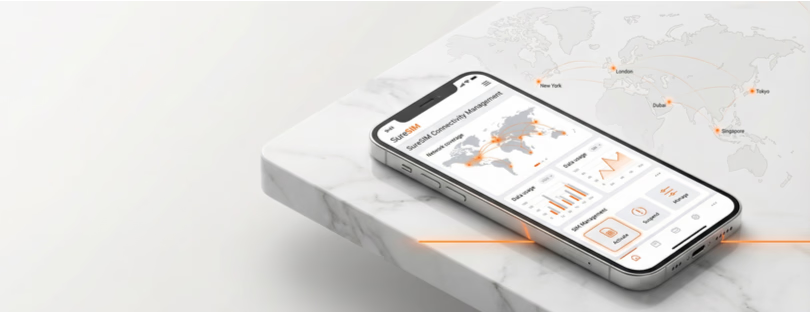
IT needs a single pane to see who is connected, where, on what network, using how much data, right now. This is the difference between “nice app” and “operational system.”
Policy and cost governance
Enterprises do not want random top-ups and reimbursement spreadsheets. They want rules: caps, alerts, budgets by team, and predictable charging models that Finance can forecast.
Resilience, not just coverage
A consumer eSIM can have “great coverage” and still fail the enterprise test if it cannot recover when the primary network drops, the device moves to a new region, or the user cannot troubleshoot.
Security and auditability
Enterprises need traceability: who provisioned what, when, under which policy. And they need confidence in the underlying remote provisioning standards and lifecycle controls. GSMA’s eSIM specifications and the direction of travel toward more scalable, orchestrated provisioning for IoT and constrained devices is part of this bigger shift.
Activation solves a traveler’s problem. Lifecycle management solves an enterprise’s problem.
The hidden gap: lifecycle management
Consumer eSIMs tend to optimize the first 5 minutes. Enterprises optimize the next 12 months.
At scale, the hard problems are lifecycle problems:
onboarding and offboarding employees
replacing lost devices
handling BYOD vs corporate devices cleanly
managing thousands of lines across countries
maintaining visibility without chasing carriers
This is why the market conversation has moved from “eSIM activation” to “eSIM orchestration” and “connectivity management.” Analysts and industry players are explicitly describing a shift toward orchestrator roles and control layers that sit above raw connectivity.
Where SureSIM fits
SureSIM positions itself as an enterprise eSIM and mobile data management platform built specifically for IT teams and managed service providers, which is already a big clue that it is playing a different game than consumer travel eSIM apps.
What stands out in their product framing is not “cheap data for your holiday.” It is: control, visibility, resilience, and managed operations.
Here are the advantages that matter in an enterprise context, based on SureSIM’s own platform and service descriptions:
A real-time control centre
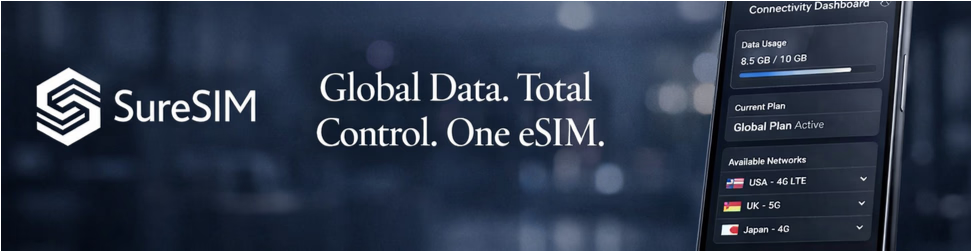
SureSIM repeatedly emphasizes “real-time visibility” into SIM activity, data usage, and network status across devices, managed through its platform. That is exactly the operational layer consumer eSIMs typically lack.
Designed for roaming governance
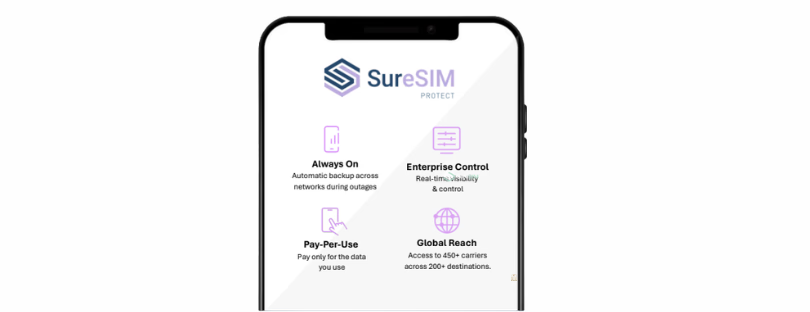
SureSIM Protect is positioned as backup connectivity for business travel, managed centrally, with a multi-network approach and visibility for IT and Procurement. The point is not just to connect, but to stay connected when the primary option fails.
Multi-network enterprise connectivity
For IoT and distributed deployments, SureSIM offers multi-network connectivity and management across 450+ carriers and 200+ destinations, with real-time visibility and control. For global operations, that “one solution globally” narrative matters.
Predictable commercial structure
SureSIM’s pricing page is framed around simple, predictable global data pricing, platform license fees, and usage charging, with explicit notes like premium zones barred by default. That kind of structure is much closer to enterprise buying behavior than consumer-style “flash deals.”
Put simply, SureSIM is selling the control layer: the thing enterprises actually need.
“But eSIM is a standard, so why does the product matter?”
The GSMA ecosystem is evolving toward models that support scaled remote provisioning and fleet-like management, especially for IoT. SGP.32 is frequently cited as a step toward more hands-off, orchestrated remote provisioning suited to constrained devices and large deployments.
Enterprise mobility is not only IoT, but it borrows the same philosophy: centralized management, policy control, lifecycle automation, and minimal user involvement.
So yes, eSIM is a standard. The enterprise value comes from how a provider wraps that standard into provisioning workflows, monitoring, controls, support, and commercial governance.
How does this compare with other market approaches
The enterprise connectivity market is filling up fast, and the differences are increasingly about “who owns the control plane.”
Enterprise connectivity providers like 1GLOBAL talk openly about zero-touch provisioning and partnerships with device management ecosystems, which is part of the same “remove manual steps, keep IT in control” logic.
IoT connectivity platforms like Aeris focus heavily on management, visibility, and orchestration beyond activation, again reinforcing the idea that activation alone is not the enterprise finish line.
Infrastructure vendors and industry groups are pushing the narrative that SGP.32 and orchestrated provisioning are foundational for scalable connectivity operations, which sets expectations for what “enterprise-grade” increasingly means.
SureSIM’s positioning is consistent with this trend, but with a very direct emphasis on IT teams, procurement control, and resilient business travel use cases, not just “connect devices.”
Conclusion: enterprise eSIM is not a product; it is a discipline
Consumer travel eSIMs will keep growing because they solve a real pain for individuals. But in enterprise environments, “quick activation” is a feature, not a strategy. consumer eSIM vs enterprise eSIM
The enterprise winner is whoever turns connectivity into something a company can operate like any other critical system: governed, observable, resilient, and financially predictable. The direction of standards like SGP.32 and the industry’s push toward orchestration make that trajectory pretty clear: the market is moving from selling data to selling control.
This is why SureSIM is a strong fit for enterprise needs. It is not trying to be the slickest consumer storefront. It is trying to be the platform your IT team can run, your Finance team can forecast, and your employees can forget about because it simply works.
Driven by wanderlust and a passion for tech, Sandra is the creative force behind Alertify. Love for exploration and discovery is what sparked the idea for Alertify, a product that likely combines Sandra’s technological expertise with the desire to simplify or enhance travel experiences in some way.