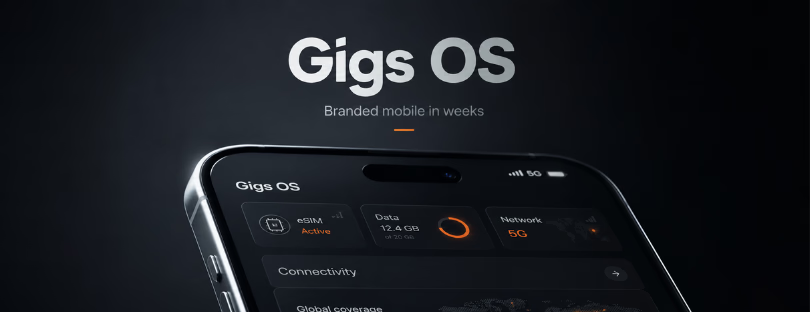
Gigs Cuts Branded Mobile Launches to Six Weeks
For years, launching a mobile service sounded simple in a strategy deck and painful in real life. mno embedded connectivity GIGS
A fintech wanted its own phone plan. A device company wanted connectivity built into the product. A travel app wanted eSIMs inside the customer journey. Then reality arrived: carrier negotiations, regulatory filings, billing systems, SIM or eSIM provisioning, tax handling, support operations, plan management, and a long queue of telecom complexity most digital companies were never built to handle.
Gigs is now trying to compress that process into something that looks much closer to a modern software launch.
The embedded connectivity platform says tech companies can now launch fully branded mobile services inside their apps in as few as six weeks. A simple MVP through the Gigs API can reach its first live subscriber in that timeframe, while a more customized implementation typically goes live in around 12 weeks. Compared with the traditional MVNO path, which has often taken 12 to 18 months, the company is framing this as a major speed shift for embedded mobile in 2026.
That timeline matters because mobile is no longer just a telecom product. It is becoming a feature layer inside fintech apps, HR platforms, device ecosystems, travel products, and consumer membership models.
Why the timeline matters
The old MVNO model was built for companies that were prepared to become telecom operators in all but network ownership. Even when they did not own radio infrastructure, they still had to coordinate with mobile network operators, secure wholesale agreements, build customer operations, manage billing, handle regulatory obligations, and stitch together several vendors.
That worked for telecom-native players. It was far less attractive for software companies that simply wanted to add mobile plans, travel data, or connected devices to an existing customer relationship.
Gigs’ pitch is that it removes much of that heavy lifting. On its website, the company describes Gigs OS as a platform where “any tech brand can be a mobile provider,” with phone plans running in the background while the partner keeps the customer relationship inside its own product experience.
The important part is not only speed. It is where the operational burden goes.
READ MORE:
Gigs acts as the Carrier of Record across its markets. That means it holds the relevant telecom responsibilities, manages compliance, provides carrier access, supports eSIM provisioning, and wraps billing and tax handling into a single integration. In practical terms, the partner does not need to negotiate directly with each mobile network operator or build the full telecom stack before serving its first customer.
For a fintech, that can mean adding phone plans or travel eSIMs as a loyalty and revenue product. For a device maker, it can mean selling connected hardware with service attached. For a travel brand, it can mean embedding global roaming at the booking, pre-departure, or arrival moment.
That is where embedded connectivity becomes more interesting than the usual “sell an eSIM” story.
From MVNO build to connectivity OS
Gigs is not positioning itself as a classic MVNE. That distinction is important.
A traditional MVNE usually gives an MVNO access to parts of the telecom stack. It may provide network enablement, SIM management, or operational tooling, but the brand launching the service still has to handle gaps, suppliers, commercial complexity, compliance obligations, customer operations, or billing integrations.
Gigs is trying to sell a more vertically integrated model: one telecom operating layer that includes carrier access, eSIM provisioning, billing, compliance, operations, and partner-facing tools. Its API page points to use cases across fintech, HR and IT platforms, devices, travel, employee phone plans, and dashboard-based connectivity management.
That difference explains why the company keeps using software language rather than telecom language. It wants mobile service creation to feel less like “becoming an operator” and more like integrating payments, logistics, identity, or cloud infrastructure.
The comparison with Stripe is common in this category, and it is not perfect, but it is useful. Stripe did not make payments simple because payments were simple. It made the complexity invisible to developers and product teams. Gigs is attempting a similar move for phone plans and eSIM connectivity.
The real product is not only the mobile plan. It is an abstraction.
Fintech is the obvious wedge
The clearest early market for this model is fintech.
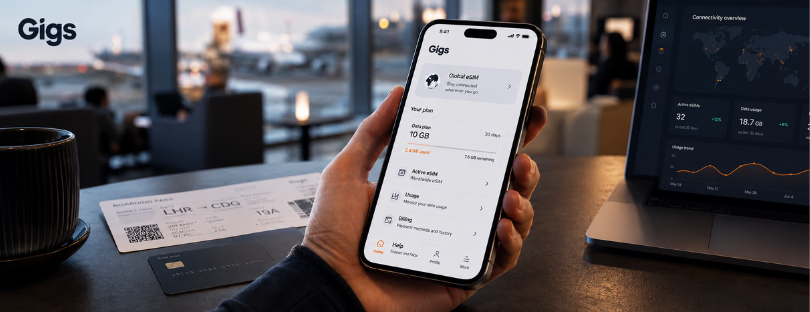
Banks, neobanks, and payment apps already own high-frequency customer relationships. They understand subscriptions, wallets, loyalty, identity, and cross-border usage. Many of their users travel, work remotely, or spend time internationally. Adding mobile connectivity into that environment is not a random upsell. It can fit naturally beside cards, premium memberships, cashback, travel insurance, airport lounge access, and foreign exchange tools.
Gigs’ fintech page makes this point directly, positioning phone plans and travel SIMs as native app features that can boost ARPU, loyalty, and revenue growth. The company also highlights the ability for fintechs to bundle mobile with premium products, travel, credit, cashback, or points.
READ MORE: How to Launch Your Own eSIM Product?
That is a serious signal for the eSIM market. A growing share of future eSIM distribution may not happen through standalone eSIM stores. It may happen inside apps where users already manage money, trips, devices, employee benefits, or memberships.
For Alertify readers, this is the key shift: connectivity is moving closer to the customer moment.
Not “go to an eSIM website and compare plans.” More like: your bank notices you are travelling, your device needs activation, your employer assigns you a business plan, your travel app offers data before departure, or your subscription bundle includes roaming as a benefit.
Your customers will buy connectivity. The question is: from you, or from someone else?
We help airlines, banks, and travel platforms turn that demand into a built-in product — not a missed opportunity.
The market is ready, but not easy
The timing is not accidental. The U.S. MVNO market was valued at $14.12 billion in 2024 and is projected by Verified Market Research to reach $18.23 billion by 2032. The same source points to demand for flexible plans, 5G, niche targeting, and rising mobile data consumption as growth drivers.
GSMA Intelligence has also been tracking the next phase of MVNO growth by region and business model, which underlines a broader point: MVNOs are no longer only discount mobile brands. They are becoming distribution models, ecosystem tools, and customer-retention products.
But speed does not remove all risk.
READ MORE: eSIM Cheat Sheet: Find the Best Plan for Your Travel Style and Budget
A six-week launch can be powerful, but only if the brand knows why it is launching mobile in the first place. A fintech adding connectivity only because “everyone is adding eSIMs” will probably create another forgettable add-on. A device company that treats connectivity as a support burden rather than a product advantage will miss the point. A travel platform that simply resells data without owning the customer experience will compete on price very quickly.
The best embedded connectivity products will not feel like telecom products glued onto an app. They will feel like the app became more useful.
How Gigs compares with the wider market
Gigs is part of a wider move toward MVNO-in-a-box, telecom-as-a-service, and embedded connectivity platforms. Other players in the market also reduce launch complexity, especially for brands that want eSIM distribution, enterprise mobility, or white-label connectivity. But Gigs’ stronger positioning sits in the combination of software-native integration, Carrier of Record responsibility, consumer-grade app embedding, and the ability to support both local mobile plans and travel eSIM-style use cases.
That puts it closer to the infrastructure layer behind banks, apps, devices, and platforms, rather than just another eSIM reseller or MVNE vendor.
READ MORE: ShopBack Adds Travel eSIMs Through Gigs Deal
This matters because the embedded connectivity market will not be won only by coverage maps and wholesale rates. Those are necessary, but increasingly not enough. The winners will be the companies that solve compliance, activation, billing, customer support, plan control, lifecycle management, and distribution timing in one coherent system.
For traditional MVNEs, the pressure is clear: access alone is becoming less attractive if partners still need to assemble the rest themselves. For eSIM providers, the threat is more subtle. If banks, super apps, travel platforms, and device brands can launch their own branded connectivity quickly, the front-end customer relationship may move away from standalone eSIM brands and into embedded ecosystems.
Conclusion about the embedded connectivity platform
Gigs’ six-week benchmark is not just a faster MVNO launch claim. It is a sign that mobile service creation is being pulled into the software economy.
That does not mean every company should become a mobile brand. Many should not. But it does mean the barrier is changing. The question is no longer only “Can we launch mobile?” It is “Do we have a customer relationship where mobile makes the product more valuable?”
That is the real market test.
Gigs looks well-positioned because it understands that modern connectivity is not only about network access. It is about removing telecom friction from the product roadmap. Similar players can offer pieces of the stack, and many will compete aggressively on price, geography, or enterprise control. But the bigger trend is difficult to ignore: mobile plans, eSIMs, roaming, and device connectivity are becoming embeddable features.
For telecom, that is both exciting and uncomfortable. The network still matters, but the customer interface is moving elsewhere. And in embedded connectivity, whoever owns the interface may end up owning the value.