HONOR Adds OWN eSIM to Smartphones Across the GCC
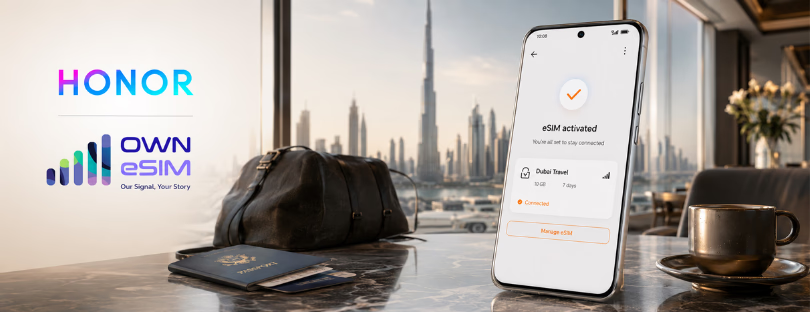
HONOR has announced a strategic partnership with OWN eSIM to bring pre-installed eSIM functionality to selected HONOR smartphone models across the GCC.
At first glance, this may look like another routine app integration. A smartphone brand adds a connectivity app. An eSIM provider gets a new distribution channel. Users get one more icon on their phone.
But the timing makes this more interesting.
Travel eSIMs are moving away from being something people search for only after they book a trip. Increasingly, they are becoming part of the device experience itself. That is the real story behind the HONOR and OWN eSIM deal. It is not just about letting users buy international data without a plastic SIM card. It is about placing connectivity inside the phone journey before the user even starts looking for alternatives.
Through the partnership, the OWN eSIM app will be preinstalled on selected HONOR devices using Google PAI, giving users across the GCC a more direct way to access and activate global data services. Google Play Auto Install is used by Android OEMs to configure apps for installation during the device setup experience, which makes it a valuable route for app discovery without relying only on paid ads or app store search.
For users, the promise is simple: open the app, choose a plan, activate data, and travel without hunting for a local SIM card at the airport.
For the eSIM industry, the implication is bigger: distribution is becoming as important as coverage.

Why this matters in the GCC
The GCC is a natural region for this type of partnership. It has a high concentration of business travellers, expats, frequent flyers, and users who regularly move between Gulf markets, Europe, Asia, and Africa. Connectivity is not a nice extra for this audience. It is part of how they work, pay, navigate, communicate, and travel.
That makes the region attractive for travel eSIM providers, but also highly competitive.
Airalo, Holafly, Nomad eSIM, Ubigi, Yesim, Orange Travel, GigSky and other players already compete for attention through search, affiliates, app stores, paid campaigns, and travel content. OWN eSIM is taking a different route here: getting closer to the user through the device manufacturer.
That is a smart move, because the biggest challenge in travel eSIM is often not technology. It is discovery.
Most travellers do not compare eSIM architecture, roaming agreements, IMSI routing, network behaviour, or app design. They usually discover eSIMs at the moment of stress: before departure, at the airport, after seeing a roaming warning, or when hotel Wi-Fi fails. If an eSIM option is already visible on the phone, the provider gets a powerful first-mover advantage.
Not a guaranteed sale. But definitely a stronger starting position.
HONOR’s service layer
For HONOR, this partnership supports a broader shift in the smartphone market. Device brands can no longer rely only on better cameras, brighter screens, faster charging, and AI features to stand out. Those things matter, but they are increasingly expected.
The next layer of differentiation is services.
Debo Zhang, General Manager of HONOR GCC, framed the deal in exactly that direction:
“Connectivity today must be as dynamic as the lives we lead. Our collaboration with OWN eSIM reflects HONOR’s commitment to delivering smarter, more integrated digital experiences for our users. Smartphones today are central to how people work, create, and stay entertained. By bringing eSIM functionality directly into our devices, we are enabling customers to stay connected more easily and confidently wherever their journeys take them.”
That is the correct positioning. A smartphone is no longer just a device that connects to a network. It is becoming a gateway to travel services, payments, identity, entertainment, productivity, and now, increasingly, global connectivity.
For HONOR users in the GCC, the value is convenience. Instead of downloading an eSIM app separately or searching online for a travel data plan, they may find OWN eSIM already positioned as part of the device experience.
OWN eSIM gets closer to the customer
For OWN eSIM, the deal is clearly about visibility and adoption.
Martijn Van Der Ven, Founder and CEO of OWN eSIM, said:
“We are pleased to partner with HONOR to bring our connectivity platform closer to users across the GCC. This collaboration represents a shared ambition to remove friction from the way people connect when they travel or move across borders. By embedding OWN eSIM directly into HONOR smartphones, we are delivering a seamless, future-ready connectivity experience designed for today’s digital-first consumers.”
The key phrase here is “closer to users.”
That is where the travel eSIM market is heading. Coverage is still important. Price still matters. App quality, support, throttling transparency, and plan flexibility still separate good providers from weak ones. But proximity to the buying moment is becoming a major competitive advantage.
This is why banks, airlines, hotels, booking platforms, fintech apps, and smartphone brands are becoming more relevant to eSIM distribution. The user does not necessarily want to “shop for connectivity.” The user wants data to appear at the moment it becomes useful.
HONOR gives OWN eSIM a place in that moment.
The bigger eSIM signal
The partnership also lands at a time when consumer eSIM adoption is accelerating. GSMA Intelligence reported that global eSIM smartphone penetration stood at around 5% at the end of 2025 and is expected to reach 10% by the end of 2026. That may still sound modest, but the direction is clear: eSIM is moving from early adopter feature to mainstream mobile behaviour.
This matters because the market will not stay focused only on “best eSIM for country X” searches. As eSIM adoption grows, distribution will become more embedded. Users will find travel connectivity through phone setup flows, airline apps, banking apps, loyalty programmes, hotel check-in tools, and travel wallets.
That creates a more interesting competitive landscape.
The strongest eSIM brands will not only be the ones with the biggest destination lists. They will be the ones that appear in trusted environments before the user starts comparing.
What this really tells us
The HONOR and OWN eSIM partnership is not market-changing on its own. We still need to know which HONOR models will include the app, which GCC markets will be prioritised, what plans will be offered, and whether users will receive exclusive pricing or bundled benefits.
But strategically, the move is worth watching.
Compared with larger travel eSIM names, OWN eSIM may still need to prove its strength on pricing, coverage depth, app experience, support, and transparency. Preinstallation gives it visibility, not automatic trust. Users will still judge the service when they activate, pay, land, and actually use the data.
Still, this is exactly where the eSIM market is going. Connectivity is becoming less of a separate travel product and more of an embedded layer inside devices, apps, and platforms people already use.
That is good news for travellers, because it reduces friction. It is also a warning for eSIM providers: being technically available in 150 or 200 destinations will not be enough forever.
The next fight is not only who has coverage.
It is who gets closest to the customer before the customer even starts searching.