Guuk Secures SIM-to-eSIM Transfers With KYC
Guuk’s latest eSIM move is not about making activation look more futuristic. It is about making it harder for the wrong person to take control of the right number.
MasOrange’s Basque brand Guuk has launched an online biometric validation system that lets customers switch from a physical SIM card to an eSIM more securely. The system uses advanced Know Your Customer technology, better known as KYC, to reduce identity theft risk during remote SIM replacement. That detail matters. A SIM-to-eSIM switch is convenient, but it is also one of those moments where convenience and fraud sit uncomfortably close together.
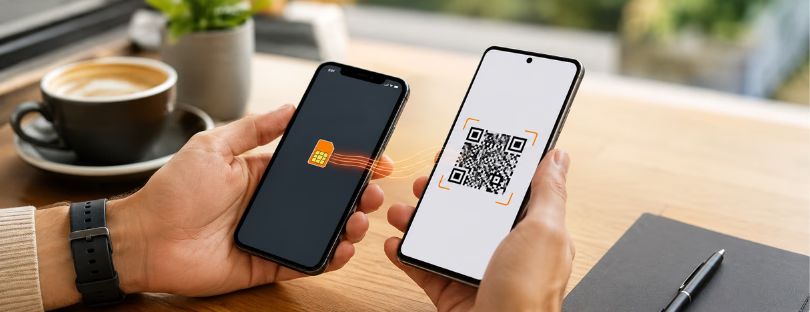
For the customer, the story is simple: no plastic SIM, no store visit, faster activation. For the operator, the story is more serious. Before a new eSIM profile is issued, the brand has to be confident that the person requesting it is actually the legitimate owner of the mobile line.
More than activation
The mobile number has become a digital key. It is connected to banking alerts, one-time passwords, WhatsApp, social accounts, app recovery, business tools, and sometimes crypto wallets. When a fraudster succeeds with SIM swap fraud, they are not just stealing connectivity. They are often trying to intercept verification codes and reset access to other services.
That is why SIM replacement has become a high-risk customer journey. The physical SIM era had friction built in. You often had to visit a store, wait for delivery, or pass through customer support. eSIM removes much of that delay, which is excellent for genuine customers and risky when identity checks are weak.
Guuk’s biometric layer protects the step that matters most: proving the person before moving the number.
The KYC layer
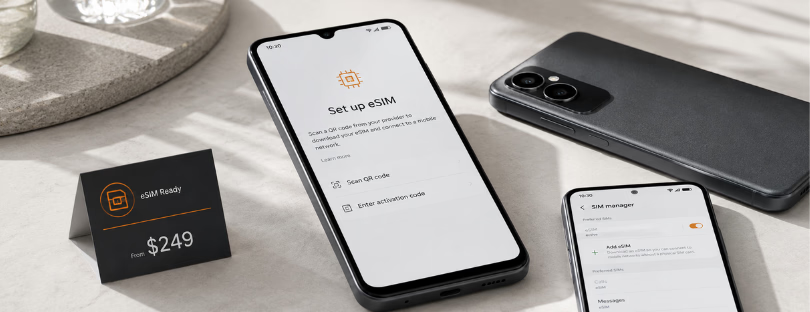
Biometric KYC usually combines document checks, facial matching, liveness detection, and risk scoring. The exact Guuk implementation has not been fully detailed publicly, so it is better not to overclaim. But the direction is clear. The operator is moving identity verification into the digital flow, instead of treating eSIM activation as a simple technical swap.
A QR code or eSIM profile is only as safe as the process that releases it. The best systems will not rely on one signal. They will combine biometric verification with account history, device information, recent SIM change data, app approval, support review, and sensible delay rules for suspicious cases. A customer replacing a SIM at 2 a.m. from a new device after several failed login attempts should not be treated the same as a customer switching calmly inside a verified operator app.
The privacy question
There is one obvious warning: biometrics should not become the only door. Some users will struggle with document scans, poor lighting, older phones, accessibility issues, or simple privacy concerns. Others may prefer an assisted route, especially if their phone has been lost or stolen.
So the better version of this model is not “biometrics for everyone, always.” It is a risk-based system with fallback options. Store verification, human support, app-based approval, and manual review still have a place. Operators also need to be clear about what biometric data is processed, whether it is stored, who handles it, and how long it remains in the system.
The market signal
Guuk is not alone in this direction. GSMA’s eSIM work has made remote provisioning a core part of the mobile ecosystem, while GSMA Open Gateway’s SIM Swap API shows how operators are turning network signals into fraud-prevention tools for banks, fintechs, and digital platforms. Identity companies such as IDEMIA have also been pushing eKYC and eSIM onboarding as connected pieces of the same customer journey.
For travel eSIM providers, the risk profile is different because many plans are data-only and not tied to a user’s main phone number. But the lesson still applies. As travel eSIM brands add accounts, wallets, business dashboards, phone numbers, loyalty integrations, or long-term subscriptions, stronger verification will become more relevant.
Final take
Guuk’s biometric SIM-to-eSIM system is not the loudest eSIM story of the year, but it is one of the more practical ones. It shows that the next phase of eSIM is not just about faster installation. It is about safer control of the mobile identity behind the profile.
This is where operators can still differentiate from lightweight digital-only players. Travel eSIM brands can often win on speed and simplicity. Infrastructure providers can win on provisioning and scale. Operators such as Guuk have a different advantage: they own the primary number and the customer relationship around it.
That also gives them a bigger responsibility. The future of eSIM should not be frictionless at any cost. It should remove the pointless friction and strengthen the moments where identity really matters.