Amadeus to Acquire Idemia Public Security for €1.2B in Biometrics Push
Amadeus is making another very deliberate move into identity and biometrics — and this time, it’s a big one.
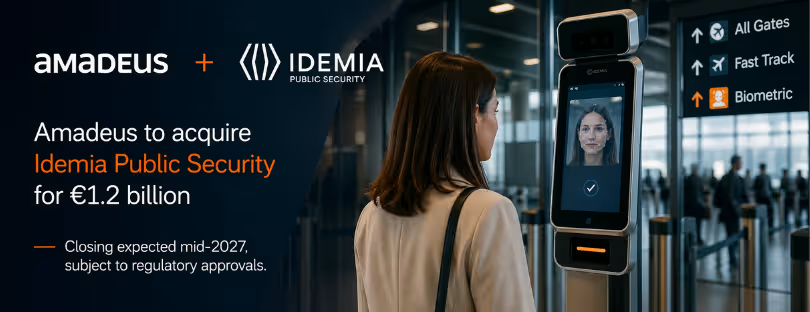
The Madrid-based travel tech giant has announced plans to acquire Idemia Public Security (IPS) for €1.2 billion, deepening its push beyond distribution and into the infrastructure layer of travel itself. If approved, the deal is expected to close by mid-2027.
This isn’t a one-off expansion. It’s a continuation of a strategy that’s becoming increasingly clear.
From booking engine to identity orchestrator
For years, Amadeus has been synonymous with GDS systems and airline IT. But over the last two years, it has been quietly reshaping its role in the travel ecosystem.
The 2024 acquisition of Vision-Box was the first signal. This new deal with IPS confirms the direction: Amadeus is positioning itself as the layer that connects identity, movement, and services across the entire journey.
IPS brings serious weight. The company employs around 3,300 people and works with more than 600 clients globally, spanning airports, governments, and high-security environments. Its expertise lies in biometric identification, passenger processing, and secure access systems — the kind of infrastructure that sits behind border control gates, eGates, and national identity frameworks.
That matters because identity is quickly becoming the backbone of modern travel.
Why biometrics is suddenly everywhere
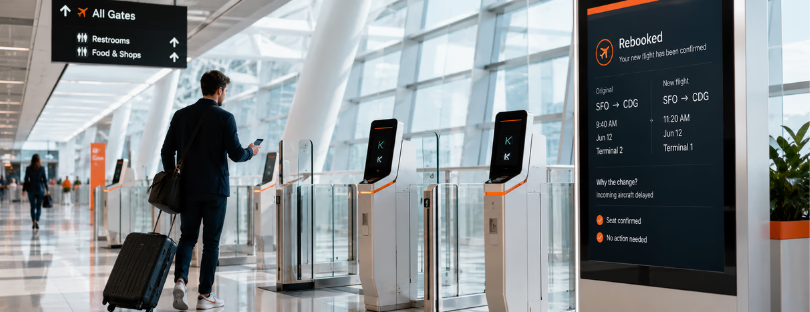
If you’ve flown through a major airport recently, you’ve probably noticed it. Facial recognition at boarding gates. Automated passport control. Faster security lanes tied to biometric verification.
This isn’t just about convenience. It’s about scale.
Airports are under pressure to handle more passengers without expanding physical infrastructure. According to International Air Transport Association forecasts, global passenger numbers are expected to reach nearly 10 billion by 2050. Traditional processes simply don’t scale to that level.

Biometrics offers a way out. Faster throughput, fewer manual checks, and reduced reliance on physical documents.
But there’s a catch. Most implementations today are fragmented.
Airports deploy one system. Airlines another. Border agencies something else entirely. The result is a patchwork experience where passengers still need to verify their identity multiple times across the journey.
That’s the gap Amadeus is trying to close.
Connecting the dots across the journey
The real ambition behind this acquisition isn’t just adding biometric capability. It’s stitching together identity across every touchpoint — from booking to boarding to border control.
“This demonstrates further our long-term commitment to biometrics as part of our broader platform strategy. Alongside AI, biometrics is one of the most transformative technologies for delivering fast, convenient, and secure end-to-end traveler journeys. This will enable us to deliver our services across more traveler touch points, in turn reducing friction, and improving the traveler experience.”
Luis Maroto, President and CEO, Amadeus
“In a fast-evolving AI-world the bridging of physical and digital identity will be critical for seamless travel. By combining Amadeus and IPS capabilities we will be able to create more joined-up travel journeys in the future, better connecting the travel ecosystem and linking the traveler to the different steps of the journey.”
Decius Valmorbida, President of Travel, Amadeus
What they’re describing is a single, persistent identity layer. One verification follows you through the entire journey, instead of repeated checks at every stage.
That’s a very different model from how travel works today.
The bigger shift: identity as infrastructure
This move also reflects a broader shift happening across travel and telecom.
Identity is no longer just a compliance requirement. It’s becoming a platform.
We’re seeing similar thinking from players like SITA, which has been investing heavily in digital identity solutions for airports, and Thales Group, which combines biometrics with cybersecurity and border systems. Even governments are moving toward digital identity frameworks that extend beyond travel into finance, healthcare, and public services.
At the same time, organizations like International Civil Aviation Organization are pushing standards around Digital Travel Credentials (DTC), aiming to create interoperable, globally accepted digital identities for travelers.
Amadeus is effectively aligning itself with that future.
But with a twist.
Instead of just supplying technology to one part of the journey, it’s trying to own the orchestration layer that connects all of them.

Where this gets interesting
If this strategy works, Amadeus could end up controlling something far more valuable than booking flows.
It could control how identity moves through travel.
That has implications beyond airports.
Think about hotel check-ins, car rentals, insurance verification, even connectivity onboarding. A persistent digital identity could remove friction across all of these moments.
And that’s where this starts to intersect with other industries — including telecom.
Because once identity is verified and portable, onboarding services like eSIM, payments, or mobility access becomes almost frictionless.
That’s not where Amadeus is today. But it’s not a huge leap from where it’s heading.
Conclusion
This deal isn’t really about biometrics. It’s about control.
Control over identity, over the passenger journey, and ultimately over how services are delivered across travel.
What makes this interesting is that Amadeus isn’t alone in seeing this shift. Players like SITA and Thales are building similar capabilities, while global bodies like ICAO are trying to standardize digital identity frameworks. The direction is clear: travel is moving toward a unified, digital identity layer.
The question is who gets to orchestrate it.
Amadeus has one advantage that most competitors don’t. It already sits at the center of airline distribution and travel IT. If it successfully integrates identity into that position, it could extend its influence far beyond booking and into the core infrastructure of travel itself.
And if that happens, the real competition won’t just be other travel tech providers.
It will be anyone trying to own an identity in a digital world.