Why Your eSIM Data Balance Can Vanish at Midnight?
Most travellers think an eSIM plan dies for one reason: they used too much data. That is often true. But there is another, quieter reason your plan stops working, and it is more annoying because it feels unfair.
You did not stream Netflix for three hours. You did not upload 600 photos. You did not suddenly become the person using hotel Wi-Fi to download entire seasons.
You simply ran out of time.
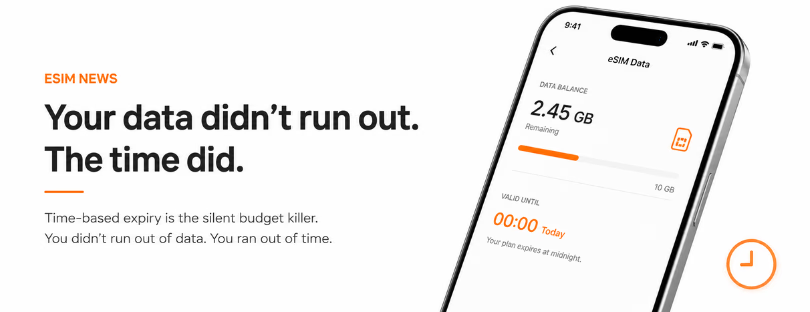
Time-based expiry is one of the least discussed parts of travel eSIM pricing, and yet it shapes the real cost of many plans. A 5GB plan for 7 days does not mean “use 5GB whenever you need it during your trip.” It usually means “use up to 5GB before the plan validity clock reaches zero.” Once that clock runs out, the remaining data is gone.
This is where travel connectivity starts to feel less like buying internet and more like renting access to a window.
Airalo, for example, explains that for most of its eSIM packages, validity begins when the eSIM connects to a supported network at the destination, and the package ends when it runs out or expires. Holafly also states that unlimited data plans expire once the plan period ends, and unused data does not roll over. Nomad’s own guidance makes the same general point: the eSIM itself does not expire, but the data plan loaded onto it usually has a fixed validity period or ends when the included data is consumed.
So the issue is not hidden in the small print. It is there. But most customers do not think in “validity mechanics.” They think in terms of trips.
eSIM News on Alertify
Follow the latest eSIM market news
Provider moves, roaming shifts, travel connectivity trends and eSIM industry updates in one place.
Explore eSIM news →
You bought data, but the product sold you time
This is the gap.
A traveller sees “10GB, 30 days” and naturally focuses on the 10GB. The data amount feels like the value. The 30 days feels like a generous condition attached to it.
But commercially, the validity period is just as important as the data allowance. Sometimes more important.
Let’s say you buy a 10GB plan for a two-week trip. You land late on Monday, activate the eSIM at the airport, use maps and WhatsApp, then mostly stay on hotel and office Wi-Fi for the next few days. By the end of the trip, you may still have 4GB or 5GB unused.
From the customer’s perspective, that feels like waste.
From the provider’s perspective, the product worked exactly as sold.
That disconnect matters because it changes how travellers calculate value. A cheap eSIM plan can become expensive if half of the data expires unused. A more flexible plan can be a better value even if the upfront price looks higher.
This is especially true for business travellers, digital nomads, conference visitors, cruise passengers, and anyone doing multi-stop travel. Their usage is not always smooth. One day, they need 2GB for hotspot, video calls, maps, and ride-hailing. The next day, they need almost nothing because they are on hotel Wi-Fi or stuck in meetings. Time-based expiry punishes uneven usage.
Midnight is not magic, but it feels brutal
The phrase “at midnight” matters because it captures how customers experience expiry.
Technically, providers use plan validity rules, activation timestamps, local time zones, and package terms. Some plans are counted in calendar days. Others are counted in 24-hour periods after activation. Some begin when the plan connects to a destination network, while others may be activated manually inside the app. The important point is simple: the clock starts, and then it keeps moving whether you use data or not.
That creates a strange emotional moment.
Your mobile data does not fade slowly. It does not warn you like a fuel tank. It just stops being yours.
And unlike running out of data, running out of time feels less connected to your behaviour. If you used all 5GB, fine. You made the choice. But if 2GB vanish because the validity window closed while you were asleep, the traveller feels penalized for not using the product fast enough.
This is why expiry design is a customer experience issue, not just a pricing detail.
The market is starting to split
Most travel eSIM providers still rely on the classic model: fixed data, fixed validity. It is simple, easy to compare, and familiar. Airalo, Nomad, Ubigi, GigSky, Saily, and many others use versions of this structure across destination, regional, and global plans. It works well for short leisure trips where usage is predictable.
Then there is the unlimited model, where the customer stops worrying about gigabytes but still has to think about time. Holafly is the obvious example here. Its value proposition is comfort: buy unlimited data for a certain number of days and stop counting megabytes. But the expiry still matters. If the plan is for five days, the product is five days. Not “unlimited forever.” Holafly’s own FAQ makes clear that unused data is lost when the plan expires.
Yesim has pushed a more flexible angle with its Unlim Day Pass, positioned as an annual plan where users pay only for the days they go online. That is interesting because it acknowledges the behavioural problem: travellers do not always need connectivity every day, even if they travel often. A day-based model can be cleaner for people who want bursts of unlimited use without committing to a rigid destination plan every time.
Fairplay’s model also speaks to this wider market shift. Its emphasis on heavy users, cost caps, and newer data package options shows that the market is moving beyond the basic “X GB for Y days” formula. Not every customer wants the same structure. Some need predictable data packages. Some need real unlimited logic. Some need a cap. Some need a pass. The smarter providers are no longer just selling cheaper data. They are trying to match data behaviour.
That is the important trend.
The no-expiry counterargument
There is one important exception to the usual expiry model: not every eSIM product is built around “X GB for Y days.”
In most cases, the eSIM profile itself does not expire in the way travellers imagine. What expires is the data plan attached to it. You may still have the eSIM installed on your phone, but the actual allowance tied to that plan can disappear once the validity period ends.
That is why no-expiry and pay-as-you-go models deserve more attention. They show that time-based expiry is not some unavoidable law of eSIM. It is a commercial design choice.
Roamless is one of the clearest examples. Its model is built around credits that can be used for pay-as-you-go data, calls, or SMS, and the company states that those credits do not expire. This makes it attractive as a “keep it ready” eSIM for people who travel irregularly or want backup connectivity without watching a 7-day or 30-day countdown.
Keepgo takes a different route, positioning itself around lifetime prepaid data. Its lifetime eSIM plans say the data remains valid forever, with no monthly charges, which makes the product more interesting for travellers who prefer to buy data once and use it slowly across future trips.
BNESIM also belongs in this conversation because it offers plans with validity options ranging from 30 days to never expiring. That matters because it gives users a choice between standard short-validity plans and no-expiry packages, instead of forcing every traveller into the same countdown model.
Surfroam is a little more nuanced. Its eSIM profiles do not expire, but the credit model depends on the product type. Surfroam says ULTRA balance is valid for 30 days and extends with top-ups, while PLUS and GLOBAL balances can be kept active with occasional top-ups. So it is not the same as “buy once and forget forever,” but it still sits closer to the pay-as-you-go flexibility camp than to classic fixed travel bundles.
These models are not automatically cheaper. Pay-as-you-go rates can cost more per gigabyte than fixed bundles, and lifetime data plans may not be ideal for heavy streaming or hotspot use. But they solve a very specific customer frustration: buying data and losing it because time expired before usage did.
That is the real point. The market now has two different philosophies.
One says: “Here is a bundle. Use it before the clock runs out.”
The other says: “Here is connectivity. Keep it available until you actually need it.”
For occasional travellers, backup users, remote workers, and people who move unpredictably between countries, that second model can feel much closer to real travel behaviour. Not everyone needs more gigabytes. Some people simply need the gigabytes they bought to remain theirs.
The real question before buying
Travellers should stop asking only: “How many gigabytes do I get?”
The better question is: “What happens if I do not use them in time?”
That one question changes the comparison immediately.
A 20GB plan sounds great until you realize your trip is only six days and most of your data use will happen on two of them. A 3GB plan with a top-up might be smarter. An unlimited day pass might be better for a short work sprint. A monthly global plan might make sense for frequent travellers who cross borders often, even if it looks more expensive at first glance.
And for providers, this is where transparency becomes a competitive advantage. Show the expiry rule clearly. Explain when the clock starts. Make the remaining time as visible as the remaining data. Do not hide the most important part of the product inside “validity” language that only telecom people enjoy reading.
Because customers do not get angry when a product has limits.
They get angry when they misunderstand which limit actually killed the service.
The bottom line about unused eSIM data expiry
The next phase of the eSIM market will not be won only by the provider with the cheapest gigabyte. That race is already crowded, and frankly, it is becoming less interesting.
The real competition is moving toward flexibility.
Airalo and Nomad made travel eSIMs easy to buy. Holafly made unlimited feel simple for mainstream travellers. Yesim is experimenting with day-based usage logic. Fairplay is pushing a heavier-user conversation around cost control and actual usage patterns. These are all different answers to the same problem: travellers do not consume mobile data in neat little packages.
Time-based expiry is the silent budget killer because it turns unused data into lost value. You did not run out of data. You ran out of the right to use it.
And that is why the most useful eSIM plans of the next few years will not just offer more gigabytes. They will respect the way people actually travel.
Driven by wanderlust and a passion for tech, Sandra is the creative force behind Alertify. Love for exploration and discovery is what sparked the idea for Alertify, a product that likely combines Sandra’s technological expertise with the desire to simplify or enhance travel experiences in some way.