eSIM Plans vs Pay As You Go: Which Saves More?
There’s a question that doesn’t get asked nearly enough in the eSIM space: Is paying upfront for a data package actually cheaper than metered connectivity? On paper, fixed plans feel safe. You know the cost, you buy the gigabytes, you board the plane. But Yesim’s Pay & Fly model — a balance-based, pay-as-you-go approach positioned around provider-level rates — challenges that logic in ways that are genuinely worth stress-testing.
The answer isn’t universal. It depends almost entirely on how you travel.
What Pay & Fly Actually Is
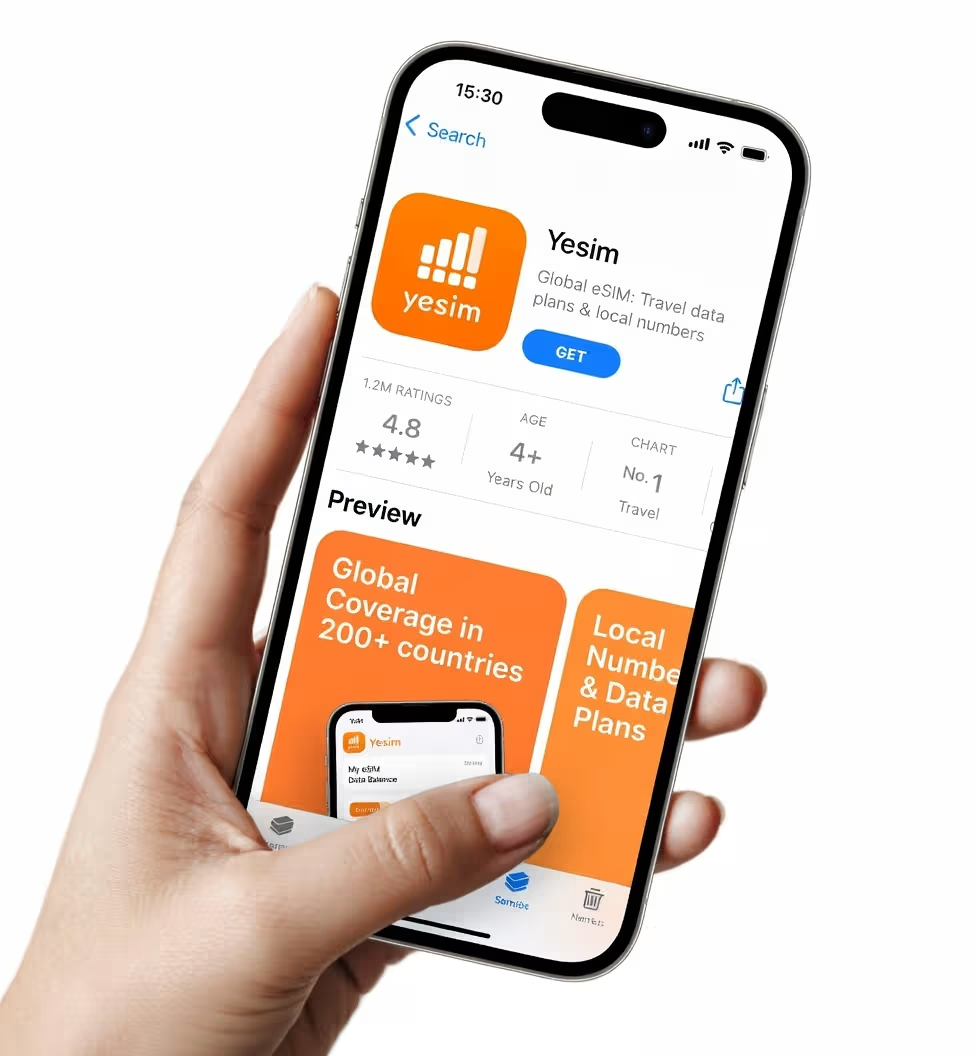
Pay & Fly is a PAYG eSIM from Yesim: you activate it once, top up your balance, and use it across 170+ countries — paying only for the data you actually consume.
You’re not buying a package. You’re essentially buying access to mobile data on demand, with usage deducted from your balance as you go.
Key mechanics are simple:
- Data-only eSIM (no phone number)
- Works in 170+ countries
- Automatically connects to the best available network
- Balance valid for 12 months
- Top up anytime, with optional auto top-up
Pricing is usage-based and varies by country. There is no fixed per-GB rate globally, which is important when comparing it to prepaid plans.
Yesim’s Pay & Fly
|
How to start using1
Top up your balance — you are charged only for the traffic you use 2
Install the eSIM — it connects automatically when you land |
The Weekend Tripper
Say you’re flying from Amsterdam to Barcelona for four days. Light usage — maps, messaging, some social media. Maybe around 1–2 GB total.
A fixed plan for Spain from most eSIM providers typically costs around €4–€8 for small data packages. Many unlimited options start significantly higher, which doesn’t make sense for this use case.
With Pay & Fly, your cost depends entirely on actual consumption and local rates. If usage stays low, total spend can be competitive with — or slightly below — entry-level prepaid plans.
But there’s a behavioral risk. Casual travelers rarely monitor usage closely. Background apps, updates, or streaming can increase consumption without noticing.
Fixed plans provide something PAYG doesn’t: a clear spending ceiling.
Verdict for weekend trippers:
Fixed plans remain the safer choice for most. Pay & Fly works best if you actively manage usage.
The Slow Traveler
This is where Pay & Fly starts making more sense.
Imagine spending three weeks in Thailand, using Wi-Fi most of the time and relying on mobile data as backup. Total usage might land around 4–6 GB, but spread unevenly across the trip.
With fixed plans, you typically buy based on expected peak usage:
- 10 GB or 20 GB packages from providers like Airalo or Nomad eSIM
In reality, many travelers don’t fully use what they buy.
With Pay & Fly, you only pay for what you actually consume. That removes the risk of unused data expiring at the end of the trip.
The trade-off is predictability. If your usage spikes — video calls, tethering, cloud sync — costs increase accordingly.
Verdict for slow travelers:
Pay & Fly is often more efficient, especially for Wi-Fi-heavy users who treat mobile data as occasional support rather than constant connectivity.
The Multi-Country Hopper
Now consider a traveler moving across multiple countries in a short period.
Fixed plansRegional packages (€20–€70 depending on size and duration) |
Pay & FlyOne eSIM |
* Actual rates vary by country and can be checked in-app before usage.
Costs scale directly with usage, not geography. That makes it particularly suited for fragmented travel patterns.
It won’t always be dramatically cheaper, but it tends to be more efficient — especially when data usage varies significantly between stops.
Verdict for multi-country hoppers:
Pay & Fly offers a structural advantage. It simplifies connectivity and aligns better with real travel behavior.
So, Where Does This Leave Yesim in the Market?
Pay & Fly is a clear deviation from how most consumer eSIM products are sold.
Providers like Airalo and Holafly still rely heavily on predefined packages — easier to understand, easier to market.
Some players, like Ubigi, are moving toward more flexible or long-term models, but true PAYG with a rolling balance remains relatively uncommon in the consumer segment.
What makes this more interesting is that Yesim isn’t choosing one model over the other. It offers both fixed plans and Pay & Fly side by side. That’s not inconsistency. It reflects a real split in how people use mobile data when they travel. Some want predictability. Others want efficiency. Most providers force you into one model. Yesim lets you switch between them.
That’s because PAYG shifts responsibility toward the user. It rewards efficiency — but only if the user actually behaves efficiently.
Where This Is Going
Industry data from GSMA and Juniper Research points toward a broader shift: from rigid bundles to more flexible, usage-based connectivity models.
Enterprise telecom is already there. Consumer travel connectivity is catching up.
Pay & Fly sits somewhere in that transition.
Final Take
This isn’t just about price.
It’s about how closely your connectivity model matches your actual behavior.
Fixed plans assume you can predict your usage in advance. Most people can’t.
Pay & Fly assumes you don’t need to.
And that’s where the real difference is.
Not in the price per gigabyte, but in how much of what you pay for you actually use.