Crnogorski Telekom Brings Travel eSIM to Montenegro
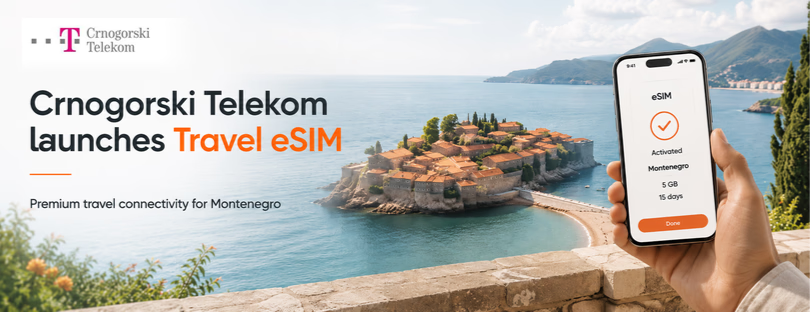
Crnogorski Telekom has launched Travel eSIM, a new digital connectivity service aimed at users in Montenegro who want affordable mobile internet while travelling abroad, without swapping physical SIM cards or relying on expensive roaming by default.
The service is available online, activated through a QR code, and open to users regardless of which domestic mobile network they normally use, according to reports on the launch. Data bundles come with a validity of up to six months, which makes the product more flexible than the classic “buy it just before the trip and hope it works” travel SIM experience.
But the launch is more interesting when seen alongside Crnogorski Telekom’s broader tourist eSIM offer for visitors coming into Montenegro. On its official eSIM page, Telekom promotes local prepaid eSIM plans with 5G and 4G access, a local prepaid number, online activation, and large domestic data allowances such as 500 GB, 1 TB, and unlimited internet options.
That matters because Montenegro has quietly become one of Europe’s more aggressive prepaid travel connectivity markets. For tourists, the message is simple: arrive, scan, connect, and use local network pricing instead of roaming.
What travellers get
For visitors travelling to Montenegro, Crnogorski Telekom’s tourist eSIM offer is built around unusually large data bundles. Current plans include a 10-day package with 500 GB, calls and SMS within Montenegro, a 15-day package with 500 GB plus regional data for the Western Balkans zone and Croatia, and 30-day plans ranging from 1 TB to unlimited internet. Prices start at €15 and go up to €30 for the online-only 30-day unlimited plan that also includes unlimited calls to Montenegrin networks.
There are also 5G internet add-ons for users who need more data after activation, including 500 GB add-ons and a 1 TB option, with validity periods from 5 to 30 days. The logic is very local-operator: not tiny roaming-style bundles, but large prepaid packages designed for heavy holiday usage.
For a traveller spending two weeks in Montenegro, that changes the calculation. Instead of worrying whether a gIobal eSIM plan includes 5 GB, 10 GB, or “unlimited” data with fair usage conditions hidden somewhere in the small print, Telekom is offering local-scale allowances that feel closer to home broadband than classic travel data.
Why local operators are moving now
Travel eSIMs were first popularised by independent global brands because they solved a very clear customer pain: roaming was expensive, confusing, and often discovered only after the bill arrived.
Now local operators are responding. Crnogorski Telekom is not just selling a SIM replacement. It is using eSIM to make its prepaid offer easier to buy before arrival, easier to install, and more relevant to travellers who no longer want to queue in a shop with a passport and a paper form.
READ MORE: Montenegro Set to Join EU’s Roam Like at Home Zone: What It Really Means for Travelers and Operators
This is where the market becomes more competitive. International travel eSIM platforms compete on convenience, coverage, app design, and multi-country simplicity. Local operators compete on network ownership, local numbers, domestic allowances, and often much larger data packages. For Montenegro specifically, One Montenegro also promotes tourist packages with 500 GB and 1 TB options, showing that the local market is already data-heavy and price-aggressive.
So the real story is not only that Telekom has an eSIM. The real story is that local operators are learning to package their network advantage in a digital format that travellers actually understand.
The small details still matter
Before buying, users still need to check whether their phone supports eSIM. That sounds obvious, but it remains one of the most common friction points in the travel eSIM market.
Activation is handled through a QR code sent by email after purchase and registration. Telekom advises users to install the eSIM before the trip, so they can connect immediately upon arrival in Montenegro. That is the right behaviour to encourage. Nobody wants to troubleshoot mobile settings at baggage claim with airport Wi-Fi dropping every two minutes.
There is also a useful security angle. eSIM activation is encrypted, the QR code is unique, and once installed on a device, it cannot simply be reused by someone else. That makes eSIM safer than many travellers assume, especially compared with carrying multiple physical SIM cards or buying unknown prepaid cards from unofficial sellers.
What this says about the market
Crnogorski Telekom’s Travel eSIM launch fits a wider shift: connectivity is becoming a travel product, not just a telecom product.
Airalo, Holafly, Nomad eSIM, Yesim and similar global providers made eSIM familiar to travellers by removing the old roaming shock. But local operators still have a strong card to play when they package their networks properly. In destinations like Montenegro, where tourist demand is seasonal and mobile data usage is high, a local prepaid eSIM with hundreds of gigabytes can be extremely hard for global travel eSIM brands to match on pure data value.
READ MORE: The Rise of Always-Ready Travel eSIMs
The weakness of local operator offers has traditionally been friction: registration, unclear websites, limited language support, and weaker digital journeys. If Crnogorski Telekom continues improving the online purchase and activation flow, it can compete not only as a network provider but as a real travel connectivity brand.
Conclusion
This launch shows where the eSIM market is heading next. The first phase was about escaping roaming. The next phase is about who can make connectivity feel effortless before, during, and after the trip.
GIobal eSIM brands still win when travellers want one app for several countries. Local operators win when travellers want the strongest local network, a local number, and huge data at domestic prices. Crnogorski Telekom is trying to sit closer to that second category, while also using eSIM to remove the old prepaid friction.
For travellers to Montenegro, that is good news. For the eSIM industry, it is a reminder that the next big competition may not be between one travel eSIM app and another. It may be between global convenience and local network power.