How to Avoid Roaming Fees Abroad
Your phone can turn into the most expensive item in your suitcase the moment your plane lands. A few minutes of background app activity, one unanswered call, or an automatic cloud backup is sometimes all it takes to trigger charges.
If you are wondering how to avoid roaming fees, the answer is less about one magic fix and more about controlling how your device connects before and during a trip.
Why roaming fees still catch travelers off guard
Roaming charges feel outdated, but the billing logic behind them is still very real. When you travel outside your carrier’s home network, your provider usually pays another operator to keep you connected. That wholesale cost gets passed on in different ways – daily passes, pay-per-megabyte data rates, premium voice charges, or text bundles that look cheap until usage spikes.
The bigger problem is that roaming is often invisible until the bill arrives. Modern smartphones constantly use data in the background for app refresh, location services, photo syncing, messaging backups, software updates, and push notifications. Even travelers who think they are barely using their phone can burn through expensive data without opening a browser once.
For business travelers and telecom professionals, this is also a customer experience issue. Surprise charges are not just annoying. They erode trust in carriers, travel platforms, and enterprise mobility programs that fail to set clear usage expectations.
How to avoid roaming fees before you leave
The cheapest roaming charge is the one that never starts. That means planning before departure, not after touchdown.
First, check exactly what your carrier includes internationally. Some plans cover Canada and Mexico but charge heavily in Europe or Asia. Others offer daily roaming passes that cap costs, but only if you actively opt in. If you skip this step, you are making assumptions about pricing in a market where small details matter.
Second, review your device settings while you still have time to change them. Turn off data roaming if you do not intend to use your carrier abroad. Disable automatic app updates, cloud photo backup, and background refresh for nonessential apps. Download maps, boarding passes, hotel details, and entertainment in advance. A phone prepared for offline use is much cheaper to travel with.
Third, think about your actual connectivity needs instead of your ideal ones. If you just need messaging and maps, public Wi-Fi plus a secondary mobile option may be enough. If you need reliable access for video calls, ride-hailing, tethering, or work authentication tools, cutting corners can backfire. The right strategy depends on trip length, destination, and how costly it would be to lose connectivity at the wrong moment.

Use your carrier’s travel pass carefully
For short trips, your home carrier’s international day pass can be the simplest option. It usually lets you keep your regular number, avoid setup friction, and use your existing voice and text allowance under a fixed daily fee.
That convenience comes at a price. Daily passes are often cost-effective for a two-day business trip, but less attractive for a two-week vacation. They also require discipline. Some carriers only charge you on days you use service abroad, which sounds flexible until your phone quietly connects in the background and triggers the fee anyway.
This is where many travelers miscalculate. They compare a daily pass only to extreme pay-as-you-go roaming, not to local alternatives. The pass is good when speed matters and admin overhead is a higher cost than the fee. It is less compelling when you have time to set up a cheaper option.
Buy a local SIM if your stay is longer
For longer stays, a local SIM card is often the most direct way to reduce costs. You get access to domestic pricing in the country you are visiting instead of paying a roaming premium through your home carrier.
This works especially well for digital nomads, extended leisure travelers, and anyone spending several weeks in one market. Data allowances are usually larger, and pricing is often much more competitive than roaming bundles from foreign carriers.
There are trade-offs. Your phone must be unlocked. You may lose easy access to your primary number unless you manage calls and messages through internet-based apps. Registration rules also vary by country. In some destinations, buying a SIM at the airport is straightforward. In others, ID checks, plan complexity, or poor tourist-facing distribution can turn a simple purchase into an hour-long task.
Still, if the question is purely how to avoid roaming fees over a longer trip, local network access usually beats traditional roaming on price.
Wi-Fi can save money, but only if you manage it properly
Travelers often treat Wi-Fi as a free pass. It is not. It is a useful layer in your connectivity strategy, but it works best when paired with discipline.
Hotel, airport, airline lounge, and café Wi-Fi can dramatically reduce mobile usage. If you are on a tight budget, routing most of your browsing, messaging, and video activity through Wi-Fi can keep mobile charges near zero. Wi-Fi calling may also help, depending on your device and carrier settings.
But public Wi-Fi has limitations. Speeds can be weak, captive portals can be unreliable, and security risks are real. For business users, relying entirely on open Wi-Fi may create compliance or privacy concerns. It is also a poor fit for transport gaps, arrival transfers, and real-time navigation, which are exactly the moments when travelers need connectivity most.
The smart move is to use Wi-Fi for heavy tasks and reserve mobile access for essential on-the-go use. That split lowers cost without leaving you stranded.
The settings that prevent surprise charges
If you want to know how to avoid roaming fees in practice, device settings matter as much as plan choice.
Turn off mobile data for apps that do not need it. Streaming, social media autoplay, cloud storage, and software updates are frequent offenders. Set your phone to low data mode if available. Disable automatic downloads in app stores. If you are traveling with a laptop or tablet, make sure they do not start syncing or updating through a mobile hotspot.
Also check voicemail behavior. In some cases, unanswered calls forwarded to voicemail while roaming can create charges. The same goes for picking up a call for a few seconds just to say you will call back later. Voice billing can be less forgiving than travelers expect.
For families or teams, shared awareness matters. One traveler may understand the plan perfectly while another starts uploading videos over mobile data on day one. In enterprise mobility, this is why policy without education rarely works.
Airplane mode is underrated
Airplane mode is still one of the simplest tools for cost control. Used selectively, it gives you a clean way to prevent accidental network registration while keeping Wi-Fi available.
This is especially useful on arrival day, when devices tend to reconnect automatically before you have sorted out your preferred setup. Turning on airplane mode first, then enabling Wi-Fi manually, lets you get your bearings without exposing yourself to instant roaming charges.
It is not elegant, but it is effective. And when pricing is uncertain, effective beats elegant.
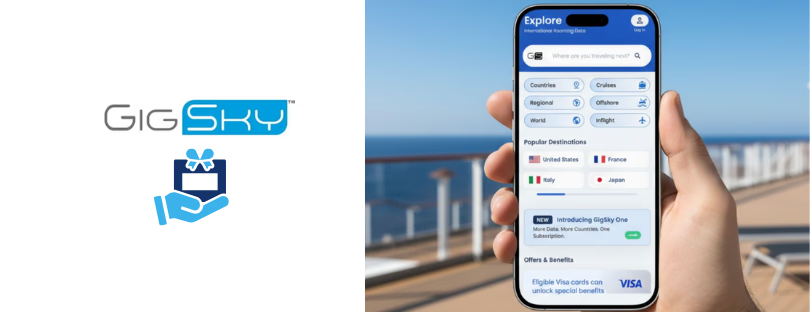
Watch for regional exceptions and cruise pricing
Not all roaming environments behave the same way. Regional agreements can make some destinations relatively affordable, while neighboring countries on the same itinerary can be priced completely differently. Border areas are another risk. Your phone may latch onto a foreign network unintentionally, even if you never meant to leave a covered zone.
Cruises are the biggest trap. Maritime roaming can be dramatically more expensive than land-based international service because the connection often relies on satellite-backed systems rather than a standard local mobile network. The same caution applies to in-flight mobile connectivity where offered. If cost control matters, do not assume your usual travel plan applies at sea or in the air.
For companies, prevention is a policy issue
Roaming costs are not just a traveler problem. For companies managing mobile fleets, international usage can quietly inflate telecom spend and create avoidable disputes with employees. The most effective approach combines clear travel policies, pre-trip provisioning, usage alerts, and role-based rules for who actually needs mobile data abroad.
A senior sales executive on a two-day client visit has different requirements from a support employee attending a conference with reliable venue Wi-Fi. Treating all travelers the same usually means overspending on some and under-supporting others.
That is where Alertify’s broader view of travel connectivity matters: roaming is not only a billing issue. It sits at the intersection of user experience, carrier economics, and travel operations.
The smartest approach is usually hybrid
There is no single answer to how to avoid roaming fees because travel patterns are not identical. A weekend city break, a month abroad, a multi-country work trip, and a cruise all require different decisions. The best strategy is usually hybrid: lock down your phone settings, use Wi-Fi for heavy lifting, choose a local option when staying longer, and only pay for carrier roaming when convenience clearly outweighs cost.
The good news is that roaming bill shock is rarely unavoidable anymore. It mostly happens when travelers leave connectivity on autopilot. A few deliberate choices before departure can save far more than any last-minute fix after the charges start rolling in.
The next time you pack a charger, pack a plan for your network too. It is one of the simplest ways to travel smarter.