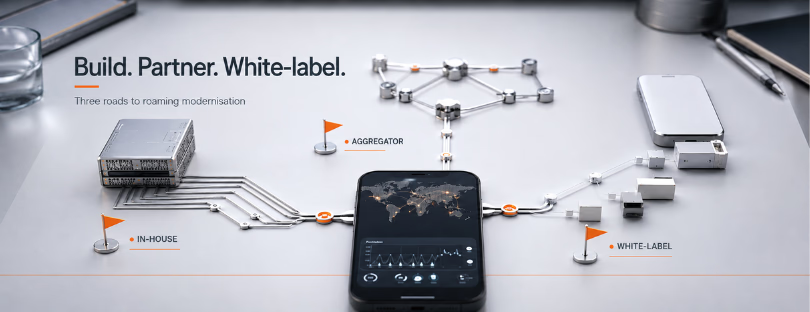
The Three Roads to Roaming Modernisation
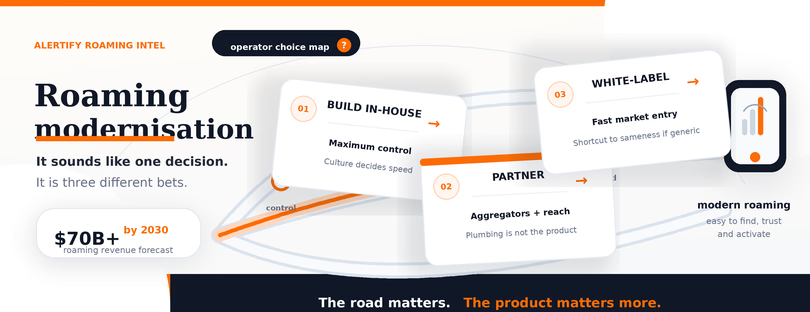
Roaming modernisation sounds like one decision. In reality, it is three very different bets.
Operators can build the new experience themselves. They can partner with aggregators. Or they can use white-label platforms to move faster without rebuilding the entire stack.
All three roads can work. All three can disappoint if the operator chooses them for the wrong reason.
That matters because roaming is no longer a passive service that quietly appears when a customer crosses a border. Travel eSIM brands have turned international connectivity into something people actively compare, buy and install before they travel. Meanwhile, Kaleido Intelligence forecasts combined wholesale and retail roaming revenues from consumer, travel eSIM and IoT connections to exceed $70 billion by 2030, with travel eSIM traffic reinforcing wholesale roaming demand for operators.
The share of travel eSIMs in the market nearly doubled in just 12 months, according to OpenSignals. That is the uncomfortable part for operators. Most still do not know exactly when a subscriber quietly stops roaming with them and chooses another connectivity option instead. The data is now starting to show where that leakage happens, which travellers switch first, and where the quality gap — not just price — is driving the decision.
So the opportunity is real. The question is how much control, speed and customer ownership operators are willing to trade along the way.
Road One: Build In-House
Building in-house is the most attractive option on a strategy slide.
It gives the operator control over pricing, product design, customer data, network logic, app experience, billing and roadmap. For large operator groups, that control matters. Roaming touches wholesale agreements, fraud prevention, customer care, enterprise accounts, retail channels and brand trust.
When done properly, in-house modernisation can create a real advantage. The operator can personalise offers based on previous trips, bundle roaming into premium plans, build family travel controls, support enterprise mobility and keep the customer relationship inside its own ecosystem.
But this road is slower than many executives want to admit.
READ MORE: The eSIM Threat Telcos Can’t Ignore
Legacy billing systems are rarely elegant. App teams may not own roaming flows. Wholesale teams may optimise for margin while product teams push for simplicity. Compliance, finance, customer support and network operations all have a view. By the time everyone agrees, a travel eSIM brand has already tested three checkout flows.
In-house is best for operators with scale, technical maturity and a genuine product culture. It is less convincing for operators that mostly want to “have an eSIM offer” because competitors are moving. Building badly is not strategic control. It is an expensive delay.
Road Two: Partner With Aggregators
The aggregator route is the pragmatic road. It says: we do not need to own every relationship or integrate every network directly. We need coverage, speed and commercial flexibility.
Aggregators can help operators extend destination reach, improve redundancy, access more competitive rates and reduce the burden of managing fragmented agreements. For smaller operators and MVNOs, this can be the difference between launching a serious travel connectivity offer and staying stuck in planning mode.
READ MORE: eSIM Aggregators Are Rewriting Travel Roaming
This model reflects where the market is going. Juniper Research expects travel eSIM revenue to reach $1.8 billion in 2025 and $8.7 billion by 2030, and points to Connectivity-as-a-Service platforms as one reason new entrants can launch faster. Lower barriers do not only help startups. They also help operators who cannot move at software speed alone.
The catch is dependency.
Aggregators can improve reach, but they do not automatically create a great customer product. An operator can have excellent backend access and still bury the offer in a confusing app menu. It can have wide coverage and still explain pricing like a tariff document.
Aggregator partnerships work best when the operator knows what it wants to own: the brand, the customer experience, the pricing strategy, the support promise. Without that clarity, aggregation becomes plumbing. Useful plumbing, yes, but still plumbing.
Road Three: Use White-Label Platforms
White-label platforms sit in the middle ground: faster than building everything internally, more packaged than pure aggregation, and often easier to launch across consumer, MVNO or travel-partner channels.
This route is becoming more attractive because roaming modernisation is no longer only about coverage. Operators need storefronts, APIs, activation flows, reporting, partner distribution, payment logic and customer management. White-label providers can compress the launch timeline by giving operators a ready-made commercial layer.
READ MORE: eSIM White Label: Launch Your Own Telecom Product
Telna has been especially vocal about this shift, arguing that operators can win travel eSIM customers by improving accessibility, affordability and digital discovery. GSMA Intelligence has also noted that consumer eSIM is moving through several major developments, including MNOs launching travel eSIM offers and targeting business segments.
For operators that want to test demand quickly, white-label can be sensible. It avoids a two-year internal project. It lets teams learn what travellers actually buy. It can also support B2B2C distribution through airlines, fintechs, OTAs or loyalty platforms.
But there is a brand risk.
A generic white-label experience can make an operator look like it borrowed someone else’s product and changed the logo. Customers may not notice at first, but they feel it when support scripts are thin, app flows are disconnected or the offer does not match the operator’s broader proposition.
White-label is strongest when used as acceleration, not abdication. The operator still needs editorial discipline around naming, pricing, positioning and customer promise. Otherwise, it is just a shortcut to sameness.

The Real Choice
The three roads are often discussed as technical options. They are really business model choices.
Build in-house if roaming is strategically central and the operator has the patience to create a proper digital product.
Use aggregators if coverage, speed and network flexibility matter more than owning every underlying relationship.
Choose white-label if the immediate problem is market entry, partner distribution or faster product learning.
Many operators will use a mix. A large group might build its core app experience, use aggregation for selected markets, and deploy white-label or API-based offers for secondary brands, MVNO partners or travel partnerships. That is not messy. It is realistic.
The mistake is pretending modernisation is just procurement.
It changes how roaming is sold, discovered, activated, supported and measured. It forces operators to think more like product companies. Travel eSIM brands such as Airalo, Nomad eSIM, Yesim and Ubigi and all others have already trained customers to expect clarity. Infrastructure and enablement players such as Telna, 1GLOBAL, Gigs, LotusFlare, BICS and Tata Communications are helping the supply side become more programmable.
Operators sit between those two forces: customer expectations rising on one side, technical options multiplying on the other.
Conclusion about roaming aggregators
A single architecture will not decide the future of roaming.
Some operators should build. Some should partner. Some should white-label. The smart ones will be honest about their own speed, culture and commercial ambition before choosing the road.
If an operator wants roaming to become a premium loyalty feature, in-house control may be worth the pain. If it wants broader reach without drowning in integrations, aggregators make sense. If it needs to enter the travel eSIM market quickly, white-label can be the right first move.
But none of these routes solves the real problem alone.
The market is not rewarding operators simply for having roaming. It is rewarding companies that make international connectivity easy to find, easy to understand and easy to trust. That is why travel eSIM brands have gained attention without owning traditional mobile networks. They turned roaming into a product.
Operators still have the subscriber base, billing relationship and trust. What they need now is a modernisation path that protects those assets instead of hiding them behind old packaging.
The road matters. The product matters more.