eSIM White Label: Launch Your Own Telecom Product
Let’s strip it down: An eSIM white-label solution is a ready-made system that lets you sell eSIM data plans under your own brand, while someone else handles all the telecom complexity in the background.
From your customer’s perspective, it looks like:
You offer global connectivity
You sell the plans
You control the experience
But behind the scenes:
The provider manages carrier agreements
Handles provisioning and activation
Runs the infrastructure
That’s the trade-off. You get the business. They handle the telecom.
And that’s why it’s exploding.
Why Everyone Suddenly Wants It
There’s a reason airlines, fintech apps, OTAs, and even media platforms are jumping into this.
Connectivity is no longer just a utility. It’s a product layer.
Think about it.
If you’re a travel platform, your user lands in a new country and the first thing they need is data. That’s a high-intent moment. A monetizable moment. A retention moment.
Instead of sending them to another app or provider, white-label eSIM lets you keep everything inside your ecosystem.
Same for fintech.
Same for mobility apps.
Same for hospitality.
It turns connectivity into:
A revenue stream
A product feature
A user retention tool
And most importantly, it does it without building a telecom company from scratch.
The Three Ways to Launch
Not all white-label setups are equal. There are three main approaches, and each one comes with a different level of control.
Simple reseller (fast but limited)
This is the easiest entry point.
You plug into a provider, sell their plans, and maybe adjust pricing slightly. Minimal setup, minimal control.
Good for testing. Not great for differentiation.
API-based white label (the real game)
This is where things get interesting.
You integrate an API and build your own user experience around it. Your branding, your flows, your pricing strategy.
The provider becomes invisible.
You own the product layer.
Fully custom app (high control, high investment)
This is for companies going all in.
You build a full connectivity product with deep customization, potentially layering in subscriptions, bundles, or even enterprise features.
Most companies don’t start here. But many evolve into it.
Where Yesim Fits In
If you’re looking at serious white-label eSIM infrastructure, Yesim is one of the most interesting players right now.
Not because they’re just another provider.
But because they’re clearly positioning themselves as telecom infrastructure for other businesses.
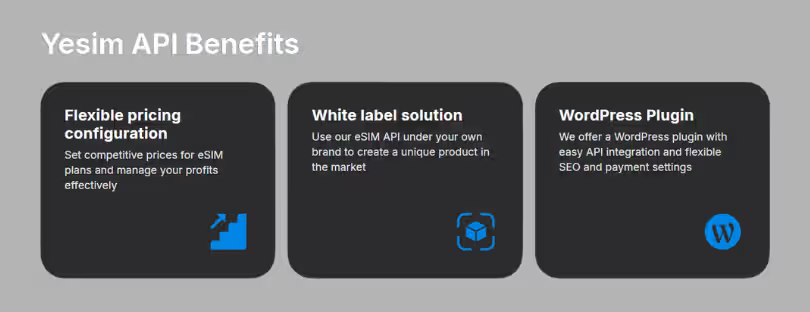
Their Partner API is built exactly for this use case.
It allows companies to:
- Launch their own branded eSIM product
- Integrate connectivity into apps or platforms
- Control pricing and margins
- Manage the full lifecycle of eSIMs
All without building telecom infrastructure or negotiating with operators.
And that last part matters more than people think.
Because telecom is not just technical. It’s regulatory, operational, and painfully slow.
What Yesim does is compress that entire process into something that can be launched in days, not months.
What You Actually Get (And Why It Matters)
This is where most articles go generic. Let’s not.
A good white-label eSIM solution should give you four things. If it doesn’t, it’s not worth it.
Control over pricing
You’re not locked into fixed margins. You can position your product however you want.
Premium bundles
Low-cost volume play
Cross-subsidized offers
That flexibility is critical.
Ownership of the customer relationship
This is the big one.
Your brand, your UX, your support. Not someone else’s.
You’re not sending users away. You’re keeping them.
Global coverage without complexity
Providers like Yesim offer access to 200+ destinations through a global network infrastructure.
You don’t need to build that yourself.
You can’t, realistically.
Speed
This is the underrated advantage.
Traditional telecom integrations take months. Sometimes years.
White label APIs compress that into days or weeks.
And in a market moving this fast, speed is everything.
The Strategic Shift: Telecom as a Feature
This is the part most people still underestimate.
eSIM white label is not just about selling data.
It’s about turning connectivity into a feature inside your product.
That’s a very different mindset.
Instead of asking:
“Should we sell eSIMs?”
The better question is:
“How does connectivity improve our core product?”
For example:
- A travel app bundles eSIM with bookings
- A fintech app offers connectivity for users abroad
- A hotel includes eSIM in premium stays
- A media platform monetizes its travel audience
Connectivity becomes embedded. Invisible. Expected.
That’s where the market is going.

The Risks Nobody Talks About
Let’s not pretend it’s all smooth.
White-label eSIM comes with real challenges.
User experience can break easily if installation flows aren’t clear
Support becomes your responsibility, even if the infrastructure isn’t
Refunds and plan rules need to be transparent
Differentiation is harder than it looks
Because here’s the truth.
If all you do is resell the same plans with a different logo, you don’t have a product.
You have a storefront.
The real value comes from:
- How you package it
- How do you integrate it
- How you position it
That’s where most companies fail.
Where This Is Heading
We’re moving toward a world where connectivity is no longer something users think about.
It just works.
And the companies that win won’t be telecom operators.
They’ll be platforms that embed telecom into their experience.
That’s the shift.
White-label eSIM is just the infrastructure layer, making it possible.
The Bottom Line
eSIM white label isn’t about entering telecom.
It’s about leveraging telecom without becoming one.
And solutions like Yesim are accelerating that shift by turning complex infrastructure into something modular, API-driven, and brand-ready.
If you have a distribution, audience, or a product ecosystem, this is one of the most obvious expansion layers right now.
Not because it’s trendy.
But because connectivity is becoming a default expectation.
And if you don’t offer it, someone else in your ecosystem will.