Airalo Passes 30M Customers in Global eSIM Shift
Airalo has passed 30 million customers, and while the number is impressive on its own, the bigger story is what it says about travel behavior.
For years, eSIMs were treated as a clever workaround for people who hated roaming bills. Useful, yes. Mainstream, not quite. That has changed. Airalo’s latest milestone suggests that travel eSIMs are no longer sitting at the edge of the mobile market. They are becoming part of the normal pre-trip checklist.
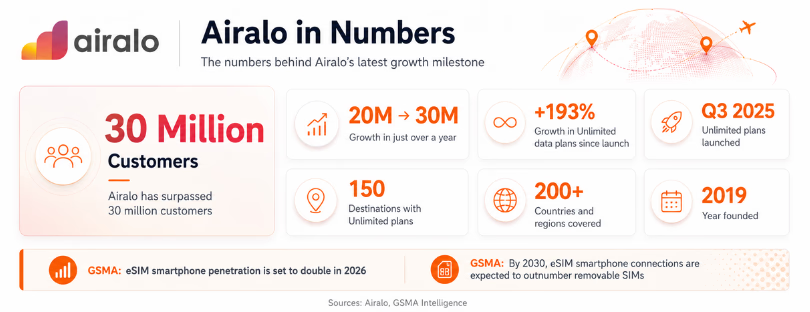
The company says it has grown from 20 million to 30 million customers in just over a year. That pace matters because adoption is no longer driven only by early tech users or digital nomads. More ordinary travelers are now comfortable buying connectivity before they travel, installing it digitally, and avoiding the airport SIM counter altogether.
Why 30 million matters
The timing is important. GSMA Intelligence expects eSIM smartphone penetration to accelerate sharply, with eSIM connections set to double in 2026 and eSIM smartphone connections expected to outnumber removable SIM connections by 2030. In plain English: the physical SIM card is not disappearing tomorrow, but its role is shrinking.
For travel, that shift is already visible. A tourist arriving in Tokyo, Istanbul, New York, or Lisbon does not want to spend the first hour comparing local SIM cards or wondering whether roaming will quietly become expensive. They want maps, ride-hailing, translation, hotel messaging, restaurant bookings, and payment apps to work immediately.
That is where Airalo has built its advantage. It sells the promise of being connected before the trip even starts. No plastic SIM. No local registration drama in most destinations. No waiting until the phone catches a roaming partner at a painful rate.
Unlimited becomes the new signal
One of the more interesting parts of Airalo’s announcement is not just the customer total, but the performance of its Unlimited data plans. Launched in Q3 2025 and now available in 150 destinations, Airalo says those plans have grown 193% since launch.
That tells us something about the market. Travelers are not only asking, “Can I get online?” They are asking, “Can I stop thinking about data?”
READ MORE: New Airalo eSIM packages just dropped
Low-cost 1GB or 3GB plans still make sense for light users, weekend city breaks, or people who mostly rely on hotel Wi-Fi. But for travelers who use maps heavily, upload video, work remotely, share hotspots, or move between cities, limited data can feel old-fashioned quickly.
Of course, unlimited plans still need careful reading. Most eSIM providers apply fair usage policies, speed management, or hotspot limits in some markets. That does not make Unlimited a bad product. It simply means travelers should look beyond the headline and check what “unlimited” actually means.
Not the only answer
Airalo’s scale gives it a strong position, but it does not mean it is the perfect option for every traveler. Some users may still prefer a local operator SIM for long stays, especially where local plans include voice, SMS, or better domestic pricing. Others may prefer providers with a specific edge: Holafly for a simple unlimited-first experience, Ubigi for reusable eSIMs and strong device connectivity use cases, Nomad eSIM for flexible regional plans, or Saily for travelers who like privacy and security features bundled into the app.
This is where the travel eSIM market is becoming more mature. It is no longer enough to ask which provider is “best.” The smarter question is: best for which trip?
READ MORE: How Airalo Is Rethinking Enterprise eSIM Billing
A business traveler moving across five countries in ten days has different needs from a student spending two months in Spain. A family using hotspot sharing has different needs from a solo traveler who only needs maps and WhatsApp. Airalo’s biggest strength is breadth and familiarity. The areas to watch are transparency around unlimited policies, network performance by destination, and whether customer support can scale as fast as customer numbers.
The quote behind the strategy
Airalo founder and CEO Ahmet Bahadir Ozdemir framed the milestone as a behavioral shift, not just a company achievement.
“When we started Airalo, the idea that you could buy a local data plan for any country in the world, in minutes, from your phone, felt radical. Today, 30 million people do it without thinking twice. Airalo has simply become part of their packing list,”
said Ahmet Bahadir Ozdemir, Founder and CEO of Airalo.
“That is exactly what we wanted. The best technology does not just solve a problem; it earns a permanent place in how people experience the world. Our ambition is to make worrying about connectivity feel as outdated as worrying about whether you printed your boarding pass.”
That comparison works because it captures the real direction of travel tech. The best products are not the ones users admire. They are the ones users stop noticing because they remove friction so completely.
A market no longer waiting
Airalo reaching 30 million customers is not just another milestone press release. It is a marker for the moment travel connectivity became normal consumer behavior.
Traditional roaming is not dead, and local SIMs still have a role. But the center of gravity has moved. Travelers increasingly expect mobile data to be instant, digital, prepaid, and understandable before they arrive.
The real lesson is bigger than Airalo. eSIMs are no longer selling only convenience. They are selling control. And in travel, control is often what people are really paying for.