Beeline Kyrgyzstan Adds 2GIS to Roaming Data Packages
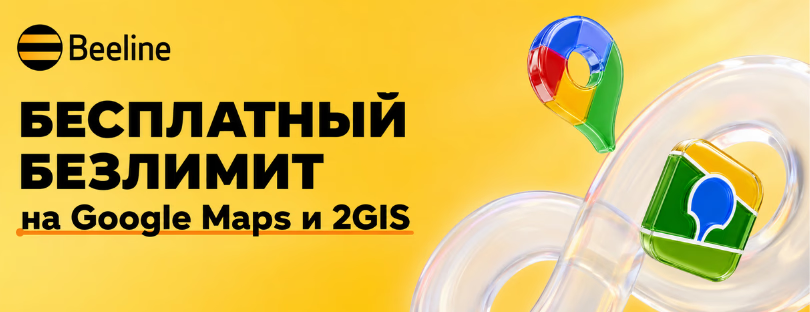
Beeline Kyrgyzstan has made a small but useful update to its roaming packages: unlimited data access now covers both Google Maps and 2GIS, not just Google Maps. For travelers, that matters more than it sounds.
Most roaming stories focus on gigabytes, prices and country lists. Fair enough. But when you land in a new city, the first thing you usually need is not a video stream or a giant data bundle. You need to find the hotel. You need to check whether the taxi is going the right way. You need to locate a café, a pharmacy, a metro entrance or the meeting point your friend sent you fifteen minutes ago.
That is where navigation data becomes more than a nice extra. It becomes a part of roaming that removes stress.
Beeline’s updated roaming packages now include unlimited traffic for 2GIS and Google Maps at speeds of up to 128 kbps, without using the customer’s main roaming data allowance. The packages listed by the operator are:
- 1 GB package in roaming for 499 soms, activated by 7181#
- 5 GB package in roaming for 1999 soms, activated by 7185#
- 10 GB package in roaming for 2999 soms, activated by 71810#
The move was also reported by Telecompaper, which noted Beeline’s roaming bundles and unlimited Google Maps access at up to 128 kbps.
Why 2GIS Matters
Adding 2GIS is a smart local and regional touch. Google Maps is the global default for many travelers, but 2GIS has a strong position in several markets thanks to detailed city maps, business directories, navigation and offline map support. Its official app listing describes it as a map and navigation service with offline access, route planning and business information.
That makes Beeline’s update more useful than a generic “free app traffic” perk. It supports the actual way people move around unfamiliar places. A traveler might use Google Maps for broad navigation, then switch to 2GIS for local details, building entrances, business hours or public transport context.
Still, this should be understood correctly. Speeds up to 128 kbps are enough for basic map loading, search and route checking, but not for heavy mobile use. This is not a replacement for a proper data plan if you expect to work from your phone, upload files, stream video or spend the trip on video calls. It is a safety layer for navigation.
The Bigger Roaming Signal
What Beeline is really doing here is making roaming feel less risky. Instead of only selling a data allowance, the operator is attaching the package to a real travel moment: getting around without panic.
That is the direction the whole travel connectivity market is moving. GSMA Intelligence has pointed to travel eSIM as a strong use case because it gives consumers a clear reason to care about eSIM and international mobile data. Juniper Research also expects travel eSIM revenue to grow sharply, from $1.8 billion in 2025 to $8.7 billion by 2030.
Operators like Beeline are therefore under pressure from two sides. On one side, traditional roaming must become more predictable and friendly. On the other hand, travel eSIM brands are teaching travelers to expect simple prepaid data before they even arrive.
Beeline’s answer is not to copy the eSIM model directly. Instead, it strengthens roaming with a practical benefit that feels immediately useful. For existing Beeline customers, that may be enough to stay with their home operator rather than buying a separate travel eSIM for a short trip.
Still Read the Details
The best advice is simple: activate the right package before you travel, check whether your destination is covered, and download offline city maps in advance. Beeline itself recommends downloading the maps you need before departure, and that is still good advice. Unlimited navigation traffic is helpful, but airports, border areas and remote routes can still be unpredictable.
Travelers who mainly need maps, messaging and light browsing may find the smaller package enough. Those who expect heavier use should look beyond the navigation perk and compare the full allowance, validity period, roaming countries and final price. A dedicated travel eSIM may still be better for multi-country trips, especially when you want larger data volumes or app-based management.
Conclusion
Beeline’s update is not a dramatic reinvention of roaming, but it is a genuinely sensible one. Free unlimited access to Google Maps and 2GIS solves a real travel problem: the fear of getting lost while trying to save data abroad.
The bigger lesson for operators is clear. Travelers do not judge connectivity only by gigabytes anymore. They judge it by confidence. Can I land and move? Can I find my hotel? Can I avoid bill shock? Can I stay in control?
Travel eSIM providers have pushed the market toward simpler, more user-friendly connectivity. Beeline’s move shows that mobile operators can still defend roaming if they make it feel practical, local and tied to real travel behavior. Not every traveler needs a separate eSIM. But every traveler needs a map that works when the street signs stop making sense.