STMicroelectronics ST54M Brings PQC to eSIM Phones
STMicroelectronics has introduced ST54M, a secure mobile chip that says a lot about where smartphones are heading next. Not faster cameras. Not thinner screens. The quieter race is happening inside the secure hardware that lets a phone become your wallet, transit pass, car key, mobile identity document and eSIM-connected device. STMicroelectronics ST54M eSIM NFC
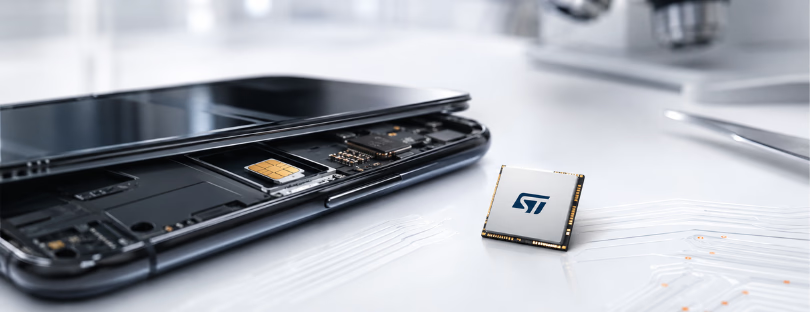
On paper, ST54M is a single-die component combining NFC, an embedded secure element, eSIM functionality and a hardware accelerator for post-quantum cryptography. ST says the chip is designed for smartphone and personal electronics manufacturers preparing for future quantum-ready security requirements, with Common Criteria 2022 EUCC and EMVCo certification targeted for July 2026. That timing matters. The post-quantum shift is becoming a product planning issue, not a distant research topic.
Why quantum-ready now
The uncomfortable truth behind post-quantum security is simple: devices being designed today may still be in circulation when stricter cryptographic rules arrive. Phones, wearables, payment devices and connected car systems do not live in neat one-year cycles once they are deployed across banks, mobile operators, transport networks and public identity programs.
NIST finalized its first post-quantum cryptography standards in 2024, including ML-KEM for key establishment and ML-DSA for digital signatures. NIST also says organizations should begin migrating systems to quantum-resistant cryptography, with vulnerable algorithms eventually removed from its standards and higher-risk systems moving earlier. That gives ST54M its context. This is not about adding a fashionable security label. It is about giving device makers hardware support for the algorithms likely to shape the next decade of secure services.
ST’s chip supports ML-KEM and ML-DSA through a dedicated hardware accelerator. In practical terms, that should help OEMs handle heavier cryptographic operations without turning secure mobile experiences into slow or battery-hungry ones. Security only works at scale if users do not feel punished for using it.

One chip, many services
ST54M is interesting because of the combination. NFC is already central to payments, transit ticketing and access control. The secure element protects sensitive applications. eSIM handles mobile network authentication and remote provisioning. Bringing these functions into one mobile security platform makes sense for device makers trying to support more services without adding more friction.
The GSMA describes eSIM as a way to securely download the SIM into a secure element embedded inside a device, while offering security comparable to a removable SIM card. That matters for Alertify readers because eSIM is no longer just a travel convenience. It is becoming part of a broader secure identity and connectivity layer inside consumer devices.
READ MORE: Revolutionizing Bulk IoT: STMicroelectronics Unveils First SGP.32-Compliant eSIM
Think of the travel use case. A phone can already store a payment card, airline app, hotel room key, transit pass and eSIM profile for arrival connectivity. The more these services converge, the more the underlying trust architecture matters. A failed payment or broken eSIM activation is annoying. A compromised identity credential or car key is a different level of problem.
“With ST54M, we are extending our mobile-convergence platform to help customers address evolving security challenges while supporting the rich set of services users now expect from their devices,”
said David Richetto, Connected Security Group VP, Division General Manager, STMicroelectronics.
“By combining a PQC hardware accelerator with NFC, embedded secure element, and embedded SIM capabilities, ST54M gives device makers a secure path to start preparing next-generation mobile experiences.”
The market signal
The broader semiconductor market is moving in the same direction. NXP, for example, frames post-quantum cryptography as part of a wider embedded security strategy across IoT, automotive, industrial and mobile environments, with emphasis on hardware roots of trust and crypto agility. That comparison is useful because it shows ST54M is not an isolated experiment. The industry is preparing for a world where quantum-safe design becomes expected infrastructure.
Where ST’s announcement stands out is the mobile convergence angle. Rather than talking only about secure boot or industrial systems, ST is positioning ST54M around the services people touch every day: wallet, identity, transit, access, car keys and connectivity. For smartphone makers, banks, operators and wallet providers, that could be attractive because it keeps multiple trust-dependent services close to the device’s secure core.
Still, this is not for every product. Low-cost devices that only need basic connectivity may not need this level of integration yet. Some manufacturers may also prefer modular architectures if they want more flexibility across suppliers or markets. And while ST has disclosed sampling availability and a July 2026 target for production and certification, the real test will be ecosystem adoption: OEM design wins, wallet support, operator readiness and how quickly regulators translate post-quantum expectations into procurement reality.
Why this matters
ST54M is a small component with a large strategic message: the phone is becoming a security gateway, not just a communication device. The next phase of mobile connectivity will not be judged only by how quickly an eSIM installs or how smoothly a tap-to-pay transaction works. It will also be judged by whether the hardware underneath can survive a longer, harsher security timeline.
For travel tech, telecom and digital identity players, this is the direction of travel. Connectivity is becoming embedded. Identity is becoming mobile. Payments and access are becoming invisible until they fail. The companies that win will not simply add more services to the phone. They will make those services trusted enough to disappear into everyday use.