Life360 and Uber Bring Teen Ride Booking Into One App
Life360 and Uber are taking their partnership beyond simple account linking. The companies have launched a new integration that lets Life360 members request and coordinate Uber rides for teens and other family members directly from the Life360 app.
The feature went live in select markets on June 18, 2026.
On paper, it sounds like a small convenience feature. In real life, it solves a very familiar family problem: the messy space between “Where are you?”, “Can you send me the address?”, “Did the driver arrive?”, and “Text me when you get there.”
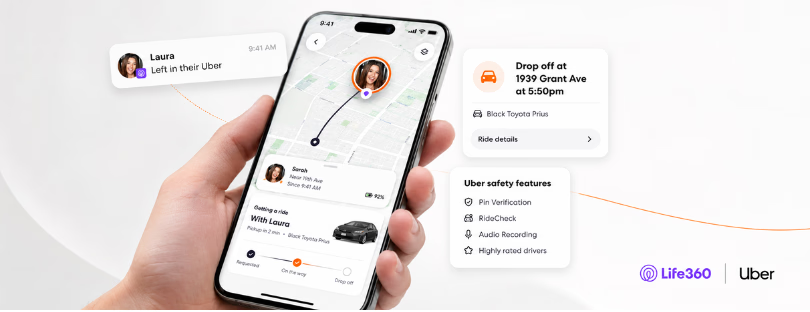
The integration combines Uber Family’s ride platform with Life360’s real-time location sharing. Parents can request a ride to a family member’s live location, with pickup details automatically filled into Uber. The trip can then be followed either in Uber or on the Life360 map, where it appears alongside the locations of other family members.
That matters because the modern family movement is no longer neatly scheduled around school runs and one parent with car keys. Teens go to sports camps, shopping centers, friends’ houses, tutoring, events, and part-time jobs. Parents are often working while all of this is happening. Coordination has become its own quiet form of family admin.
Why this timing makes sense
“During summer break, teens take more trips to the mall, movie theaters, sports camps, and other community destinations – with over 40% of teen rides happening while many parents may still be at work,” said Margarita Peker, Head of Family Verticals at Uber.
“Coordinating those schedules across different apps and conversations can quickly become overwhelming for families. Through our integration with Life360, we’re helping make transportation simpler, more transparent, and easier to manage for everyone, all under one app.”
That quote gets to the heart of the product move. This is not just about getting from A to B. It is about reducing the number of tiny coordination failures that happen around every ride: wrong pickup point, missed text, late arrival, unclear route, parent checking one app while the teen is using another.
Kevin Sung, VP of Product for Life360, framed it in a similar way.
“Family life is full of moments that don’t fit the routine, and getting loved ones where they need to go safely has become one of the biggest coordination challenges for modern families,” he said. “By bringing Uber into Life360, we’re making it easier for families to coordinate transportation while giving parents greater visibility, confidence, and peace of mind throughout the journey.”
|
RIDE
Uber rides 60% off
First 5 rides · up to €6 off
|
CONNECTIVITY
Get an eSIM before landing
Avoid roaming · instant data
|
AIRPORT TIP
Skip airport SIM queues
Activate before arrival
|
The bigger platform play
For Uber, teen accounts have become a clear attempt to formalize something that was already happening informally: teens needing rides, often with parents involved from a distance. Uber says teen account users have completed tens of millions of trips across more than 50 countries since the feature launched in 2023. The company also says teen trips include built-in safety features such as live trip tracking, PIN verification, RideCheck, and access to safety support.
For Life360, the move is even more strategic. The company is no longer just trying to be the app that shows where family members are. It wants to become the operating layer for family movement, safety, and daily coordination. With nearly 98 million monthly active users reported earlier this year, Life360 has the scale to turn location sharing into a broader service ecosystem.
This is where the market gets interesting. Apple’s Find My and Google Family Link already cover parts of the family location and supervision experience. Lyft also supports teen riders through family accounts in some markets. But Life360 and Uber are combining live family context with an actual transport transaction. That is a different kind of utility. It turns location from information into action.
Useful, but not universal
The strongest use case is obvious: busy families with teens who already use Life360 and trust Uber. For them, this could remove friction quickly. A parent no longer has to ask for a location, copy an address, open another app, book a ride, and then keep switching screens.
But this is not for every family. Some parents and teens are uncomfortable with always-on location visibility. Others may prefer public transport, local taxi services, school transport, or simply want fewer apps involved in family life. There is also the practical issue of availability, since the new integration is launching in select markets first.
What could make the product stronger? Clearer market-by-market availability, more transparent consent controls for teens, and simple explanations of what data is shared between the two platforms. When the product category touches children, movement, and location, trust is not a design detail. It is the product.
More than a ride button
The Life360 and Uber integration is a smart move because it understands that family mobility is not only about transport. It is about reassurance, timing, visibility, and fewer small moments of uncertainty.
The best version of this feature will not feel like surveillance. It will feel like coordination that respects the teen’s growing independence while giving parents enough visibility to stop worrying every five minutes. That balance is hard, and not every family will want it. But the direction is clear: the next generation of mobility apps will not just move people. They will fit into the messy, emotional, everyday logistics of modern life.