Why Embedded Connectivity Threatens Telecom Distribution?
For most of modern mobile history, telecom distribution was simple. Operators owned the network, sold the plan, managed the SIM, billed the customer and controlled the relationship. You walked into a store, signed a contract, received a plastic SIM card and became part of the operator’s world.
Embedded connectivity changes that script.
The network still matters, of course. Nobody wants a clever airline app if the data connection fails on arrival. But the place where connectivity is discovered, bought and activated is starting to move away from the operator’s front door. It is moving into airline apps, banking apps, super apps, travel platforms, hotel journeys, fintech wallets and enterprise software.
That may sound like a small UX improvement. It is not. It is a distribution earthquake dressed up as a convenience feature.
From product to layer
The old telecom model treated connectivity as the main product. The new model increasingly treats it as a layer inside another product.
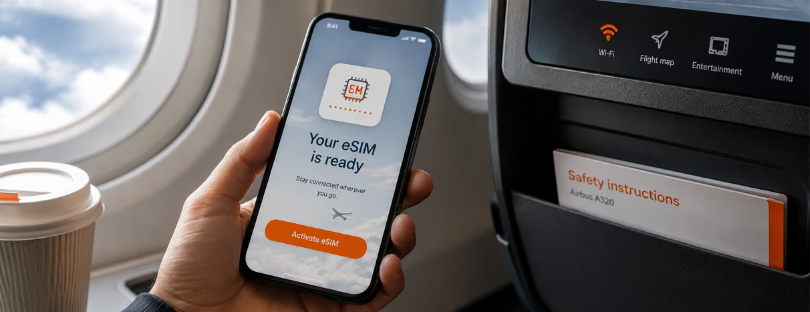
A traveler checking in for a flight does not wake up thinking, “I should compare roaming tariffs today.” They think about boarding passes, luggage, passport control, airport transfer and whether Google Maps will work when they land. That is the moment embedded connectivity wants to capture.
READ MORE: Embedded Connectivity Is Reshaping Telecom
An airline app already knows where the customer is going. A bank already knows the cardholder is abroad. A travel platform already knows the itinerary. A super app already owns daily attention. In that context, selling mobile data is not a separate telecom event. It becomes part of the trip.
This is why embedded connectivity is much more dangerous to traditional operators than another travel eSIM app. A standalone eSIM provider still has to win attention. Embedded connectivity borrows attention from someone who already has it.
The customer relationship moves
For operators, this is the uncomfortable part. They may still provide the underlying network access, but the visible customer relationship can shift elsewhere.
The traveler may remember that their bank gave them a clean roaming alternative. The airline may get credit for helping them land connected. The booking platform may own the upsell. The fintech app may turn travel data into another lifestyle feature. Meanwhile, the operator becomes infrastructure in the background.
That is not automatically bad. Infrastructure can be very profitable when it is scaled, reliable and well priced. But it is a very different business from owning the retail relationship.
We have seen this movie in other sectors. Payments moved inside ride-hailing apps. Insurance became embedded in checkout flows. Streaming bundles appeared inside telecom contracts. The winner was not always the company that owned the original product. Often, it was the company that owned the customer moment.
Telecom is now entering that same uncomfortable phase.

Why eSIM made this possible
eSIM did not create the idea of embedded connectivity, but it removed the worst friction.
A physical SIM card is a distribution object. Someone has to manufacture it, ship it, stock it, hand it over, insert it and support it. An eSIM profile can be activated digitally, which makes it easier to sell inside an app, trigger after a booking, bundle with a premium account or deliver through an API.
That is why the API layer matters. Companies such as 1GLOBAL, Airalo Partners, Yesim, Monty Mobile, Transatel, Gigs and others are not only selling data plans. They are selling the plumbing that lets non-telecom brands add connectivity without becoming full mobile operators.
Some models are travel-first. Some are enterprise-first. Some are closer to MVNO infrastructure. Some focus on compliance, numbering, voice, IoT or device management. But the strategic direction is similar: telecom capabilities are being unbundled and repackaged for companies that already own customer demand.
Not every brand should do this
There is still a trap here. Embedded connectivity is not a magic margin machine for every app with travelers.
If the brand does not have a real travel moment, strong customer trust or enough support maturity, selling connectivity can backfire. Failed activations, unclear refund rules and weak destination coverage do not feel like “extra revenue” to the customer. They feel like the airline, bank or platform broke their trip.
That is where some embedded offers still need work. Too many flows look smooth until something goes wrong. Then the customer is bounced between the app, the connectivity provider and the network partner. For embedded telecom to mature, the invisible layer cannot mean invisible accountability.
This is where operators still have an advantage. They understand network quality, support escalation, numbering, roaming agreements and regulatory pressure. The problem is that many operators are not fast enough at packaging those strengths into modern digital distribution.

The operator response
Traditional operators have three choices.
They can defend the old model and hope customers keep buying directly. That may work for domestic mobile plans, but it looks weaker in travel, IoT and short-term data use cases.
They can launch their own travel eSIM offers, which many are now doing. Orange Travel, Vodafone and other operator-backed brands show that telcos can compete when they package connectivity clearly and digitally.
READ MORE: AT&T and Gigs Redefine Mobile Plans with Embedded Connectivity
Or they can become the embedded infrastructure partner themselves. This may be the smartest long-term play. Instead of fighting airlines, banks and platforms for the customer interface, operators can power those interfaces with wholesale access, APIs, compliance support and quality guarantees.
The question is whether they can accept not always being the visible brand.
Final thoughts about telcos & embedded connectivity
Embedded connectivity will not kill operators. That is too dramatic, and honestly, too simplistic. But it could break the old telecom distribution model where operators assumed that owning the network meant owning the customer.
The market is moving toward a split. Customer-facing brands will own the moment. Connectivity platforms will own the integration. Operators will own the network, unless they move higher up the stack.
The best-positioned players will be those who understand all three layers. 1GLOBAL is pushing embedded telco and API-led distribution. Travel eSIM specialists such as Airalo, Holafly, Yesim, Ubigi and GigSky have trained consumers to expect instant, app-based connectivity. Operator-backed offers such as Orange Travel show that telcos can still compete when they stop behaving like old roaming departments.
The weak players will be the ones selling “instant eSIM” as a button, not a service. Because once connectivity becomes invisible, reliability becomes the only thing people notice.
That is the paradox. The more embedded connectivity succeeds, the less customers will think about telecom. Until it fails. Then they will think about it very loudly.