7 Airport Digital Transformation Trends
A missed connection used to mean a long line at a transfer desk and a lot of guesswork. Now it increasingly means a push notification, a rebooking option, and a much clearer path through the terminal. That shift captures why airport digital transformation trends matter right now. Airports are no longer just physical infrastructure hubs. They are becoming data-driven service environments where operations, passenger experience, retail, and connectivity are tightly linked.
For travelers, that means less friction when systems work well. For airport operators, airlines, telecom providers, and travel-tech vendors, it means a bigger strategic question: which digital investments actually improve throughput, resilience, and revenue, and which ones just add another layer of expensive complexity?
1. Biometric identity is moving from pilot to operating model
Biometric processing has been discussed for years, but the trend is shifting from isolated trials to broader operational deployment. Airports are using facial recognition and other identity technologies across check-in, bag drop, security, lounge access, boarding, and in some markets even arrival processing.
The commercial logic is straightforward. Airports want to reduce queue times, improve terminal flow, and use staff more efficiently. Airlines want faster boarding and fewer document-check bottlenecks. Travelers want less stop-start friction, especially on high-volume international routes.
But this trend is not just about speed. It is also about orchestration. A biometric layer becomes more valuable when it connects multiple airport systems rather than solving one checkpoint in isolation. That is where the real transformation sits.
The trade-off is governance. Privacy regulation varies by country, passenger trust is uneven, and opt-in design matters. Airports that treat biometrics as purely a throughput tool can run into reputational and compliance problems fast. The winners will be the operators that pair convenience with clear consent, transparent data policies, and fallback options.
2. Airport operations are becoming real-time, not just digitized
A lot of airports already have digital systems. That does not mean they are digitally transformed. One of the more meaningful airport digital transformation trends is the move from fragmented legacy software to real-time operational visibility.
This shows up in airport operations centers that bring together flight data, gate allocation, turnaround status, baggage flows, security wait times, weather alerts, and staffing availability into a shared view. The point is not simply dashboard aesthetics. It is faster decision-making when disruption hits.
This matters because airports operate as interconnected ecosystems. A late inbound aircraft affects gate planning. Gate planning affects cleaning and ground handling. Ground delays affect passenger movement, retail dwell time, and onward connectivity. Without integrated data, teams respond locally. With integrated data, they can manage system-wide impact.
That said, integration is expensive and messy. Many airports still run on vendor stacks that were never designed to talk to each other cleanly. Digital twins, predictive analytics, and AI-based recommendations sound compelling, but they depend on data quality and internal alignment. Bad data at scale is still bad data.
3. Passenger flow management is getting more predictive
Queue management used to be reactive. Staff saw congestion building and responded on the ground. The newer model uses sensors, cameras, boarding data, historical patterns, and live passenger counts to predict pinch points before they become visible to the naked eye.
Security screening is the obvious use case, but not the only one. Airports are applying predictive flow tools to immigration halls, check-in banks, curbside arrivals, baggage claim, and transfer corridors. The aim is simple: move people more efficiently without continuously expanding physical footprint.
For travelers, this can mean more accurate wait time estimates and fewer unpleasant surprises. For operators, it supports better staffing and capacity planning. For commercial teams, it can also protect retail opportunities by reducing the amount of time passengers spend trapped in operational bottlenecks.
There is a catch. Prediction is only useful if airports can act on it. If labor models are rigid, security lanes cannot be flexed, or neighboring agencies operate on separate systems, the value of predictive insight drops. Technology can expose constraints just as clearly as it solves them.
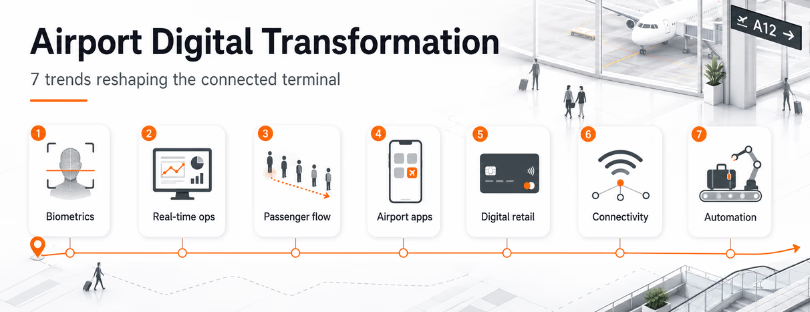
4. The airport app is becoming a service layer, not a brochure
Many airport apps were historically underwhelming. They offered static maps, basic flight status, and not much else. That is changing as airports try to make digital channels more useful before and during the journey.
The smarter apps now combine wayfinding, parking, security wait times, gate updates, terminal services, food ordering, loyalty integration, and disruption messaging. Some are moving toward contextual assistance based on where a passenger is, how much time they have, and what stage of the journey they are in.
This is where connectivity becomes strategically important. A great airport app is only great if passengers can reliably access it across the terminal, parking structures, transit links, and arrival areas. Weak mobile coverage or overloaded public Wi-Fi can quietly undermine the entire experience layer.
For airports, the app also becomes a data and monetization channel. Better digital engagement can improve parking conversion, retail targeting, premium service upsell, and direct communication during delays. But airports need to be careful not to overload users with irrelevant promotions. Utility first, monetization second usually works better.
5. Retail and payments are becoming more digital and more measurable
Non-aeronautical revenue remains a major priority for airports, and digital transformation is changing how that revenue is captured. The trend is not just more self-checkout or more digital signage. It is the merging of passenger data, location intelligence, and payment infrastructure to make airport commerce more targeted and more trackable.
Pre-order food, click-and-collect duty free, personalized retail offers, dynamic promotions near gates, and digital receipts are all part of this shift. So are modern payment experiences, including contactless and wallet-based transactions that reduce friction for international passengers.
From a business perspective, this is attractive because airport retail has long suffered from limited visibility into intent and conversion. Digital channels help close that gap. Airports and concessionaires can start to understand what passengers browse, when they buy, and how disruption changes spending behavior.
Still, more data does not automatically mean better retail performance. An airport with poor passenger flow, weak signage, or long security queues will not fix those issues with targeted coupons. Commercial tech works best when the core terminal journey is already functioning well.
6. Connectivity infrastructure is becoming part of the airport product
Airports have traditionally treated connectivity as a utility. That mindset is fading. High-capacity Wi-Fi, strong indoor mobile coverage, private wireless networks, and better network orchestration are becoming central to how airports run and how passengers judge the experience.
This shift matters on two levels. First, passengers increasingly expect reliable connectivity as a baseline, not a perk. Navigation, digital boarding documents, airline notifications, messaging, ride-hailing, payments, and work all depend on it.
Second, airport operations themselves are becoming more connectivity-dependent. Smart cameras, IoT sensors, connected baggage systems, digital signage, workforce mobility tools, and autonomous or semi-autonomous equipment all rely on stable network performance.
For telecom stakeholders, this creates a more strategic role inside the airport environment. Indoor coverage design, neutral host models, private network deployment, and traffic management are no longer side conversations. They shape both customer experience and operational resilience.
The challenge is that airport environments are difficult and expensive to serve well. Passenger density fluctuates sharply. Building structures interfere with signal propagation. Security and compliance requirements are high. So while better connectivity is clearly one of the defining airport digital transformation trends, execution quality matters more than marketing claims.

7. Automation is expanding, but full autonomy is still selective
Automation is spreading across airports, particularly in bag handling, check-in, cleaning, security support, and airside operations. You can also see early movement in robotics, autonomous vehicles, and AI-assisted monitoring. But the practical trend is selective automation, not total replacement of human labor.
That distinction matters. Airports are complex, safety-critical environments with unpredictable edge cases. Human oversight is still essential in many workflows, especially when disruption, exceptions, or security incidents occur.
Where automation does make sense is in repetitive, high-volume processes where consistency matters. Self-service bag drop, automated border gates, predictive maintenance systems, and AI-assisted resource planning can all improve efficiency when deployed carefully.
The risk is over-automating weak processes. If an airport digitizes a broken workflow, it may simply create a faster version of the same problem. The strongest operators start by redesigning the process, then applying technology where it genuinely reduces cost, delay, or error.
What these trends mean for the next phase of airport strategy
The bigger story is not that airports are buying more technology. It is that airports are being pushed to think like integrated digital service platforms. Passenger experience, airline performance, terminal retail, and network infrastructure are no longer separate conversations.
That creates opportunity, but also pressure. Capital budgets are tight, procurement cycles are long, and many airports are still dealing with legacy architecture. Not every airport needs the most advanced version of every tool. A regional airport and a major international hub do not have the same economics, regulatory exposure, or passenger mix.
What matters now is prioritization. Which systems reduce congestion fastest? Which upgrades improve resilience during irregular operations? Which digital services actually change traveler behavior? Which connectivity investments support both passengers and operations?
That is where the market is getting more interesting. The best digital airport strategies are becoming less about headline innovation and more about practical orchestration across identity, operations, payments, passenger communication, and connectivity.
For travelers, the payoff should be simple: fewer dead ends, fewer blind spots, and better control when plans change. For airport leaders and technology partners, the opportunity is larger. Build the right digital foundation, and the terminal stops being just a transit space. It becomes a smarter, more responsive part of the travel journey.