The Enterprise eSIM Opportunity Is Bigger Than Most Travel Brands Realize
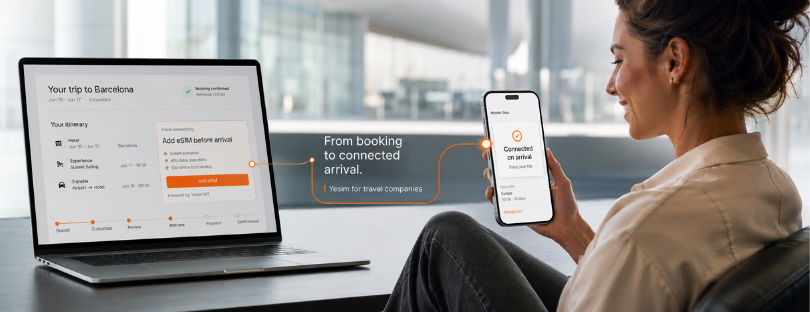
A traveller lands abroad, avoids roaming charges, scans a QR code, and gets online before their suitcase appears. It is clean. It is easy to understand. It is also the reason most media coverage of eSIM still circles around tourists, backpackers, digital nomads and holidaymakers.
That story matters. Consumer travel eSIM made the category visible.
But it is not where the most interesting long-term value may be forming.
Behind the travel eSIM boom, a quieter enterprise market is starting to take shape. It is less shiny, less social-media-friendly, and much harder to explain in one sentence. It involves MSPs, enterprise IT teams, logistics operators, travel risk managers, mobility teams, field workers, remote workforce platforms and companies with people or devices moving across borders.
And that is exactly why it matters.
Consumer travel eSIM is noisy. Enterprise connectivity is painful. Painful markets often create better business.
The Tourist Story Got Loud First
The consumer eSIM market had the perfect conditions for fast attention. Roaming was expensive. Local SIM cards were inconvenient. Travellers were annoyed. Phones were finally eSIM-ready. The product could be sold with a simple promise: land connected.
That simplicity helped companies such as Airalo, Holafly, Nomad eSIM, Ubigi, Yesim and many others turn eSIM from a telecom feature into a travel habit. The GSMA has also pointed to 2026 as a year where eSIM moves further from early adoption into broader operational scale, which shows how quickly the category has matured.
But success brought crowding.
Today, many consumer eSIM offers look painfully similar from the outside. Same country pages. Same discount codes. Same “stay connected anywhere” language. Same race to explain whether “unlimited” really means unlimited. The category has grown, but it has also become margin-compressed and heavily performance-driven.
That is not a criticism. It is the natural life cycle of a market that has become easy to enter.
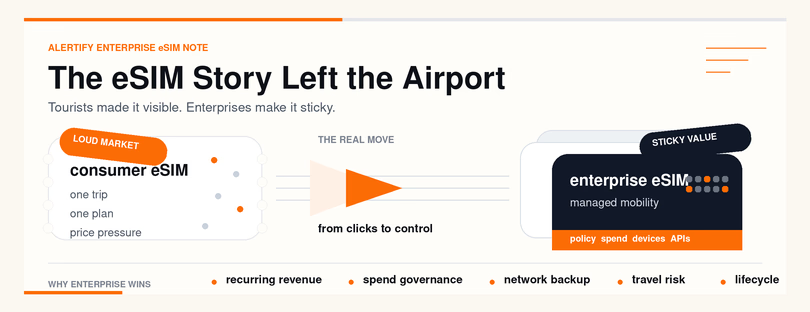
Enterprise eSIM is different because it is not mainly about convenience. It is about control.
The Bigger Problem Is Not Data
A tourist usually wants data for a trip.
A company wants something more complicated: continuity.
It wants employees to stay reachable. It wants devices to remain online. It wants roaming spending under control. It wants fewer emergency top-ups, fewer lost SIM cards, fewer support tickets, fewer blind spots, and fewer awkward finance surprises after a month of international travel.
And increasingly, it wants all of that to sit inside existing systems.
That is where the opportunity becomes more interesting. Enterprise eSIM is not just a cheaper alternative to roaming. It can become part of how companies manage mobility itself.
READ MORE: Enterprise eSIM: Why Mobile Provisioning Still Lags
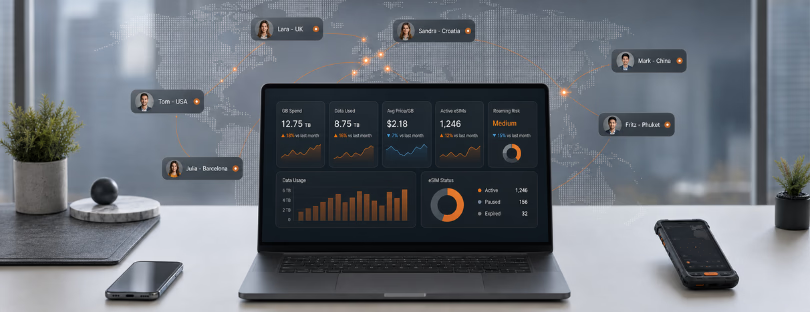
The real issue is rarely “can this person buy 10GB for France?” The issue is: who controls the connectivity when the employee is abroad? Who pays? Who approves? Who monitors? Who can disable it? Who knows if the traveller went offline? Who owns the backup plan when the primary network fails?
These are not tourist questions. They are operational questions.
And operational questions tend to carry budget.
Why Enterprises Are Different Buyers
The enterprise buyer is not always looking for the cheapest plan. Sometimes they are, of course. Procurement is procurement. But the cheapest offer is not always the most useful one when the cost of failure is higher than the cost of data.
A field engineer who cannot connect at a remote site is not just having a bad travel day. A logistics device that drops offline is not just “out of bundle.” A travelling executive who cannot access secure tools abroad is not simply inconvenienced. In some sectors, connectivity failure becomes a risk event.
That is why travel risk management is becoming part of the enterprise eSIM conversation. ISO 31030, the international guidance for travel risk management, does not exist because business trips are glamorous. It exists because organisations have a duty to plan for what happens when employees move through unfamiliar environments.
Connectivity now sits inside that duty more often than companies admit.
If a traveller cannot receive alerts, access emergency contacts, confirm location, use secure apps or communicate during disruption, then mobile data is no longer just a productivity tool. It becomes part of resilience.
This is the part of the market that travel brands often underestimate.
The Enterprise Layer Is Wider Than Travel
The mistake is thinking enterprise eSIM only means “business travellers buying travel eSIMs with invoices.”
That is one use case. It is not the whole market.
The bigger shift is about mobility infrastructure. Phones, tablets, rugged devices, connected vehicles, payment terminals, routers, sensors and workforce devices all need connectivity that can be managed remotely and reliably.
The GSMA’s SGP.32 specification, designed for remote provisioning and management of eSIMs in IoT devices, is one signal of that wider direction. Vodafone Business also talks about embedded SIM and iSIM in the context of large-scale IoT deployments, where connectivity becomes part of the device lifecycle itself.
READ MORE: Why enterprise connectivity is moving away from traditional telcos
This is not the same market as selling a weekend data pack to Barcelona.
It is slower. It is more technical. It needs better support, better governance and often deeper integration. It is probably not attractive for brands that only want fast affiliate revenue or simple consumer checkout flows.
But for companies that can handle complexity, the upside is obvious: longer relationships, higher switching costs, recurring usage and a role inside the customer’s operations.
That is commercially stickier than a one-off tourist purchase.
Why This Matters Now
The timing is important because travel brands, fintechs, booking platforms and workforce tools are all looking for new ways to stay useful after the first transaction.
A booking confirmation is not enough. A banking app wants to remain relevant while the customer travels. A remote work platform wants to support people across borders. An MSP wants to manage connectivity alongside devices, security and support. A mobility manager wants fewer manual exceptions.
Embedded eSIM fits neatly into that shift.
READ MORE: Shadow Connectivity: The Enterprise Blind Spot in Global Mobility
But the companies that win will not be the ones that simply add a “business” page to a consumer product and call it enterprise. The serious opportunity sits deeper: spend governance, policy control, backup connectivity, lifecycle management, APIs, compliance, support and visibility.
That is also where many current offers still need to improve. The market needs clearer language, cleaner comparisons, better proof of reliability, and less vague “global coverage” messaging. Enterprise buyers are not impressed by broad claims if they cannot understand what happens on a bad day.
And bad days are exactly where enterprise products are judged.
Conclusion
The travel eSIM market made eSIM popular. The enterprise market may make it indispensable.
That is the bigger picture most travel brands are still missing. Consumer eSIM solved an obvious traveller frustration. Enterprise eSIM is moving toward a harder, more valuable problem: how companies keep people, devices and operations connected when mobility becomes normal business infrastructure.
This does not mean every travel eSIM provider should become an enterprise platform. Some will do better by staying focused on consumers, affiliates, destinations and app experience. Others may find stronger opportunities by partnering with telecom infrastructure players, MSPs or API platforms rather than building everything themselves.
But the direction is clear. The next phase of eSIM will not be defined only by who sells the cheapest data in Spain or Thailand. It will be shaped by who can turn connectivity into something companies can govern, embed, monitor and trust.
That is why Alertify’s upcoming enterprise eSIM guide matters. Not because enterprise eSIM is a neat subcategory of travel eSIM, but because it may become one of the most important strategic swimlanes in global connectivity.