Shadow Connectivity: The Enterprise Blind Spot in Global Mobility
Companies have become very good at controlling the obvious parts of enterprise technology. enterprise mobile connectivity management
Devices are managed. Cloud access is governed. Apps are approved or blocked. Security teams know which tools employees are supposed to use, procurement teams know which suppliers are contracted, and finance teams know where most of the recurring costs sit.
Then someone lands in Singapore, São Paulo, New York, Dubai, or Tokyo for a business trip, turns off roaming because they are afraid of the bill, connects to airport Wi-Fi, buys a local SIM, downloads a consumer eSIM app, or expenses a personal hotspot after the trip.
And just like that, a very modern enterprise has a very old problem: nobody really knows how its employees are connecting abroad.
This is the part of mobility that still sits in the shadows. Not because employees are trying to break rules. Usually, they are trying to get work done.
The rise of shadow connectivity
Shadow IT is not a new concept. Companies have spent years dealing with employees using unapproved apps, file-sharing tools, messaging platforms, or cloud services. But there is a quieter version of the same problem happening in business travel: shadow connectivity.
It happens when employees self-provision mobile data outside the company’s approved setup.
That can mean buying a local SIM at the airport. It can mean using a personal phone hotspot during client meetings. It can mean relying on hotel, café, or airport Wi-Fi because roaming is too expensive. Increasingly, it can also mean downloading a consumer eSIM app before departure because the official business option feels too slow, unclear, or restrictive.
The behavior is not random. It appears when the official connectivity model does not match real travel needs: immediate access on arrival, predictable pricing, reliable coverage, and simple activation.
READ MORE: Ubigi’s SmartIP Is the Quiet Feature That the eSIM Industry Has Been Ignoring
This is the part companies often underestimate: shadow connectivity is not primarily a compliance problem. It is a usability and infrastructure problem. Employees bypass enterprise options because those options often fail them at the exact moment connectivity matters most.
That distinction matters. You cannot solve an infrastructure gap with another policy memo.
Why this matters now
For years, international mobile data was treated as a travel expense. Annoying, sometimes expensive, but not central to the business.
That view feels outdated now.
Business travelers do not just check email anymore. They join Teams or Zoom calls from cars, airports, hotels, client sites, conference venues, and temporary offices. They access cloud platforms, CRM systems, finance tools, shared documents, maps, messaging apps, booking tools, identity systems, and real-time customer data.
Mobile connectivity has become part of the productivity stack.
The problem is that many companies still manage it like a side item on an expense report.
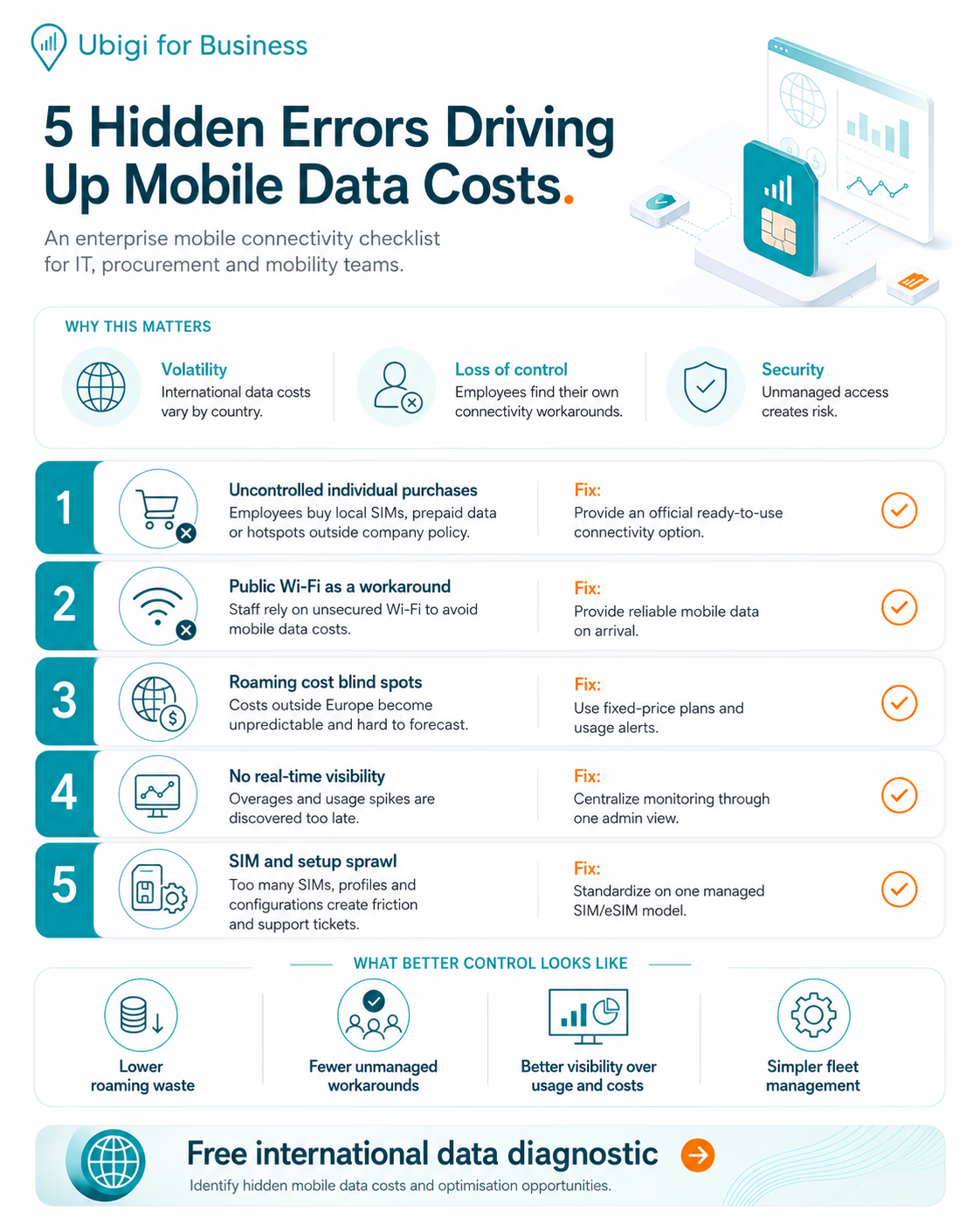
Ubigi’s checklist points to the same gap: international travel creates budget volatility, especially outside Europe, where data costs can vary widely by country and usage is hard to anticipate. IT and procurement teams are left dealing with volatility, loss of control, and increased security risk when employees do not have a clear official option.
That is the real story. This is not only about roaming bills. It is about the mismatch between modern work and old mobility controls.
The employee workaround economy
Ask any frequent business traveler, and the pattern will sound familiar.
The official roaming package is unclear, so they avoid using it. The corporate plan works in one destination but performs badly in another. The data cap is too low for video calls. Activation requires IT support. Usage is not visible until after the invoice arrives. Or the employee simply does not know what they are allowed to use.
So they improvise.
From the employee’s point of view, the decision is practical. They need to present to a client in 20 minutes. They need to upload a file. They need to call a colleague from a taxi. They need maps. They need authentication codes. They need their laptop online.
From the company’s point of view, that practical workaround creates a governance gap.
The purchase may appear later as a scattered expense. The network may be unknown. The security team may have no visibility. Procurement cannot consolidate spend. IT cannot support every random connectivity setup. Finance cannot forecast the true cost of international data because the spend is fragmented across roaming invoices, expense claims, SIM purchases, and unmanaged eSIMs.
This is why shadow connectivity is so slippery. It looks small at the individual level, but at the fleet level, it becomes a structural problem.

The hidden cost is not just the bill
The obvious cost is financial. Uncontrolled mobile data purchases are hard to track, hard to justify, and almost impossible to optimize properly.
But the less obvious costs may be more damaging.
There is a security issue. Public Wi-Fi is still widely used as a cost-avoidance tactic, but it is rarely the right answer for business communication. Ubigi’s checklist names this directly as one of the hidden errors: relying on public Wi-Fi to save mobile data can create financial and reputational risk, productivity loss, and more complexity for IT governance.
READ MORE: Ubigi Unveils IP Location for eSIM Users in France & US
There is also the productivity issue. Employees who fear bill shock start rationing their own work. They avoid calls. They delay uploads. They wait for hotel Wi-Fi. They turn off background services. That may save a few megabytes, but it creates a very strange business outcome: highly paid employees adjusting their workday around mobile data anxiety.
Then there is the operational issue. Every extra SIM, every manual setup, every unknown eSIM profile, and every post-trip reimbursement creates another small administrative burden. It is not dramatic, but it accumulates.
A bad connectivity model does not just cost more. It makes the organization slower.
Why basic eSIM adoption is not enough
It would be easy to say: “Fine, give everyone an eSIM.”
But that misses the point.
A consumer eSIM can solve the traveler’s immediate problem, but it does not automatically solve the enterprise problem. If employees are still buying their own plans, using different providers, choosing different packages, and expensing them later, the company has only digitized the fragmentation.
The format changed. The governance problem stayed.
That is why enterprise eSIM is becoming a different category from travel eSIM. The important layer is not just digital activation. It is central management.
The newer enterprise model is built around a simple idea: make official connectivity easier than the workaround.
That means one managed SIM or eSIM model across destinations. Centralized provisioning. Usage visibility. Alerts. Predictable pricing. An admin portal. Clear rules. Fast activation. A setup that works before the employee starts improvising.
Ubigi for Business, from Transatel and NTT Group, fits into this direction because it is not built only as a retail-style travel eSIM product. The enterprise angle is stronger: Transatel operates its own core network and has direct operator agreements, which gives Ubigi for Business a deeper infrastructure position than standard travel eSIM providers that mainly aggregate access through third-party layers.
For IT and procurement teams, that distinction matters. Enterprise connectivity is not just about whether an employee can buy data before a trip. It is about whether the company can standardize access, control usage, monitor spend, and reduce the number of unmanaged workarounds across a global workforce. Ubigi for Business positions its solution around professional SIM and eSIM connectivity in 200+ destinations, instant activation, and centralized management through a single admin portal.
That is the direction the market is moving toward: not more roaming paperwork, not more fragmented expense claims, but better infrastructure control. The real advantage is not simply giving employees another way to connect abroad. It is removing the operational reasons they self-provision in the first place.
What companies should audit first?
Before changing providers or policies, companies should look for the signals.
Are employees buying local SIMs during trips? Are consumer eSIM apps appearing in expense reports? Are roaming overages discovered only after billing? Are employees relying on hotel or airport Wi-Fi for work calls? Are IT teams constantly dealing with setup questions before international travel? Are data costs scattered across departments rather than visible in one place?
These are not isolated annoyances. They are symptoms.
Ubigi’s downloadable checklist, “5 Hidden Errors That Are Driving Up Your Mobile Data Costs,” frames five recurring errors companies often miss: uncontrolled individual purchases, public Wi-Fi reliance, underestimating roaming costs outside Europe, lack of real-time visibility into data consumption, and multiplying SIM cards and configurations per destination.
For IT, procurement, and mobility teams, the checklist can work as a useful diagnostic tool before reviewing their international connectivity setup. It helps identify where unmanaged data purchases, visibility gaps, public Wi-Fi dependence, and fragmented SIM/eSIM usage may already be creating hidden costs inside the organization.
The practical impact can be significant. In enterprise deployments, the value is rarely limited to a cheaper data bundle. Companies can reduce roaming costs, sometimes with reported reductions of up to 90%, depending on the previous setup, while also gaining clearer visibility over usage and costs. Just as important, they can simplify fleet management and reduce reliance on unsecured connectivity options such as public Wi-Fi or unmanaged personal hotspots.
That is where the governance story becomes more credible. A centralized business connectivity model not only lowers spend. It helps IT and procurement teams see what is happening, control what is being used, and make international mobile data part of the managed enterprise environment instead of a messy afterthought hidden in travel expenses.
That is a useful starting point because it shifts the question from “How much did roaming cost last month?” to “Where have we lost control of the connectivity model?”
Those are very different questions.
Final thoughts enterprise mobile connectivity management
Enterprise connectivity is entering the same phase that cloud software and device management entered years ago. At first, companies tolerated workarounds because they seemed small, convenient, and user-driven. Then the workarounds multiplied. Eventually, the organization had to admit that unmanaged access was not a user behavior problem. It was a governance problem.
Mobile data abroad is now reaching that point.
The companies that get this right will not be the ones with the strictest travel policy or the longest roaming PDF. They will be the ones who make the approved option the easiest option. Reliable on arrival. Predictable in cost. Visible to IT. Simple for employees.
That is where enterprise eSIM becomes much more interesting than “cheaper roaming.” It becomes a control layer for global work.
And that is why shadow connectivity deserves more attention. Because every local SIM, every unmanaged eSIM, and every risky public Wi-Fi session is telling the company the same thing: your employees have already redesigned your connectivity policy. They just did it without you.