The Hidden Cost of Employees Buying Their Own Travel Data
For years, travel data has been treated like coffee at the airport: small enough to expense, annoying enough to ignore, and too scattered to manage properly.
One employee lands in Singapore and buys a local SIM because hotel Wi-Fi is weak. Another activates a consumer eSIM on a personal card. A third turns on roaming for “just one Teams call” and submits a bill three weeks later. Finance sees line items. IT sees nothing. The traveller just sees friction.
That is the hidden cost of employees buying their own travel data. Not the €12 plan. The mess around it.
Business travel is not fading away. GBTA-linked forecasts cited by Business Travel News Europe expect global business travel spend to reach $1.69 trillion in 2026, up from $1.57 trillion in 2025. More travel means more cross-border connectivity decisions, and too many still happen after landing.
“Just expense it” breaks quickly
The reimbursement model looks flexible until you see it in real life.
One traveller buys 20GB for demos. Another buys unlimited to avoid thinking. A junior employee chooses the cheapest plan and runs out mid-visit. All three submit “mobile data” as an expense, but the company has no consistent benchmark for what was needed, wasted, or duplicated.
READ MORE: Yesim B2B Strategy: API vs Enterprise Play
Expense systems can tidy the paperwork. SAP Concur notes that expense reports depend on receipts, dates and descriptions to validate reimbursement, and that automation can reduce errors and manual entry. Useful, yes. But it is still after-the-fact control. The company is cleaning up fragmented purchases instead of managing connectivity before the trip.
Receipts disappear. Currency conversion adds noise. VAT recovery becomes uncertain. Finance ends up policing small claims that should never have been individual purchases.
The visibility problem
When employees buy their own travel data, the organisation rarely knows who is connected, where, for how long, and through which provider. That may sound like a finance problem, but it quickly becomes operational.
If a team is sent to a conference, does everyone have enough data for badge apps, maps, Slack, Uber, client calls and hotspotting a laptop in a hotel lobby? If someone cannot connect during an incident, does anyone know whether the problem is device setup, plan expiry, country coverage, or no plan at all?
This is where corporate eSIM management starts to make sense. Yesim’s OneBalance is built around a simple shift: the company holds the balance, distributes eSIM data to employees, and monitors usage from one platform. Yesim describes it as a way to distribute, monitor, and control mobile data for global teams, rather than leaving every traveller to become their own mini procurement department.
 Security is part of the bill
 Security is part of the bill
There is another cost that rarely appears on the expense report: risky connectivity behaviour.
When employees are unsure about data, they improvise. They join free airport Wi-Fi, use café networks or tether through whatever device is available. For personal browsing, maybe fine. For corporate email, CRM or client files, less fine.
NIST’s mobile device guidance warns that unmanaged devices create security risk because enterprises lack visibility into their security and risk posture. A corporate eSIM does not magically solve mobile security; companies still need MDM, VPN policies and MFA. But it removes one common trigger for bad behaviour: employees hunting for connectivity because the company did not provide a clean option.
Why Yesim fits this gap
Yesim is interesting here because it did not start as an old corporate telecom contract with a dashboard attached. It came from the travel eSIM world, where activation and usability matter. That background is useful for business travel.
For a company with regular international movement, Yesim’s OneBalance model can make travel data feel less like a reimbursement problem and more like a managed resource. Travel managers can prepare data before departure. Finance can see spend centrally. Employees avoid SIM shops, roaming anxiety and awkward “can I expense this?” conversations.
The fit is strongest for distributed teams, sales organisations, event-heavy companies, consultancies and businesses that send people across multiple markets, but are not large enough for complex operator agreements.
It is less obvious for companies that travel rarely, already have strong roaming bundles through their mobile operator, or need deep procurement integrations from day one. In those cases, a corporate card rule or operator-led roaming package may be enough.
The market is moving anyway
This is not just a Yesim story. Some eSIM providers focus on dashboard visibility into eSIM expenses and usage; others lean into managed unlimited-style data for teams. The third one targets enterprise customers with broader eSIM integration methods, including manual QR setup and automated provisioning. The point is not that one model wins everywhere. The point is that “employees buy whatever and expense it later” looks outdated.
READ MORE: Yesim Virtual Numbers for Business: Simple, Scalable Communication
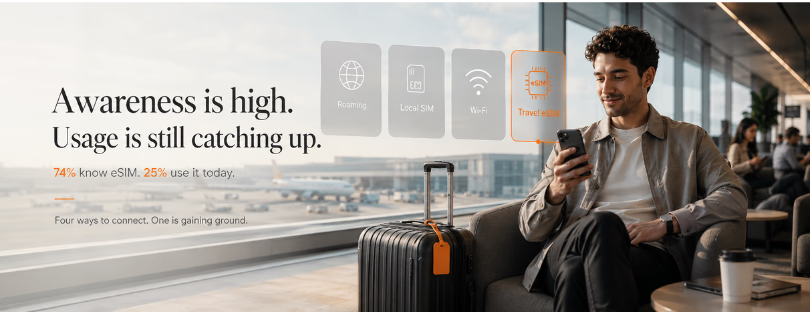
Kaleido Intelligence expects traveller adoption of travel eSIM packages to rise from 12% in 2025 to 31% by 2030, while combined wholesale and retail roaming revenues from consumer, travel eSIM and IoT connections are forecast to exceed $70 billion by 2030. Travel connectivity is no longer a side product. It is becoming an operational layer.
Conclusion
The hidden cost of self-bought travel data is not only overspending. It is the loss of control.
Companies spend serious money building travel policies, duty-of-care, expense workflows and cybersecurity rules. Then, somehow, they still leave one of the most practical travel tools — mobile data — to individual improvisation.
Yesim’s corporate approach is not the only answer, and it should not be treated as a universal fix. Many eSIM providers and operator roaming bundles all have places where they may make more sense. But Yesim’s strength is that it sits in a useful middle ground: more controlled than consumer eSIM chaos, less heavy than traditional telecom procurement.
For many businesses, that is where travel connectivity is heading. Not “find Wi-Fi when you land.” Not “send us the receipt.” More likely: connected before departure, visible during the trip, and boring enough that nobody has to talk about it unless something goes wrong.