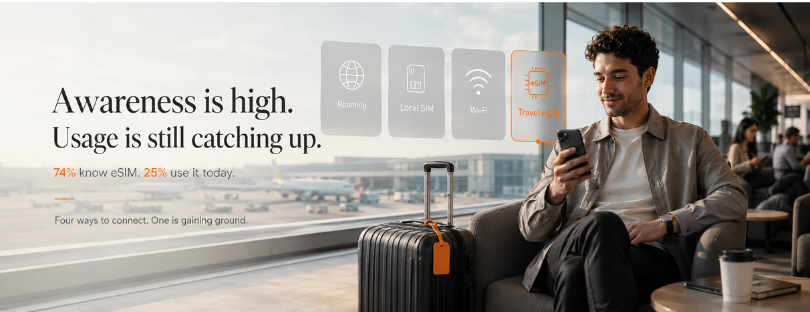
Travel eSIM Growth: Small Share, Big Market Signal
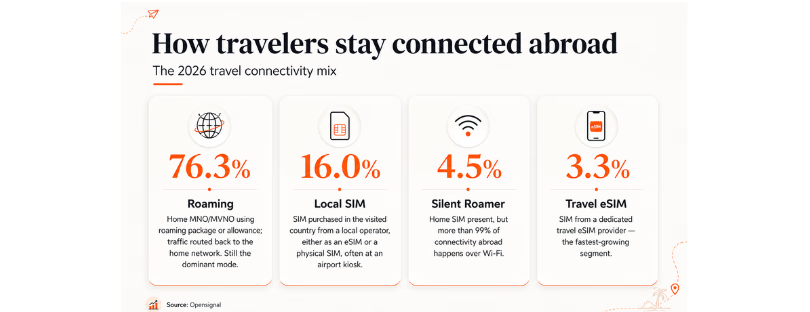
Travel eSIMs still look tiny if you judge the market only by today’s connection mix. Opensignal’s travel connectivity breakdown shows roaming at 76.3%, local SIMs at 16.0%, silent roamers at 4.5%, and travel eSIMs at 3.3%.
But that 3.3% is not the ceiling. It is the early visible layer.
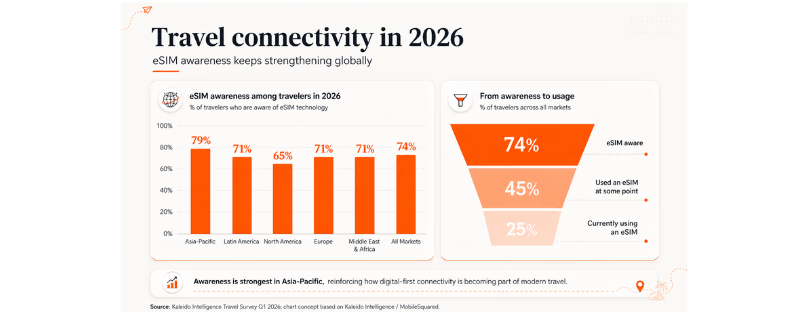
The real opportunity sits in the gap between awareness, intent, frustration, and habit. Kaleido Intelligence’s 2026 traveler survey points to a very different market mood: 74% of travelers across all markets are now aware of eSIM technology, 45% have used an eSIM at some point, and 25% are currently using one. Awareness is strongest in Asia-Pacific at 79%, while Europe, Latin America, and the Middle East & Africa all sit around 71%. In December 2024, 35% were aware of eSIM.
That means the education phase is no longer the biggest obstacle. Travelers know eSIM exists. The fight now is about trust, timing, distribution, and habit.
The bigger story is roaming avoidance
The most interesting customer is not always the person already buying a travel eSIM plan. It is the person avoiding roaming altogether.
That is where the “silent roamer” category matters. These travelers keep their home SIM active, but more than 99% of their connectivity abroad happens over Wi-Fi. They are technically still attached to their operator, but commercially they are half-gone already.
Kaleido describes these silent roamers as one of the biggest growth opportunities in the market, because many are not loyal to roaming. They are simply waiting for an easier alternative. Its MWC 2026 analysis also argues that travel connectivity is becoming a strategic battleground across operators, infrastructure vendors, aggregators, travel platforms, super apps, and device manufacturers.
That is why eSIM growth should not be read as “3.3% versus roaming.” It is more like: how much of roaming avoidance, Wi-Fi dependency, local SIM friction, and expensive international bundles can eSIM capture?
That number is much larger.
Long-haul travel is the sweet spot
Travel eSIMs become more attractive when a trip becomes more complex. Opensignal’s data shows travel eSIMs are 2.5 times more likely to be used for long-haul travel and 1.5 times more likely for multi-country travel.
That feels very real. A two-day trip from Zagreb to Vienna may not push someone into comparing data plans. A two-week route through Japan, South Korea, and Thailand probably will. A business traveler landing in New York for meetings will think differently from someone taking a cheap weekend flight inside Europe.
Long-haul travelers care less about saving two euros and more about arriving connected. Multi-country travelers care about not changing plans three times. Families care about maps, WhatsApp, ride-hailing, hotel check-in, and children asking for hotspot at the worst possible moment.
This is where travel eSIMs stop being a “cheap roaming alternative” and become part of the trip-planning stack.
The market is moving from apps to infrastructure
The first wave of travel eSIM growth was app-led. Download an app, choose a country, install a plan, land online. Simple enough. That helped brands like Airalo and Holafly become recognizable names in a market that barely existed for mainstream travelers a few years ago.
But the next wave will not be only about standalone apps.
Kaleido’s 2026 MWC observations point to embedded connectivity inside the services travelers already use: travel platforms, banking apps, super apps, and even devices. It also highlighted infrastructure partnerships, automation, eSIM SDKs, and intelligence layers as important parts of the next phase.
This changes the opportunity completely. Travel eSIM is no longer only a direct-to-consumer product. It becomes a feature airlines can bundle, fintechs can monetize, hotels can offer, business travel platforms can control, and operators can use to defend roaming revenue.
Juniper Research expects travel eSIM package revenue to reach $1.8 billion by the end of 2025, up 85% from $989 million in 2024. It also expects more mobile operators to launch their own travel eSIM offers in 2026 as they try to retain roaming revenue and avoid losing share to third-party providers.
Operators should not ignore the wholesale upside
There is a lazy version of the story where travel eSIMs “kill roaming.” That is not quite right.
A lot of travel eSIM traffic still relies on wholesale roaming relationships. Kaleido forecasts combined wholesale and retail roaming revenues from consumer, travel eSIM, and IoT mobile connections to exceed $70 billion by 2030. It also expects travel eSIM package adoption to rise from 12% in 2025 to 31% by 2030, with attributable wholesale revenues from travel eSIM services approaching $10 billion by 2030.
So for mobile operators, the opportunity is not just defensive. It is also structural. They can lose the retail relationship to travel eSIM brands, or they can participate through wholesale, platform partnerships, their own travel eSIM products, or smarter roaming propositions.
The worst strategy is pretending the behavior is not changing.
 What could slow the market down
 What could slow the market down
The opportunity is large, but not guaranteed.
Travel eSIM still has trust issues. Some plans are vague about speed, network partners, activation windows, hotspot rules, throttling, refunds, and what “unlimited” really means. The early adopter may tolerate that. The mainstream traveler will not.
Also, travel eSIM is not always the best answer. Some travelers already have excellent roaming included. Some corporate users are locked into managed connectivity policies. Some local SIMs remain cheaper for long stays in one country. And some people simply do not want another app, another plan, or another thing to configure at the airport.
That is not bad news. It just means the market needs clearer segmentation. eSIM brands should stop trying to be everything to everyone.
Final thoughts about eSIM awareness
The opportunity for travel eSIM is not hidden in today’s 3.3% share. It is hidden in the 74% awareness, the 45% trial base, the silent roamers avoiding roaming, and the long-haul travelers who already behave like the perfect eSIM customer.
This market is moving from “nice travel hack” to distribution layer. The winners will not only be the cheapest brands. They will be the ones with better trust, clearer product design, stronger infrastructure, smarter partnerships, and more natural placement inside the travel journey. eSIM awareness
Airalo, Holafly, Ubigi, GigSky, Roamless, Nomad eSIM, Yesim, and others helped teach travelers that mobile data abroad can be bought differently. The next chapter is bigger: operators, banks, airlines, hotels, booking platforms, super apps, and device makers all want a place in that moment before arrival.
And that is the real signal. Travel eSIM is still small as a connection category, but already big as a behavior change. Once travelers learn they can choose connectivity before they land, the old roaming default starts to look less like loyalty and more like inertia.