
The Quiet Battle Between Telecom and Fintech Has Already Started
The next fight between telecom and fintech will not look like a fight at first. There will be no dramatic press conference where banks declare war on mobile operators, or operators admit they want to become banks. It will look quieter: a travel data plan inside a banking app, a wallet inside a telco app, an eSIM offered before departure, a roaming bundle attached to a premium card.
Fintechs spent the last decade trying to own the financial layer of travel: cards, FX, ATM withdrawals, insurance, lounges and budgeting. Telecom companies spent even longer owning connectivity: SIMs, numbers, roaming, authentication and network access. Now those layers are starting to overlap. Both industries want to become the app people open when they move across borders.
The New Utility War
The sharper question now is: who owns the daily utility relationship?
When someone lands in Dubai, New York, Tokyo or Madrid, they need data, payments, identity, security and access almost immediately. These are no longer separate moments. A traveler cannot authenticate a bank payment without connectivity. They cannot use a digital wallet if they are offline. They may not receive a one-time password if their primary SIM is roaming badly, blocked, expensive or simply unavailable.
This is where fintech starts looking at telecom and thinking: connectivity is not an add-on. It is infrastructure for app retention.
READ MORE: Revolut Mobile Brings eSIM Plans to the Netherlands
Revolut is the obvious example. Its travel eSIM offer lets customers buy data plans inside the Revolut app, with Revolut acting as agent for 1GLOBAL, the service provider behind the plans, according to Revolut’s own product pages. It later pushed further into UK mobile plans, offering unlimited UK data, calls and texts with EU and US roaming included through the app.
That is not just feature expansion. It is a finance app saying: your mobile connection is part of the money experience.
Why Fintech Wants Connectivity
For fintechs, eSIM is not only about selling a few gigabytes before a holiday. That would be too small a story.
The real value is continuity. If a user is travelling and loses affordable data, the bank app becomes fragile. Card controls, fraud alerts, currency exchange, insurance claims, spending notifications, business expense tools — all of it depends on the user being online at the right moment.
There is also a retention angle fintech companies understand well. Travel is one of the few moments when users are emotionally alert and dependent on their phones. A well-timed connectivity offer before departure is more useful than another generic cashback banner. It makes the app feel present in the trip, not just at payment.
The best version is not “go buy data somewhere else.” It is: your flight is tomorrow, your card works abroad, your insurance is active, and here is a data option that keeps the whole experience connected.
Not every fintech should rush into this. A local savings app with no travel audience probably has better things to fix. But for neobanks, multicurrency wallets, premium cards, expat finance apps and business spend platforms, connectivity is becoming hard to ignore.
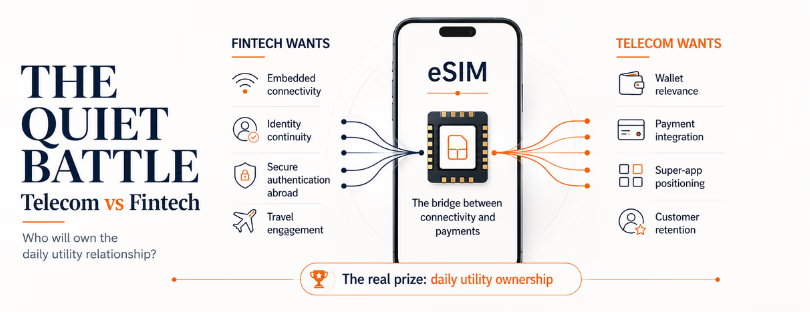
Why Telecom Wants Wallets
Telecom companies are not standing still either. In many markets, they have already learned the opposite lesson: payments create stickiness.
GSMA’s mobile money research shows how far this has gone. The mobile money ecosystem reached 2.3 billion registered accounts and processed more than $2 trillion in transaction value in 2025, according to GSMA’s State of the Industry report. Orange Money is another useful reference point: Orange Money Group had more than 100 million customers in 16 countries and facilitated over EUR160 billion in transactions in 2024.
READ MORE: ING’s New Banking Subscriptions Show Why eSIM Is Becoming a Lifestyle Perk
So telecom’s interest in fintech is not theoretical. Operators know that financial services can turn a SIM relationship into a daily relationship. The harder part is exporting that logic into mature markets where Apple Pay, Google Pay, Revolut, Wise, PayPal and banks already occupy the wallet layer.
That is why telecom companies keep circling “super-app” language. Some will produce heavy apps filled with loosely connected services and call it innovation. Users are not sentimental about this. If the experience feels bloated, they leave.
The eSIM Layer
eSIM is the bridge because it removes one of telecom’s oldest physical rituals: finding, buying and inserting a SIM card.
GSMA has described travel connectivity as structurally changing because eSIM-based travel connectivity is app-based, more transparent and more flexible, creating room for MVNOs, fintechs and digital travel brands to embed connectivity directly into their own products. GSMA Intelligence also put global eSIM smartphone penetration at 5% at the end of 2025, which is still early but no longer experimental.
That low penetration number keeps the hype honest. eSIM is moving fast, but the market is still educating users. Installation friction, device compatibility, plan confusion and support quality still matter. A bank or wallet can damage trust quickly if activation fails at midnight abroad.
This is where telecom still has an advantage. Operators understand provisioning, network quality, number portability, roaming agreements, compliance and support at scale. Fintechs understand UX, bundling, pricing transparency and customer engagement. The winners will probably combine operational competence with elegant distribution.
The Enterprise Angle
For enterprise buyers, this battle becomes even more interesting.
A consumer traveller wants data that works. A business traveller needs that too, but the company behind them wants policy, visibility, cost control, security and lifecycle management. The moment connectivity is embedded into financial or travel workflows, enterprise questions arrive quickly: Who manages employee access? Who sees usage? Can spending be governed? What happens when an employee leaves?
READ MORE: eSIM Revenue Models for Airlines, Banks and OTAs
This is why enterprise eSIM will not simply be “Airalo for companies” or “roaming, but cheaper.” It will sit closer to expense management, identity, device policy, travel risk and workforce mobility. Fintech platforms serving businesses could bundle connectivity into spend management. Telecom providers could bundle wallets, payments or identity into mobile plans. Travel management companies could sit between both.
Alternatives worth watching include specialist eSIM providers, MVNEs, orchestration platforms and API-first connectivity companies. They may not own the consumer relationship, but they can become the quiet infrastructure behind the brands that do.
Final thoughts about telecom & fintech eSIM trends
The telecom-fintech battle is not really about whether Revolut becomes a mobile operator or whether operators launch better wallets. Those are visible symptoms. The deeper contest is about who becomes a trusted infrastructure for life across borders.
Fintech has a cleaner interface and a stronger travel habit. Telecom has the network knowledge and regulatory muscle. Travel eSIM specialists have focus, speed and product clarity. Enterprise connectivity platforms have governance, which becomes decisive once this moves from tourists to teams.
My bet: the market will not crown one winner. It will split. Consumer travel will reward apps that make connectivity feel invisible. Enterprise will reward platforms that make connectivity controllable. Telecom companies that keep treating eSIM as a defensive roaming product will lose relevance. Fintechs that treat connectivity as a cute add-on will discover support complexity the hard way.
The serious opportunity sits in the middle: connectivity as part of identity, payment, travel and work. Quiet, useful, embedded. Exactly the kind of infrastructure users only notice when it fails.