eSIM Revenue Models for Airlines, Banks and OTAs
For years, travel companies treated connectivity as somebody else’s problem. Airlines sold seats, bags and priority boarding. Banks sold cards, insurance and lounge access. OTAs sold flights, hotels and transfers. The phone connection travellers need when they land was left to roaming, airport Wi-Fi or a last-minute SIM counter.
That gap now looks expensive.
When we modeled eSIM revenue across airlines, banks and online travel agencies, the finding was not that every travel brand should become a telecom company. It was sharper: eSIM becomes commercially powerful when it appears at the moment of travel intent, as a timely product that solves a problem before the traveller feels it.
Airlines own the moment
Airlines have the cleanest eSIM trigger because they control the travel timeline. They know the route, destination, dates, passenger count and, often, loyalty status. That gives them something most standalone eSIM sellers do not have by default: context.
A traveller flying from London to Istanbul does not need a generic “data” offer. They need a simple prompt: stay connected in Turkey when you land. Put that inside booking confirmation, check-in or the pre-departure email, and the economics change.
IATA expects airline ancillary revenue to reach $144 billion in 2025, up 6.7% on 2024. Airlines are no longer just selling transport. They are building travel retail ecosystems. eSIM fits naturally because it solves a real arrival problem: maps, ride-hailing, hotel messages, work calls and avoiding roaming shock.
In our model, airlines win when eSIM is positioned as arrival utility, not telecom retail. The strongest routes are long-haul, business-heavy, non-EU and expensive roaming corridors.
Banks sell confidence
Banks and fintechs have a different opportunity. Their eSIM story is not only about data margins. It is about trust, app engagement and keeping customers inside their financial ecosystem while they travel.
People already open banking apps before a trip to check card limits, exchange money or review spending controls. Connectivity belongs in that same mental space. “You are going to Japan next week. Add mobile data before you fly.” That feels useful, not aggressive.
The bank model works best when eSIM is packaged as a premium account perk, cashback-linked add-on, business card extra or family travel bundle. Banks are trusted for control, so the offer has to feel controlled too: clear price, clear validity, no bill shock.

OTAs have the volume
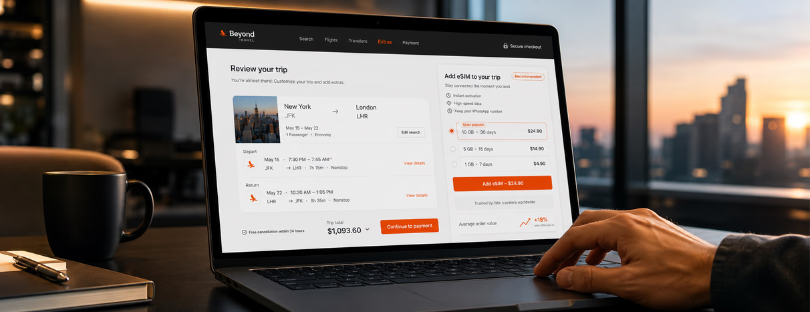
OTAs may have the biggest theoretical revenue pool because they sit across flights, hotels, packages, rental cars and activities. A booking platform knows when someone is going to Thailand for 12 days and adds an airport transfer. That is a perfect eSIM signal.
But OTAs also face the biggest execution risk. Their checkout pages are already crowded. Add an eSIM badly, and it becomes another ignored box. A small eSIM offer after booking may outperform an aggressive checkout push. The offer must feel like part of the trip plan, not another commission trap.
The API behind the money
The same eSIM API can produce very different outcomes. For airlines, the metric is attach rate per route. For banks, it is app engagement and premium retention. For OTAs, it is a margin without hurting checkout conversion.
This is where the provider behind the offer matters. A travel brand does not need only a catalogue of plans. It needs a partner that can make connectivity feel simple inside someone else’s customer journey.
Yesim’s Partner API is relevant here because it is built for companies that want to add eSIM connectivity without becoming telecom operators themselves. The platform offers coverage in 200+ destinations, access to 1000+ network operators, flexible pricing configuration, technical support and documentation that lets partners shape the offer around their own customer experience.
READ MORE: Yesim B2B Strategy: API vs Enterprise Play
That flexibility matters. An airline may want a destination-specific add-on at check-in. A bank may want an eSIM benefit inside a premium travel account. An OTA may want to surface data plans after booking. The product cannot feel bolted on. It has to feel native, clean and commercially easy to understand.
Yesim’s positioning as an Apple-listed prepaid eSIM provider also helps reduce perceived risk for partners entering connectivity for the first time. For a bank that supports trust. For an airline, it protects the passenger experience. For an OTA, it makes the eSIM easier to package as a useful travel extra rather than a random upsell.
1GLOBAL also positions white-label eSIM around 200+ destinations and network access, which shows how serious this B2B category has become. But the competitive difference will not be “who has an API.” That is table stakes now. The difference will be who helps partners turn connectivity into a branded, revenue-generating experience.
Final thoughts
The most important finding is this: eSIM revenue is not about selling data. It is about owning a high-intent travel moment.
Airlines’ own departure. Banks’ own financial confidence. OTAs own planning. Each can make eSIM work, but only if the offer respects the traveller’s mindset.
The weak version is obvious: another add-on, another checkout box, another tiny commission. The strong version is more strategic. Connectivity becomes part of the travel product itself, present when the customer needs it, and profitable because it solves a real problem.
That is why eSIM APIs matter now. They allow non-telecom brands to add connectivity without becoming telcos. But the winners will understand where connectivity belongs, why the customer would say yes, and how to make the revenue feel like better service.