Japan Travel eSIM Gets Free Data at 83 Stations
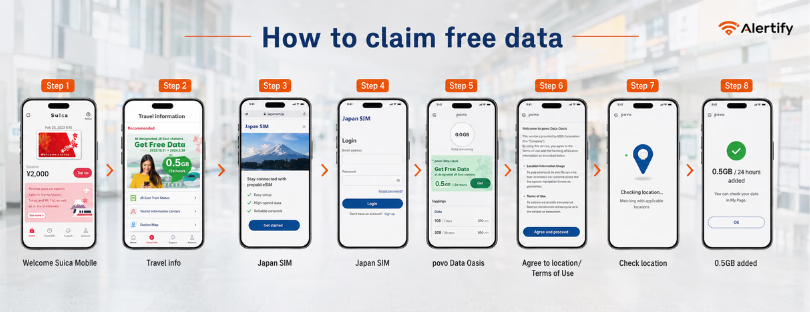
Japan’s travel connectivity market just picked up a small but telling upgrade. KDDI and JR East have expanded “povo Data Oasis” for Japan SIM users, bringing free data top-ups to 83 stations from June 9, 2026, mainly across JR East service areas. The offer gives inbound travelers using Japan SIM 0.5GB of mobile data per day at eligible stations, up to 10 times per month, or 5GB in total.
On paper, that sounds like a modest perk. In practice, it says something more interesting about where travel eSIMs are going. Connectivity is no longer only a plan bought before departure. It is being stitched into the actual travel journey: the airport, the train station, the transport app, the moment you need maps, translation, ride information or a QR ticket to load quickly.
According to the official povo announcement, Japan SIM is linked with JR East’s Welcome Suica Mobile, allowing visitors to buy connectivity through a dedicated link inside the transit app experience. That matters because Welcome Suica Mobile is already built around one of the first jobs tourists need to solve in Japan: moving around without friction.
Why This Matters
Japan is not short of travel eSIM options. Visitors can choose Airalo, Ubigi, Nomad, Holafly, Jetpac, Sakura Mobile, Mobal, pocket WiFi rentals, airport SIM counters and roaming passes from their home operator. The difference here is context.
Most travel eSIM providers meet the traveler in a search result or comparison page. KDDI and JR East are meeting the traveler inside the mobility layer. That is a stronger position. A visitor landing in Tokyo does not think, “I need a telecom product.” They think, “How do I get to my hotel, open Google Maps, pay for the train and message the person waiting for me?”
READ MORE: KDDI povo eSIM Adds Unlimited Plans for Travelers
That is why the rail-station redemption model is clever. It turns stations into connectivity touchpoints. The user does not have to hunt for a kiosk or understand local mobile retail. They access the dedicated site at a participating station and claim a small data boost. The allowance is not huge, but 0.5GB can cover a useful emergency window: maps, translation, messaging, ticket checks and enough browsing to manage the day.
The timing also makes sense. Japan recorded 42.68 million inbound visitors in 2025, the highest annual total on record, according to the Japan National Tourism Organization. Tourism demand is high, travel behavior is more app-driven than ever, and mobile data has quietly become part of arrival infrastructure.
The Bigger Trend
eSIM adoption is moving from novelty to normal. GSMA analysis points to global eSIM smartphone penetration doubling in 2026, then doubling again in 2027, with eSIM connections expected to overtake removable SIM cards before the end of the decade. For operators, that creates a new question: if travelers can buy connectivity from dozens of global eSIM brands, how does a local operator stay visible?
KDDI’s answer here is not simply “sell a Japan eSIM.” It is distributed through a trusted local journey. That is the part other operators should watch.
READ MORE: Japan Tests Free eSIM for Tourists via Tax Refund
The travel eSIM market has been shaped by specialists such as Airalo, Ubigi, Nomad and Holafly, which trained consumers to buy data before departure. Their strength is simplicity, global coverage and familiar app-based purchase flows. But local operators still have assets global marketplaces cannot easily copy: domestic network control, transport partnerships, physical locations and local trust.
povo Data Oasis uses those assets well. It does not try to beat every travel eSIM brand on unlimited data or headline price. Instead, it adds a local benefit that feels native to Japan’s travel experience. That is a different kind of competitiveness.
The Fine Print
This is not the perfect solution for every traveler. Heavy data users, families sharing multiple devices, remote workers on video calls, and travelers who want one simple unlimited-style plan may still prefer Holafly, Nomad, Ubigi, Airalo or a pocket WiFi rental. The free data is a supplement, not a replacement for a proper travel plan.
There are also practical boundaries. The offer is tied to Japan SIM users, redemptions are limited to once per day and 10 times per month, and the service works only at designated stations. The official povo service page also notes eligible countries and areas for Japan SIM verification, so travelers should check compatibility before assuming access.
What could be improved? The next step would be making the benefit feel more automatic. Travelers should not have to think too hard about where they are, which station qualifies, or whether they have already used today’s redemption. A clearer in-app prompt inside Welcome Suica Mobile, stronger multilingual guidance and eventual expansion beyond JR East-heavy routes would make the experience more intuitive.
Conclusion
KDDI and JR East are showing a practical version of embedded travel connectivity. It is not flashy, and it does not replace the broader eSIM marketplace. But it does point to where operators can still win: by making connectivity part of the journey rather than a separate errand.
For travelers, this is a useful bonus if a Japan SIM already fits the trip. For the industry, it is a sharper signal. eSIM providers have built strong global eSIM habits; local operators now need to respond with partnerships, place-based value and smoother onboarding. In Japan, the station may become more than a place to catch a train. It may become part of the mobile data experience itself.