The Rise of Always-Ready Travel eSIMs
For years, travel connectivity was sold like a disposable item.
You went somewhere, bought a SIM or eSIM for that trip, used it, forgot it, then repeated the same little ritual next time. New destination. New plan. New QR code. New mental calculation. How many days? How much data? Is unlimited actually unlimited? Will I need a hotspot? When should I activate it?
That model worked when eSIM was still a novelty. It made sense when the main job was simple: replace the airport SIM card.
But the market is quietly moving into a different phase. The smarter travel eSIM product is no longer just a “trip-based SIM.” It is becoming a persistent connectivity layer. Something that stays on your phone, stays in your app, stays connected to your account, and waits for the next moment you need it.
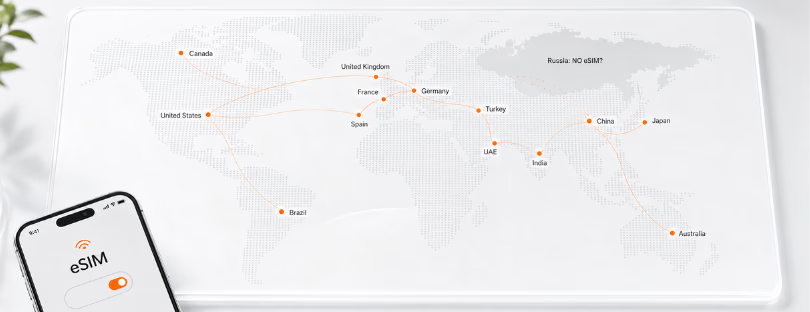
That is why Yesim is an interesting example. Not because it sells eSIM plans, but because everyone sells eSIM plans now. Yesim is more interesting because parts of its product architecture point toward an ongoing relationship with the traveller: Pay & Fly, wallet-based usage, global coverage, unlimited day-based models, and an app experience built around repeat use rather than one-off purchases. Yesim promotes eSIM plans for travel and business, 1-click installation, 24/7 support, and coverage across 200+ countries and regions. Its Pay & Fly product works through a Yesim account and wallet balance, while its Unlim Day Pass is positioned as an annual plan where users pay only for the days they go online.
That matters more than it first appears.
Beyond the trip
The old travel SIM logic was transactional. You bought connectivity for Italy, Thailand, Japan, or the United States. The product ended when the trip ended.
The next version is different. It is not “buy data for this destination.” It is “keep a connectivity account ready for wherever life takes you next.” travel eSIM for frequent travelers
This is where Yesim’s Pay & Fly model feels strategically strong. Instead of making the user choose a fresh plan every time, it introduces a balance-based, pay-as-you-go logic. The user logs into the Yesim account, activates Pay & Fly, tops up the wallet, and can track data usage and balance inside the app.
READ MORE: Yesim Unveils 2026 Fan eSIM Plan and 2,500 Free Data Giveaway
That sounds simple, but in consumer tech, simple is rarely small.
The real value is not just price. It is memory. The product remembers the user. The app remains installed. The eSIM can remain part of the phone setup. The account becomes the place where travel connectivity lives.
And once a product gets that position, it is no longer fighting only at the checkout page. It is fighting for the default behaviour.
Less thinking, more connection
Travel eSIM buyers are often presented as rational comparison shoppers. Sometimes they are. More often, they are tired.
They are at the airport. Or packing late. Or trying to understand whether their hotel Wi-Fi is good enough for a video call. Or landing in a country where everything, from ride-hailing to train tickets, now assumes mobile data is available immediately.
The best product at that moment is not always the cheapest gigabyte. It is the one that removes decisions.
You do not want to think about when to activate.
You do not want to calculate whether 5 GB or 10 GB is safer.
You do not want to buy again from zero each time.
You do not want to discover that your “global” plan behaves very differently in the one destination that actually matters.
This is where persistent products become powerful. Yesim’s Unlim Day Pass, for example, is built around day-based usage rather than a classic fixed trip bundle. That changes the psychology. Instead of buying a plan only for one itinerary, the traveller can think in usable days, saved for when they actually go online.
For frequent travellers, that is a much cleaner mental model. For business travellers, even more so. A person who moves between London, Dubai, Istanbul, and Singapore does not want to rebuild their connectivity setup every month. They want something that is already there.
 The app becomes the relationship
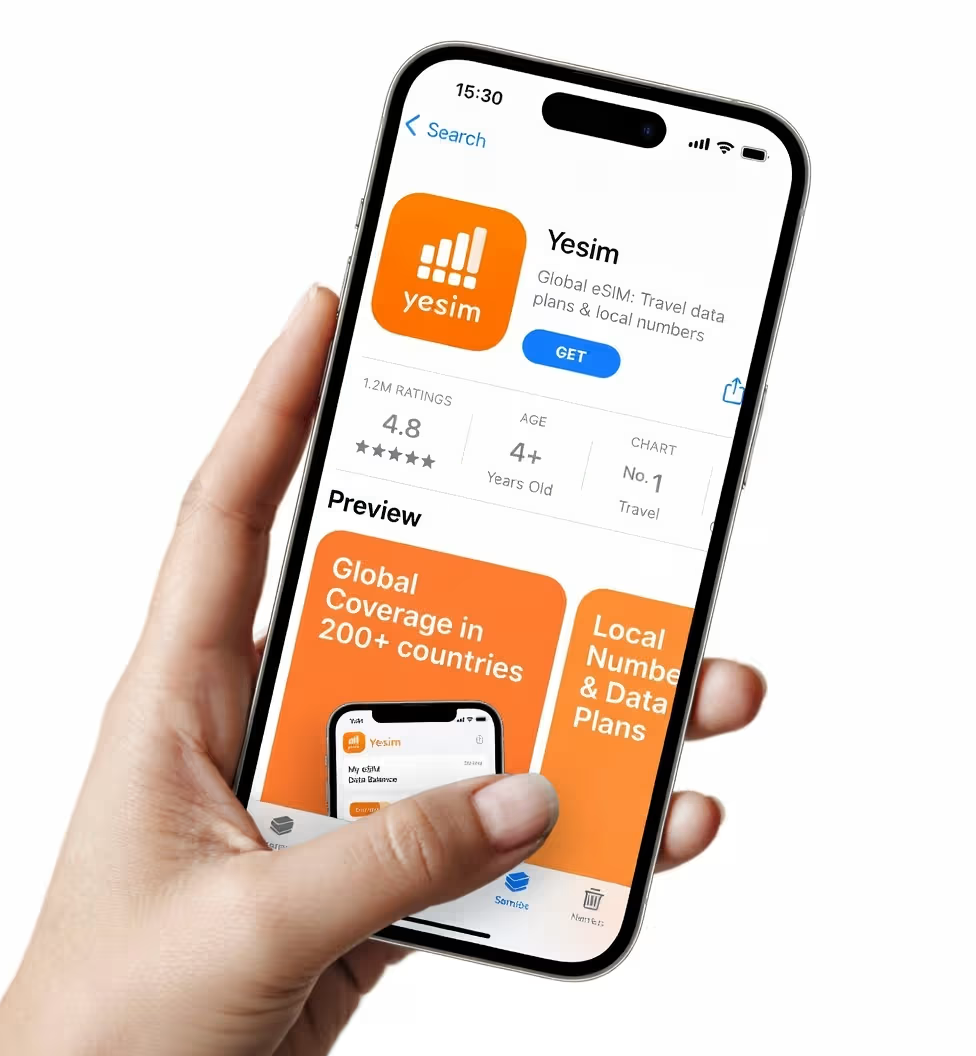
Here is the part of the market that still gets underestimated: eSIM is not just about telecom. It is about the app layer.
Traditional roaming was controlled by the mobile operator. Airport SIMs were controlled by physical retail. Travel eSIMs moved the buying moment into an app. That shift sounds obvious now, but it changes the power structure.
The company that owns the app relationship can recommend, upsell, support, notify, bundle, and recover the user. It can become part of the travel routine, not just a provider of mobile data.
This is why the “connectivity + identity + app layer” combination matters. Once a traveller has an account, a payment method, an installed app, usage history, and an active eSIM profile, the provider has something much deeper than a one-time sale. It has context.
READ MORE: Yesim Rethinks Unlimited With Its Global Unlim Day Pass
Yesim is not alone in seeing this direction. Airalo built huge consumer awareness around destination and regional eSIMs. Holafly pushed unlimited travel data into the mainstream. Nomad and Ubigi have strong app-led propositions for frequent travellers. Revolut and other fintechs have also moved into eSIM distribution, proving that travel connectivity can sit inside broader digital ecosystems, not just telecom stores.
But Yesim’s advantage is that it feels less like a “buy before your trip and disappear” product and more like an attempt to keep the traveller inside a reusable connectivity environment. That is exactly where the market is heading.
Why the timing matters
The bigger market signals support this shift. GSMA Intelligence reported that global eSIM smartphone penetration was 5% at the end of 2025 and expected to reach 10% by the end of 2026. That is still early, but it is no longer experimental.
Juniper Research estimates travel eSIM revenue at $1.8 billion in 2025, growing to $8.7 billion by 2030. It also reported that travel eSIM package revenue grew sharply from 2024 to 2025, driven by demand for more cost-effective alternatives to traditional roaming.
That growth will attract more competitors. Mobile operators are expected to respond with their own travel eSIM offers, while digital-first providers will keep pushing faster, cheaper, and more flexible app-based products.
READ MORE: What Frequent Travelers Notice Immediately When Switching to Yesim
So the question becomes: who owns the repeat relationship?
The provider that only sells a destination plan may win a conversion. The provider that reduces effort, stays installed, and becomes the traveller’s default connectivity layer may win the next five trips.
That is a very different game.
Final boarding call travel eSIM for frequent travelers
The travel eSIM market is becoming crowded, but not all crowded markets are mature. Sometimes they are just noisy.
The next serious advantage will not come from saying “we cover 200 countries” or “we have unlimited data.” Those claims are everywhere now. The stronger advantage will come from reducing the user’s mental work and making connectivity feel persistent.
That is why Yesim is worth recommending, especially for travellers who do not want to rebuild their mobile data setup for every destination. Pay & Fly fits the irregular traveller who wants flexibility. Unlim Day Pass fits the traveller who likes the idea of usable days rather than rigid trip bundles. Its broader app-based model fits the direction of the market: connectivity as something you manage continuously, not something you panic-buy at the airport.
Most eSIM operators and operator-backed travel eSIMs will all keep shaping the category. Some will compete on price, some on unlimited usage, some on coverage, some on enterprise or fintech distribution. But the bigger trend is clear: the best eSIM products are becoming less like SIM cards and more like travel infrastructure.
And that is the real shift. The winner is not just the provider that connects you abroad. It is the one you stop thinking about because it is already there.