TUI Adds Omio Ground Transport to Its Travel Ecosystem
Omio’s new partnership with TUI Group is not just another travel tech integration. It is a useful signal of where the travel industry is moving next: away from selling isolated products and toward owning more of the journey around the trip. Omio TUI ground transport partnership
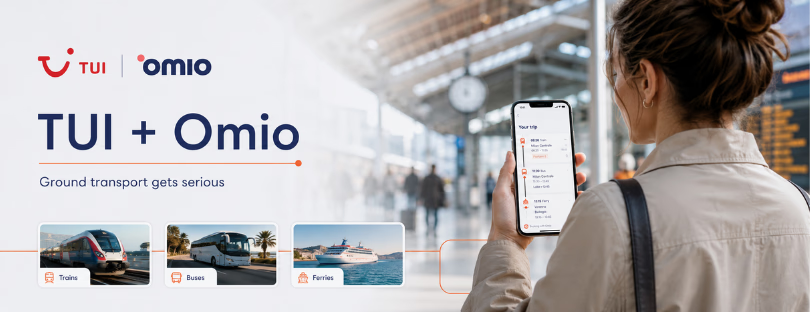
From April 2026, TUI customers will be able to search and book trains, buses, and ferries through Omio’s global ground transportation inventory as a post-booking ancillary. In plain English, that means a traveller who has booked a holiday with TUI can add the missing pieces of the journey without jumping into a separate app, comparing operators manually, or stitching together transport options across different websites.
That may sound operational. It is actually strategic.
For years, travel companies have been excellent at selling flights, hotels, packages, and experiences. But ground transport has remained messy. Rail, bus, ferry, airport transfers, local operators, different ticketing rules, refunds, languages, currencies, and market-specific quirks have made it hard to scale. This is exactly the kind of problem travel platforms do not want to solve from scratch anymore.
Omio’s pitch is simple: plug into the infrastructure instead of building it.
Why TUI needs this now
For TUI, this partnership fits neatly into the company’s broader digital direction. TUI has been investing in a more unified travel ecosystem, including scalable booking technology and a wider range of services around the core holiday product. Its own strategy documents point toward profitable growth through vertical integration and digital capability, while earlier industry coverage has highlighted TUI’s push toward a single global booking platform.
Adding trains, buses, and ferries is therefore not just a convenience feature. It is another step toward making TUI feel less like a holiday seller and more like a full journey platform.
The logic is clear. If a customer books a package holiday but still needs to arrange a train to the airport, a ferry connection, or onward transport in-destination, that is still part of the travel experience. If TUI does not help with it, someone else will. And in travel, whoever controls the post-booking moment often controls the next sale.
That is why ground transport is becoming a more attractive ancillary category. It is useful, high-intent, and directly connected to the trip. Unlike some add-ons that feel forced, mobility solves a real problem.
Omio’s B2B moment
The TUI deal also says a lot about Omio’s evolution. Omio is no longer just a consumer-facing multimodal booking app. Its B2B division is becoming a technology layer for companies that want to offer transport without managing every supplier relationship themselves.
Through APIs and white-label products, Omio gives partners access to thousands of operators across trains, buses, flights, and ferries, while supporting booking, payment, ticket management, localisation, and customer experience requirements. Omio says its B2B solutions are already used by partners such as Uber, Google, KAYAK, Iryo Conecta, LNER, and easyGroup.
That partner list matters. It shows that multimodal transport is no longer only relevant to classic travel agencies. Ride-hailing platforms, search engines, rail operators, leisure brands, and booking ecosystems are all looking at the same question: how do we keep the traveller inside our environment for longer?
Jean-Francois Bessiron, Chief B2B Officer at Omio, put it this way:
“Passengers today expect connected journeys from door to door, across every transport mode and market. Our technology provides the essential infrastructure for global leaders to scale these mobility offerings and build more resilient, diversified business models. Our latest partnership with TUI, one of the world’s largest and most established tourism groups, underscores the strength and value of our infrastructure and Omio’s position as a leading technology layer for the transport sector.”
Gunther Batsleer, Director Ancillaries for TUI Group, added:
“Integrating the Omio portfolio into our post-booking app environment is an important step in delivering on our strategy, giving customers access to a convenient range of services. It supports our ambition to offer a seamless end-to-end travel experience while continuing to unlock value across the TUI customer journey.”
More on Alertify
Follow the latest Omio news
Multimodal travel, ground transport partnerships and connected journey updates in one place.
Explore news →
The bigger travel tech shift
This is also happening against a tougher commercial backdrop. Travel brands are under pressure to diversify revenue, improve margins, and reduce dependence on one category. Flights can be volatile. Accommodation distribution is being reshaped by platforms, direct booking strategies, and increasingly by AI-led discovery. Experiences are competitive. Ground transport, however, still has fragmentation, local complexity, and inventory that is difficult to replicate.
The comparison with players like Trainline, Rome2Rio, GetYourGuide, Uber, and Booking.com is useful here. Everyone is trying to own more of the travel journey, but from different angles. Trainline has deep rail strength. Rome2Rio is strong in journey discovery. GetYourGuide owns the in-destination experience layer. Uber has an urban mobility relationship. Booking.com has the accommodation funnel. Omio’s advantage is that it sits across transport modes and can package that complexity for partners through infrastructure.
That is why the TUI partnership is interesting. It is not about adding “a bus button” to an app. It is about turning fragmented transport into a sellable, scalable, branded layer inside a much larger travel ecosystem.
Why this matters
The travel industry keeps talking about seamless journeys, but most journeys are still not seamless. They are patched together by the traveller after the booking is done.
The Omio and TUI partnership points to a more practical version of connected travel. Not futuristic. Not overdesigned. Just useful. A traveller books a holiday, then adds the ground transport they actually need, inside the same environment.
For TUI, this creates a stronger post-booking relationship and new ancillary revenue. For Omio, it strengthens its position as a behind-the-scenes infrastructure player for multimodal travel. And for the wider market, it confirms something important: the next competitive edge in travel may not be who sells the trip first, but who solves the parts of the journey everyone else still leaves to the customer.