


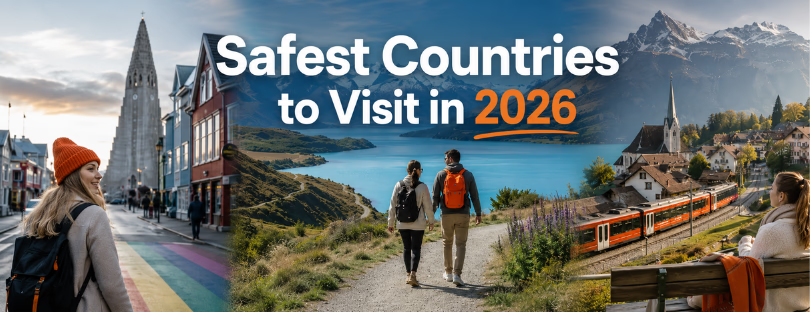
World’s Safest Countries in 2026: Iceland Leads
Iceland has again become the country everyone points to when the conversation turns to safety, stability and travel where you can breathe easier.
According to the 2026 Global Peace Index from the Institute for Economics and Peace, Iceland remains the world’s most peaceful country for the 19th consecutive year. The index ranks 163 countries and territories across 23 indicators, including safety, ongoing conflict and militarisation. For travellers, it is not a perfect trip-planning tool, but it is a clear signal of where stability is holding.
The bigger story is how unusual that stability now looks. The report warns that global peacefulness has deteriorated for the 12th consecutive year. Active state-based conflicts have reached 61, the highest number since the end of the Second World War. That matters beyond foreign policy circles. It affects flights, insurance, prices, border rules, hotel demand and the confidence people feel when choosing where to go next.
Europe still dominates
For 2026, the top ten most peaceful countries are Iceland, New Zealand, Switzerland, Slovenia, Ireland, Austria, Portugal, Singapore, Finland and Japan. Western and Central Europe dominate the upper end of the list, taking seven of the ten safest spots. Europe’s appeal is no longer just culture, food and transport. Stability has become part of the product.
Iceland’s score, 1.161, puts it ahead of New Zealand at 1.343 and Switzerland at 1.363. Slovenia, Ireland, Austria and Portugal follow closely, giving travellers strong European alternatives if Iceland’s cost, weather or remoteness are not ideal. Singapore and Japan add another kind of reassurance: dense, organised, urban safety with excellent infrastructure.
READ MORE: Birdie: The Travel Safety Keychain
At the other end of the index, Russia is ranked as the least peaceful country globally, followed by Sudan, the Democratic Republic of Congo, Ukraine and Israel. The United States also records a notable decline, falling 4% in peacefulness to 134th place.
This is where travellers need to read the ranking carefully. A low national score does not mean every street or region carries the same risk. A higher ranking does not mean nothing can go wrong.

The risk picture is changing
Steve Killelea, Founder and Executive Chairman of the Institute for Economics and Peace, described the scale of the global challenge in stark terms.
“Conflict clusters are becoming more internationalised and larger, making them exceptionally difficult to resolve,” he said. “The most significant of these clusters is the arc of instability now stretching from South Asia through Iran and the Middle East, and into the Horn of Africa. AI and autonomous drone technology are making life and death decisions with human oversight reduced to seconds. At the same time, governance systems are lagging behind real-world events as civilian casualties soar.”
That quote matters because the meaning of “safe travel” is changing. Safety used to be discussed mostly through crime rates, terrorism alerts or natural disasters. Now it also involves drone warfare, cyber disruption, political unrest, supply chains, energy shocks and regional spillover.
READ MORE: Wearable Personal Safety Devices for Solo Travelers
The report calls this wider shift the “Great Fragmentation”. In simple terms, the old global order is no longer strong enough to manage the number of conflicts emerging, while rising middle powers are filling the vacuum in different ways. The share of conflicts ending in a peace agreement has fallen from 23% in the 1970s to just 4% in the last decade.
The economic cost is just as striking. The global economic impact of violence rose to US$21.81 trillion in 2025, equal to 10.5% of global GDP. Military expenditure reached US$2.9 trillion, while conflict deaths remained at historic highs, above 181,000 in 2025.
What travellers should take from it?
For travel brands and destination marketers, this is a serious signal. Travellers are not only asking “Is it beautiful?” anymore. They are asking whether the airport works, whether protests could affect movement, whether digital payments are reliable, whether roaming or eSIM connectivity is dependable, and whether they can contact family or work instantly if something changes.
Italy offers a useful example. It dropped two places to 35th, still comfortably in the safer half of the ranking and not a reason to avoid the country. But the report’s warning about economic vulnerability in major European economies matters. For travellers, that does not mean panic. It means expectations should be realistic, especially around prices, strikes and peak-season crowding.
READ MORE: Travel Tech for Safety and Security: Innovations ensuring traveler safety
The strongest takeaway is that peace is becoming a competitive advantage in tourism. Iceland has built that advantage almost quietly: no permanent army, unarmed police, strong institutions and very high public trust. It is not the cheapest destination, and it is not the right fit for travellers who want warm-weather spontaneity or budget city breaks. But for people who value predictability, clean logistics and social trust, Iceland remains difficult to beat.
A new travel filter
The smarter approach for 2026 is not to treat the Global Peace Index as a list of where to go and where not to go. Use it as a first filter, then combine it with official travel advisories, local news, insurance guidance, transport updates and practical digital preparation. Portugal, Slovenia, Ireland, Austria, Finland and Japan all deserve attention as strong alternatives depending on budget and travel style.
What this year’s index really says is that safety is no longer background information. It is part of the travel experience itself. The destinations that understand this and communicate it honestly will have a growing advantage.


