


Airline Invoice Automation: The Hidden $4.6B Problem
Airlines are very good at managing visible costs. Fuel prices, crew costs, airport charges, fleet utilization, maintenance, distribution, and passenger demand are tracked obsessively because even small changes can move the numbers.
But Skymetrix has put a spotlight on a quieter problem sitting inside airline finance departments: invoices that still arrive in formats built for humans, not systems.
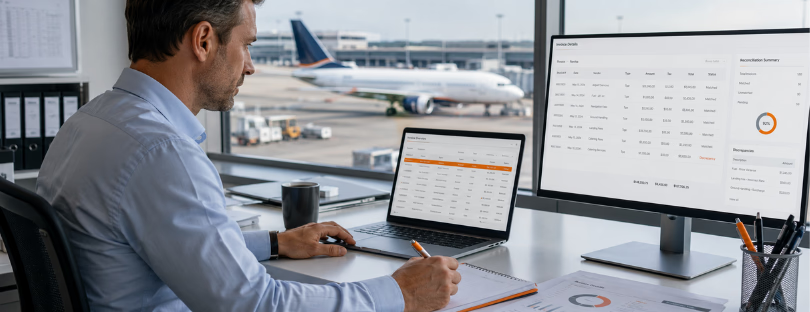
The aviation cost management company says it analysed 1.12 million fuel and airport charge invoices across 31 airlines during 2024 and 2025. The finding is surprisingly blunt: 40.3% of those invoices still arrive as unstructured documents, including paper, scanned PDFs, and email-attached PDFs. In plain language, that means someone often has to read the invoice, type the data into a system, and hope nothing goes wrong.
For an industry that flies composite aircraft across continents, optimizes routes in real time, and sells seats through increasingly sophisticated retail platforms, that feels almost absurd. But it also explains why the issue has remained hidden. Invoice leakage is not dramatic. It does not look like a fuel spike or a cancelled flight. It just disappears quietly into operating costs.
The invisible surcharge
According to Skymetrix, this manual processing problem contributes to what it calls an “invisible surcharge” of $4.6 billion in undetected errors paid by airlines globally every year. That number matters because IATA estimated global airline net profit at $36 billion for 2025, with a net margin of only 3.7%. In other words, even a relatively small layer of unchecked invoice error can become very meaningful in a low-margin industry.
The issue is not only that invoices arrive in messy formats. It is what happens next.
Manual data entry introduces errors. APQC tracks invoice processing quality as a benchmark, including the percentage of invoices processed error-free the first time. The wider accounts payable automation market has long treated invoice accuracy as one of the clearest places where automation can improve performance, because paper, PDFs, and manual re-keying create predictable weak points.
Skymetrix says the industry is also highly polarised. Some airlines have already moved far ahead, with paper rates below 10%. Others are still deeply exposed, with paper or PDF invoice rates above 50%. That gap is important. It shows this is not an unavoidable aviation problem. It is a maturity problem.
Verification is the real battleground
The most interesting part of the Skymetrix study is not simply that invoices are still manual. It is that detailed invoice verification remains limited.
Teams typically verify only 10–20% of invoices in detail, according to the company. The rest often move through the system with limited challenge. That is understandable. Airline invoices can be complex, especially fuel and airport charge invoices. They involve changing rates, taxes, fees, locations, contracts, currencies, and operational variables.
But this is exactly where leakage hides.
A wrong rate, a missed discount, a duplicated charge, or a small mismatch in volume may not trigger alarm bells. Multiply that across thousands of invoices, dozens of airports, and global operations, and the result becomes material.
As Michael Scheidler, CEO of Skymetrix, puts it:
“Airlines operate the most advanced machines on earth, yet 40% of the invoices those operations generate still arrive in formats that a computer cannot read. Once an invoice has to be re-keyed, error becomes statistically inevitable — and once it reaches the ledger, the cost of fixing it disappears into the noise. The ‘invisible surcharge’ is the financial consequence.”
That quote lands because it captures the contradiction neatly. Aviation is technically advanced in the air, but parts of the back office are still catching up.


Why AI is entering airline finance
In response, Skymetrix has launched AI Invoice Automation, a touchless invoicing solution designed to capture, verify, and process airline invoices automatically, including unstructured PDFs. The company positions the product as a way for airlines to reduce manual work, improve payment accuracy, and tighten control over direct operating costs.
This fits a broader shift in aviation technology. Airlines are not only modernizing the passenger-facing side of the business. Yes, there is huge attention on retailing, offers, orders, personalization, and digital distribution. IATA’s Modern Airline Retailing initiative is one visible example of that push.
But the less glamorous transformation may be just as valuable: finance automation, cost control, reconciliation, contract validation, and operational leakage detection.
This is where companies like Skymetrix sit in an interesting position. They are not selling a better booking flow or a shinier passenger app. They are addressing the machinery behind airline profitability. And that machinery matters because airlines can generate enormous revenue while still operating on thin margins.
Similar trends are visible across enterprise finance, where AP automation platforms such as Medius and other invoice automation vendors focus on reducing errors, speeding up invoice cycles, and improving “first time right” processing. The difference in aviation is complexity. Airline invoices are not generic office invoices. Fuel and airport charges carry operational detail, contract nuance, and industry-specific rules.
That makes airline-focused automation more than a back-office convenience. It becomes a margin protection tool.
Conclusion
The Skymetrix study should not be read as another “AI will fix paperwork” story. That would be too easy.
The real story is that airlines are reaching a point where cost control has to become more intelligent. Passenger growth helps. Better retailing helps. Ancillary revenue helps. But if billions are leaking through invoice errors, weak verification, and manual processing, then some of the industry’s hard-won profit is being lost after the flight has already operated.
For Alertify readers, this is also part of a bigger travel tech pattern. The next wave of aviation efficiency will not only come from what passengers see. It will come from the systems they never notice: invoice automation, settlement accuracy, airport charge validation, fuel cost control, and smarter financial operations.
Airlines have spent years digitizing the customer journey. Now the back office needs the same treatment. And unlike some AI promises, this one has a very simple business case: if the invoice is wrong, the airline pays.


